
225 – 258·Feast August 10
St. Lawrence
Archdeacon of Rome and Martyr of the Gridiron
Overview
Lawrence, whose Latin name Laurentius means 'laurelled', was one of the seven deacons of Rome under Pope Sixtus II and the most celebrated of the martyrs killed in the persecution ordered by Emperor Valerian in 258. Born on 31 December 225 at Huesca in the Roman province of Hispania Tarraconensis — or, less probably, at Valencia — he met the future pope, a famed Greek-born teacher, at Caesaraugusta and journeyed with him from Spain to Rome. When Sixtus was raised to the papacy in 257 he ordained Lawrence a deacon and soon named him Archdeacon of Rome, first among the seven, entrusted with the treasury of the church and the care of the poor. After Valerian's edict condemned all clergy to death and Sixtus was seized and executed on 6 August 258, the prefect of Rome demanded the church's riches. Lawrence asked three days, distributed the church's property to the destitute, and then presented the poor themselves as the true treasures of the church. Condemned and roasted on a gridiron, he died on the Esquiline Hill on 10 August 258 and was buried in the Catacomb of Cyriaca, where the basilica of San Lorenzo fuori le Mura now stands.
The Complete Life
A Son of Hispania
Lawrence was born, according to the tradition that cites St. Donato as its original source, on 31 December AD 225 at Huesca, the town from which his parents had come, in the later region of Aragon; a minority account makes Valencia his birthplace. Huesca then lay within the Roman province of Hispania Tarraconensis, and the Christianity of the Iberian provinces had already produced a generation of believers willing to suffer for the faith. Orentius and Patientia — San Orencio and Santa Paciencia, in modern Spanish usage — are named by tradition as his parents; should that be so, the boy grew up in a household that had already tasted the cost of confessing Christ. Of his education and youth the ancient sources say little; what they preserve is the encounter that changed his life. At Caesaraugusta, modern Zaragoza, the young Lawrence met Sixtus, a teacher famous for his learning and born in Greece. The meeting bound the Spaniard to the Greek, and when the teacher's road led to Rome, Lawrence traveled it with him — from the provinces to the capital of the world, and from an unknown Christian home toward the office of the first among Rome's deacons.
§ Life
Deacon and Archdeacon of Rome
In 257 Sixtus was elected pope, and one of his first acts for the young Spaniard who had followed him from Hispania was ordination: Lawrence was made a deacon at the age of thirty-two. Soon afterward the pope appointed him Archdeacon of Rome, first among the seven deacons who served the cathedral church. The office carried exceptional responsibility. The archdeacon held in trust the money and possessions of the Roman church and administered out of them the alms given to the needy — the whole temporal administration of the largest Christian community in the world, in an age when that community was already both wealthy in property and exposed to plunder. As St. Cyprian of Carthage observed, the law of the time was that denounced Christians were executed and their goods confiscated by the imperial treasury; the church's possessions stood in permanent danger. Lawrence's vocation was therefore a double one: a minister of the altar and simultaneously a steward of estates and alms, serving the table of the Lord and the table of the poor. The diaconate he received would define both his manner of life and the shape of his death.
§ Life
The Treasures of the Church
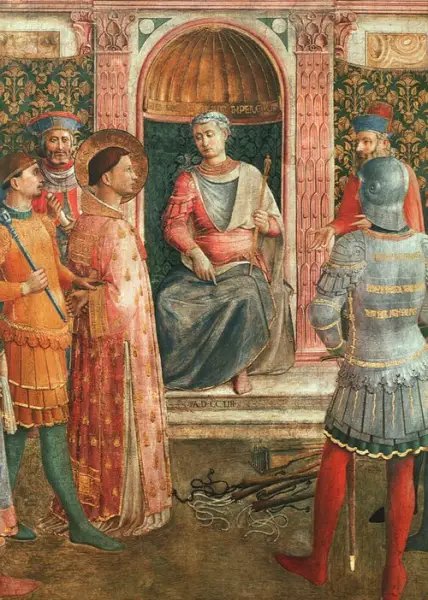
At the beginning of August 258 the emperor Valerian issued an edict directing that all bishops, priests, and deacons be put to death immediately. On 6 August Sixtus himself was seized at the cemetery of St. Callixtus in the midst of offering the liturgy and killed where he stood. The prefect of Rome then turned to the archdeacon who survived him, demanding that Lawrence surrender the riches of the church. The narrative that Ambrose hands down relates that Lawrence requested three days in which to assemble the riches — and used them to give the church's property away as fast as he could, distributing it to the indigent so that the imperial officials would find nothing to seize. On the third day he appeared before the prefect at the head of a small delegation. Ordered to deliver the treasures, he set before the official the beggars, the maimed, the blind and the afflicted of the city, announcing that in them lay the church's genuine wealth, far surpassing the emperor's. As Ambrose records, he promised the prefect still greater jewels: the widows and consecrated virgins who are the church's crown. For this answer — insolent to power, luminous to faith — the prefect's fury turned to a sentence of death.
§ Life
The Gridiron and the Burial
Condemnation was pronounced upon him at the Temple of Antoninus and Faustina; confinement followed in the home of the centurion Hippolytus, and there he baptized the prisoners held with him; the site is now the church of San Lorenzo in Fonte. The tradition that gathered around his passion tells how the prefect, beside himself with anger, ordered a great gridiron made ready with live coals heaped beneath, and the deacon stretched out upon it — hence the gridiron's place in Lawrence's iconography. His suffering took place on the Esquiline Hill, where the church of San Lorenzo in Panisperna now stands, and his death came on 10 August 258, four days after his pope's. For burial he was carried to the Catacomb of Cyriaca on the Via Tiburtina; the Almanac of Filocalus records for the year 354 that Hippolytus and Justin the Confessor, a presbyter, laid him there; over the catacomb rises today the Basilica Papale di San Lorenzo fuori le Mura. One of the earliest literary witnesses to his martyrdom is Aurelius Prudentius Clemens, in the second hymn of his Peristephanon. Historian Patrick J. Healy has argued that the roasting narrative is 'not worthy of credence', since Valerian's edict — the formula animadvertantur — ordinarily meant beheading, and he suggests a transcription slip turned passus est, 'he suffered', into assus est, 'he was roasted'; the Liber Pontificalis, drawing on independent sources, uses passus est of Lawrence, the same term it applies to Sixtus II. Whatever the exact manner of his end, the church of the fourth century already kept his feast with certainty.
§ Martyrdom
The Most Venerated of Roman Martyrs
Lawrence was honored as a martyr from the moment of his burial; no formal canonization was needed in an age that counted the martyr's death its own certificate. Damasus, Prudentius, Ambrose, and Augustine all knew the legendary particulars of his passion, and by the 300s his cult had spread far and wide. The observance of his memory on 10 August carries the rank of feast in the General Roman Calendar, a dignity that matches the most ancient Christian calendars — the Philocalus almanac of 354 lists the chief feasts of Rome's martyrs as its day kept them, his among them. He remains named among the saints of the Roman Canon of the Mass in the Latin Church. Rome especially claims him: Rome ranks him third among its protectors, behind only Peter and Paul, and the church raised above his grave, San Lorenzo fuori le Mura, came to stand among the city's seven great pilgrimage basilicas, a favored destination for travelers, giving its name to the surrounding quarter. Constantine is said to have raised a small oratory in his honor, Pope Damasus I rebuilt or repaired the church, and the gridiron of his martyrdom was placed by Pope Paschal II in the basilica of San Lorenzo in Lucina. Anglican provinces likewise keep his feast, titled 'Laurence, deacon, martyr, 258' in the Church of England's calendar.
§ Veneration
From the Esquiline to the St. Lawrence River
The deacon who died on a gridiron left his mark on the face of the earth. Rome raised six churches on the sites of his martyrdom — from San Lorenzo in Damaso, where he served as deacon, to San Lorenzo fuori le Mura over his tomb — and three more honor him besides. King Philip II of Spain built the monastery-palace of El Escorial in thanksgiving for a victory won on the saint's feast in 1557, laying it out in the shape of his gridiron; the Certosa di San Lorenzo di Padula is thought to echo the same design, and the Swiss city of Bülach bears a gridiron on its arms. In North America, Jacques Cartier named the Gulf of St. Lawrence on the feast day of 1535, and with it the river, the Laurentian Mountains, the Canadian Shield, and countless towns and streets of Québec and Ontario. In Chile the Day of the Miner is kept on his feast — Lawrence being the miners' patron — and the 2010 Copiapó rescue was named Operación San Lorenzo. Bernalillo, New Mexico, has danced the matachines in his honor in a tradition reaching back to the days of the Pueblo Revolt, reckoned among the very oldest processions of dance in the Americas. Leo XIV has joined Lawrence with St. Stephen as the two deacons of Christian service who died for the faith, and Francesco Moraglia has written that deacons like Lawrence reveal the beauty, power, and heroism of a ministry defined by the service of the poor.
§ Legacy
Timeline
- 31 Dec 225
Born at Huesca in the Roman province of Hispania Tarraconensis, the town from which his parents came
§ Life
- 257
Ordained a deacon by the newly elected Pope Sixtus II and soon appointed Archdeacon of Rome, keeper of the church's treasury
§ Life
- 6 Aug 258
Offering the liturgy at the cemetery of St. Callixtus, Pope Sixtus II is arrested under Valerian's edict and put to death on the spot
§ Life
- 10 Aug 258
Martyred on the Esquiline Hill after being roasted on a gridiron; buried in the Catacomb of Cyriaca on the Via Tiburtina
§ Martyrdom
- 354
The Almanac of Filocalus records his burial in the catacomb by Hippolytus and the presbyter Justin the Confessor
§ Martyrdom
- 10 Aug 1535
Jacques Cartier, reaching the gulf at the estuary of the Great Lakes on the saint's feast, names it the Gulf of St. Lawrence
§ Americas
- 1557
King Philip II of Spain builds El Escorial in thanksgiving for victory at the Battle of St. Quentin, won on the saint's feast day
§ Europe
- 2010
The rescue of the miners trapped in the Copiapó mining accident in Chile is named Operación San Lorenzo after their patron saint
§ Americas
In Their Own Words
Here are the treasures of the church. You see, the church is truly rich, far richer than your emperor!
Behold in these poor persons the treasures which I promised to show you; to which I will add pearls and precious stones, those widows and consecrated virgins, which are the Church's crown.
The Record
- Patron of
- Librarians and archivists·Cooks, brewers, and tanners·Comedians·Miners·The poor·Deacons·Against fire and lumbago·Rome, as third patron after Sts. Peter and Paul·Canada
- Symbols
- Gridiron·Dalmatic
- Canonization
- Pre-congregation; martyred in the persecution of Emperor Valerian in 258
Prayer
Bibliography
Show 7 sources
- Bennett, Janice. St. Laurence and the Holy Grail: The Story of the Holy Chalice of Valencia. Littleton, Colorado: Libri de Hispania, 2002.
- Kirsch, Johann Peter. "St. Lawrence." The Catholic Encyclopedia. Vol. 9. New York: Robert Appleton Company, 1910.
- Healy, Rev. Patrick Joseph (1905). The Valerian persecution: a study of the relations between church and state in the third century A.D. Boston, MA: Houghton, Mifflin, & Co. p. 184.
- Delehaye, Hippolyte (1911). "Lawrence, St". Encyclopædia Britannica. Vol. 16 (11th ed.). p. 304.
- Saint Ambrose, De officiis ministrorum, 2.28.
- Pirlo, Fr. Paolo O., SHMI (1997). "St. Lawrence". My First Book of Saints. Sons of Holy Mary Immaculate – Quality Catholic Publications. pp. 176-178. ISBN 971-91595-4-5.
- Moraglia, Fr. Francesco. "St. Lawrence, Proto-Deacon of the Roman Church". Vatican: Dicastery for the Clergy.
Profile text adapted from the Wikipedia article, licensed CC BY-SA 4.0.
Pray with this saint every day
Save St. Lawrence to your favorites, read the full profile, and get feast-day reminders in the Saints app.
Get the Saints AppFree on the App Store for iPhone and iPad