
died c. 511·Feast July 25
St. Lawrence I of Milan
Archbishop of Milan and Rebuilder of the Devastated City
Overview
Lawrence I, in Italian Lorenzo, was Archbishop of Milan from about 490 until his death around 511, and is honored as a saint by the Catholic Church. Most of what is known of him comes from the writings of Ennodius, bishop of Pavia, who was both his relative and his secretary. Elected by both the Latin population and the Heruli of Odoacer who had overrun Italy, Lawrence navigated the war between Odoacer and Theodoric the Ostrogoth, supporting Theodoric in the hope that he would better protect the hard-pressed Latin population, though he took no direct part in the fighting; later he traveled to Ravenna to plead with Theodoric to pardon the Latins who had sided with Odoacer. When a Germanic raiding tribe, probably the Rugii, devastated Milan between 491 and 493 and carried Lawrence into captivity, he returned to lead the city's reconstruction, renovating several basilicas and a baptistery, rebuilding the church of Saint Nazarius and Celsus, attaching the Saint Sixtus chapel to Saint Lorenzo Maggiore, and giving Sant'Ambrogio the ciborium whose columns still stand. A firm supporter of Pope Symmachus against the Antipope Laurentius, he presided over the Roman synod of 502 that confirmed Symmachus. He died on 25 July, after twenty-two years as bishop.
The Complete Life
A Bishop in a Broken Italy
Almost every line of the record of Lawrence's life descends from the pen of Ennodius, bishop of Pavia, who died in 521 and who had been at once the archbishop's relative and his secretary — an unusually intimate source for a sixth-century churchman. His own origins are unrecorded, and a late tradition linking him to the noble family of the Litta has no historical basis. What is known is the world into which he was chosen: Italy had passed under the rule of Odoacer and his Heruli, and the peninsula lay exposed to the collisions of Germanic powers. In about 490, or possibly 489, Lawrence was elected to the see of Milan, and significantly he was chosen by both of the peoples who shared the troubled city — the Latin inhabitants and the Heruli invaders alike — a double election that speaks to a reputation for holiness and competence that crossed the lines of race and religion. He succeeded Theodorus I in the ancient Ambrosian see, joining the long line of sainted bishops of Milan whose succession stretches back to Barnabas.
§ Life
Between Odoacer and Theodoric
Lawrence's episcopate unfolded in the shadow of the war between Odoacer, the king who had deposed the last western emperor, and Theodoric, leader of the Ostrogoths, who invaded Italy to unseat him. In that struggle the archbishop threw his influence behind Theodoric, hoping that the Ostrogoth would prove a better protector of the Latin population, which was militarily overpowered amid the invasions of the East Germanic tribes. Yet his support was political and pastoral rather than martial: Lawrence took no direct part in the fighting. His most celebrated intervention came after the war had turned against Odoacer's Latin partisans, when Lawrence traveled to Ravenna, Theodoric's seat, to beg that the Latins who had backed his beaten opponent be pardoned. The episode shows the character of his episcopal office as the sixth century understood it — a bishop as advocate for his people before the powers of the world, risking himself to soften the vengeance of kings. It set the pattern for the twenty-two years during which he would govern Milan through invasion, captivity, and rebuilding.
§ Life
Rebuilding and Defending the Church
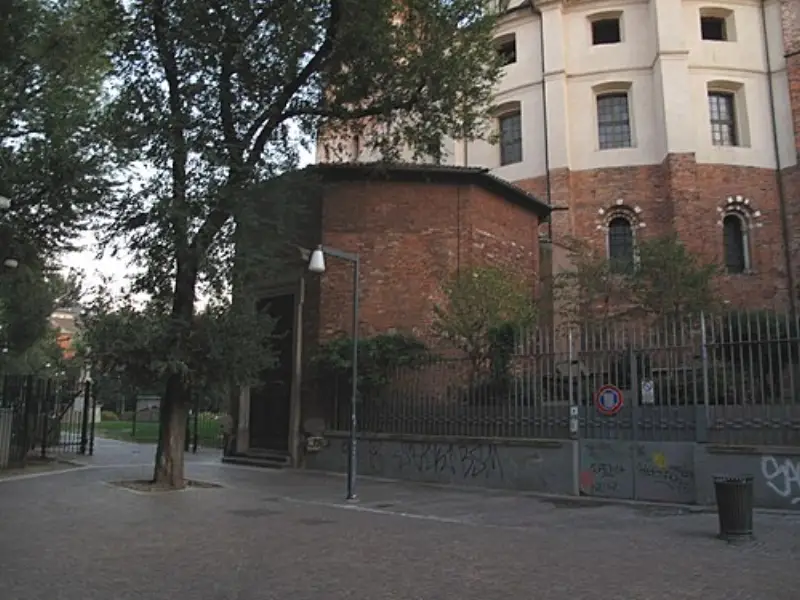
In the span from 491 to 493 a Germanic raiding people, most likely the Rugii, fell upon Milan and wrecked it, carrying Lawrence himself off into captivity. On his return he threw himself into the city's physical and spiritual reconstruction. He renovated the Basilica of Saint Calimerius and the Basilica Sanctorum, whose identification remains uncertain, restored a baptistery — possibly San Giovanni alle Fonti — and rebuilt the Church of Saint Nazarius and Celsus, where he ordered the figures of twelve bishops of Milan to be painted, binding his own episcopate visibly to the Ambrosian tradition. He erected a house probably intended as a residence for the bishops, added the chapel of Saint Sixtus beside the basilica of St. Lorenzo Maggiore, and restored the Basilica di Sant'Ambrogio, raising the ciborium whose columns are visible to this day. Lawrence was equally vigilant for the unity of the wider Church. He upheld the legitimacy of Pope Symmachus against the Antipope Laurentius, who enjoyed the backing of the Miaphysite-leaning Byzantine emperor, gave Symmachus financial support, and in 502 presided with Peter of Ravenna over the Roman synod that confirmed the pope's right to his seat. He also took part in the consecration of the Basilica Apostolorum at Novara.
§ Life
Death and Burial
Lawrence governed Milan for twenty-two years, dying on 25 July in about the year 511. He was buried two days later, on 27 July, in the chapel of Saint Hyppolytus beside the city's basilica of St. Lorenzo Maggiore — the great church to which he had devoted so much of his building energy and which still carries his name's dedication. His death closed an episcopate that had spanned the fall of one kingdom and the rise of another, a captive raid, the rebuilding of a ruined city, and a papal schism defended at a Roman synod. The succession passed to Eustorgius II, another of the sainted bishops of Milan. The sources record no last words or deathbed scene, but the deliberate choice of burial beside the Lorenzo Maggiore, among the tombs of his predecessors, joined him in death to the Ambrosian line he had honored in life by painting the figures of twelve of its bishops on the walls of the church of Saint Nazarius and Celsus.
§ Life
Veneration
Lawrence I is honored as a saint in the Catholic Church, his cult reaching back to the earliest centuries of the Milanese church. His feast is kept on 25 July, the anniversary of his death, in the basilica of St. Lorenzo Maggiore that houses his tomb; and together with all the saint bishops of Milan he is commemorated on 25 September, the common feast that gathers the Ambrosian episcopal line into a single memory. His most enduring monument is architectural rather than textual: the ciborium he raised in the Basilica di Sant'Ambrogio still stands on its ancient columns, and the chapel of Saint Sixtus beside the Lorenzo Maggiore remains attached to the basilica that bears the name he gave it. A late tradition that associated him with the Milanese noble family of the Litta long circulated, though historians have found no historical basis for the connection. For the Church of Milan he remains one of the quiet builders of the Ambrosian tradition — a bishop elected by two warring peoples, who chose advocacy over arms and stones over vengeance.
§ Life
Timeline
- 490
Elected Archbishop of Milan by both the Latins and the Heruli of Odoacer
§ Life
- 491
In the years 491 to 493 a raiding East Germanic people, most likely the Rugii, storms Milan and lays it waste; Lawrence is taken captive, then directs the city's rebuilding
§ Life
- 502
Presides with Peter, bishop of Ravenna, over a synod in Rome confirming Pope Symmachus' right to the papacy
§ Life
- 25 Jul 511
Dies on 25 July after twenty-two years of episcopate, around the year 511
§ Life
- 27 Jul 511
His remains are interred in the chapel of Saint Hyppolytus beside the basilica of St. Lorenzo Maggiore
§ Life
The Record
- Major works
- Reconstruction of Milan after the Rugii raid·Renovation of the Basilica of Saint Calimerius, the Basilica Sanctorum, a baptistery, and the Church of Saint Nazarius and Celsus·Chapel of Saint Sixtus added to the basilica of St. Lorenzo Maggiore·Ciborium of the Basilica di Sant'Ambrogio
- Symbols
- bishop's vestments·model of a basilica
- Canonization
- Pre-congregation canonization; venerated as a saint in the Catholic Church from antiquity
Prayer
Bibliography
Show 4 sources
- Cazzani, Eugenio (1996). Vescovi e arcivescovi di Milano. Milano: Massimo. pp. 32-34. ISBN 88-7030-891-X. (in Italian)
- Pasini, Cesare (1989). "Lorenzo I di Milano, santo (+511 c.)". Dizionario della Chiesa Ambrosiana. Vol. 3. Milano: NED. pp. 1768-1771. ISBN 88-7023-102-X. (in Italian)
- Felice, Mariantonia (1996). Ad sacrum lignum: la porta maggiore della basilica di Sant'Ambrogio a Milano. Bellinzona: Casagrande. p. 9. ISBN 978-88-7713-258-1. (in Italian)
- Ruggeri, Fausto (1991). I Vescovi di Milano. Milano: NED. p. 17. ISBN 88-7023-154-2. (in Italian)
Profile text adapted from the Wikipedia article, licensed CC BY-SA 4.0.
Pray with this saint every day
Save St. Lawrence I of Milan to your favorites, read the full profile, and get feast-day reminders in the Saints app.
Get the Saints AppFree on the App Store for iPhone and iPad