
1381 – 1456·Feast January 8
St. Lawrence Justinian
First Patriarch of Venice and Reformer of the Canons
Overview
Lawrence Justinian, in Italian Lorenzo Giustiniani, was a Venetian priest and bishop who rose to be the first Patriarch of Venice and is honored as a saint in the Catholic Church. Born into the illustrious Giustiniani family on 1 July 1381, he was drawn to a life of prayer by the example of his pious mother and, after ordination as a deacon, joined the community of canons regular on the island of San Giorgio in Alga in 1404. Admired for his poverty, mortification, and fervent prayer, he was ordained a priest in 1407, saw his community embrace the Rule of St. Augustine, and became its first prior. His promotion of the congregation's constitutions spread the reform to other communities, and he rose to Prior General of the Congregation, so zealous in its diffusion that many regarded him as the Order's actual founder. In 1433 Pope Eugene IV named him Bishop of Castello, a diocese in disarray which he rebuilt through vigorous administration and reform. In 1451 Pope Nicholas V united Castello with the Patriarchate of Grado, making Lawrence the first Patriarch of Venice. When Constantinople fell and Venice panicked, he helped steady the Republic, counseling Senate, clergy, and people. He died in Venice on 8 January 1456.
The Complete Life
A Noble Family and a Mother's Piety
Lawrence Justinian was born in Venice on 1 July 1381, a member of the Giustiniani, one of the most celebrated patrician houses of the Republic, a family that counts several saints among its members. His brothers were Leonardo and Marco. The formative influence of his boyhood, the sources agree, was the piety of his mother, whose devotion seems to have inspired his own spirituality and turned his thoughts early toward a life of prayer and service rather than toward the mercantile and political careers open to a young Venetian nobleman. Venice at the end of the fourteenth century was at the height of its wealth, and a Giustiniani could expect ease and influence; that Lawrence instead chose the demanding obscurity of the monastic common life made his vocation a public renunciation of his class. His first steps were clerical rather than monastic: after he had been ordained a deacon, an uncle who was a priest suggested that he join a community of canons regular leading a monastic common life on the island of San Giorgio in Alga, a house then at the heart of the reforming movement in the Venetian church.
§ Biography
San Giorgio in Alga
Lawrence entered the community of San Giorgio in Alga in 1404 and quickly became, in the judgment of his brethren, a model of the life they professed: he was admired for his poverty, his mortification, and the fervency of his prayer. He was ordained to the priesthood in 1407, and two years later the community took a decisive step, accepting the Rule of St. Augustine as its constitutive law; and there Lawrence was chosen as the community's first prior. His gifts proved organizational as much as contemplative. He promoted the constitutions that had been drawn up for the Canons Regular of St. George, and these were embraced by other communities of canons across the region, so that a local experiment in reform grew into an organized congregation. Shortly thereafter Lawrence became Prior General of the new Congregation. He propagated the reform with such zeal that his contemporaries looked upon him almost as the actual founder of the Order, though it had sprung from a common endeavor — a rare instance of a founder's mantle conferred by unanimous reputation rather than self-assertion.
§ Biography
Bishop and Patriarch
In 1433 Pope Eugene IV, who as a younger man had been one of the founders of the monastery of San Giorgio and knew Lawrence's qualities at first hand, named him Bishop of Castello. The diocese he found was in ruins, and his years of governance brought striking growth and renewal: discipline was restored, the clergy reinvigorated, and the see left transformed. In 1451 Pope Nicholas V raised the work to a new institutional level, uniting the Diocese of Castello with the Patriarchate of Grado and transferring the patriarchal seat to Venice; Lawrence thus became the first Patriarch of Venice, an office he held for over four years and which gave the Republic's church its definitive form. His patriarchate was tested almost at once. It fell within his rule that Constantinople, the Christian capital of the East and Venice's ancient trading partner, fell to Muslim forces, and the people of Venice fell into panic about their future. Lawrence came forward as a chief counselor of the Republic in the crisis, working with the Senate to chart its course and laboring among clergy and people alike to calm their fears.
§ Biography
The Ascetic Teacher
Lawrence's spirituality was formed in the school of San Giorgio in Alga and never left it. The poverty, mortification, and fervent prayer for which his brethren admired him as a young canon remained the marks of his interior life through bishopric and patriarchate, and his career stands as an argument that reform of institutions begins with reform of persons. He gave that spirituality enduring literary form: among his works, listed in the sources of his cult, is the treatise De disciplina et perfectione monasticae conversationis — on the discipline and perfection of the monastic life — alongside his sermons and letters, all of an ascetic cast. These writings, frequently reprinted after his death, carried the ideals of the Venetian canonical reform far beyond the lagoon. As a writer he belongs to the tradition of episcopal ascetic authors who governed while they wrote, and his promotion of the constitutions of the Canons Regular of St. George shows the same mind at work in law as in treatise: the conviction that holiness could be ordered, codified, and spread. He is honored as one of the spiritual masters of the Canons Regular of St. Augustine.
§ Veneration
Last Years and Death
Lawrence held the patriarchal see of Venice for just over four years, dying on 8 January 1456 in Venice, the city of his birth, at the age of seventy-four. He had thus lived long enough to see the crisis of 1453 past its worst and the church of the Republic set on its new foundations, but not long enough to grow old in the dignity he had done so much to create. His death closed a life that had passed through every grade of the ecclesiastical state — deacon, priest, prior, prior general, bishop, patriarch — without ever leaving the island community where he had begun. He was buried in Venice, and his memory settled especially around the Basilica of San Pietro di Castello, the cathedral church of his patriarchate, which remains his principal shrine. The virtues of his last years were of a piece with his whole life: the sources present him as the same man his community had known on San Giorgio — poor in spirit amid patriarchal pomp, prayerful amid administration, and calm amid the anxieties of a Republic that had lost its eastern anchor.
§ Veneration
Canonization
The cause of Lawrence Justinian advanced steadily in the century after his death. He was beatified by Pope Clement VII in Rome on 7 October 1524, and canonized by Pope Alexander VIII on 16 October 1690 — a ceremony celebrated in Rome at the presence of Cardinal Pietro Ottoboni acting as procurator, assisted by Cardinal Carpegna, with Abbot Pier Santi Fonti serving as master of ceremonies. The canonization bull itself, however, was not published until decades later: Pope Benedict XIII issued it on 4 June 1724. Pope Innocent XII, who succeeded Alexander VIII, placed the saint's feast on the General Roman Calendar, assigning it to 5 September in honor of the day he was raised to the episcopate. When the calendar was reformed in 1969, his celebration — judged of limited worldwide importance — was dropped from the universal calendar, and his observance transferred to 8 January, the anniversary of his death, on which the Catholic Church, above all in Venice and the patriarchate he first shepherded, keeps his memory today.
§ Veneration
Legacy
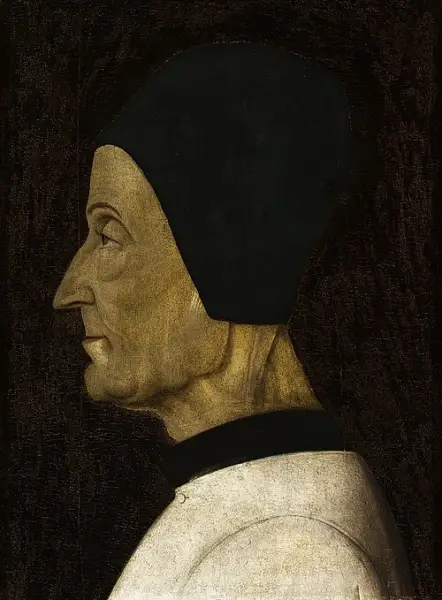
Lawrence Justinian's legacy is threefold. As a reformer he left the Congregation of the Canons Regular of St. George, whose constitutions he spread across the region and whose spirit he embodied so completely that he was accounted its founder; the canonical reform of San Giorgio in Alga became one of the models of late-medieval religious renewal. As a bishop he left the Patriarchate of Venice in the form Nicholas V gave it, having transformed a diocese found in shambles into the metropolitan church of the Republic, and he is the patron of the Patriarchate of Venice to this day. As a writer he left sermons, letters, and ascetic treatises — including the De disciplina et perfectione monasticae conversationis — that have been frequently reprinted and that keep his voice among the ascetic teachers of the Church. His portrait was painted by Gentile Bellini in 1465 and hangs in the Gallerie dell'Accademia in Venice, while later artists such as Luca Giordano depicted him adoring the Infant Christ; a statue of the saint stands in the Cathedral of Padua. His shrine is the Basilica of San Pietro di Castello, and his feast is celebrated on 8 January.
§ Veneration
Timeline
- 1 Jul 1381
Born in Venice, Republic of Venice, into the Giustiniani family
§ Biography
- 1404
Ordained a deacon and joins the community of canons regular on the island of San Giorgio in Alga
§ Biography
- 1407
Ordained to the Catholic priesthood
§ Biography
- 1409
The community adopts the Rule of St. Augustine and Lawrence is chosen as its first prior
§ Biography
- 1433
Pope Eugene IV names him Bishop of Castello
§ Biography
- 1451
Pope Nicholas V unites the Diocese of Castello with the Patriarchate of Grado, making Lawrence the first Patriarch of Venice
§ Biography
- 8 Jan 1456
Dies in Venice at the age of seventy-four
§ Veneration
- 7 Oct 1524
Beatified in Rome by Pope Clement VII
§ Veneration
- 16 Oct 1690
Canonized in Rome by Pope Alexander VIII
§ Veneration
- 4 Jun 1724
The Bull of Canonization is published by Pope Benedict XIII
§ Veneration
The Record
- Major works
- De disciplina et perfectione monasticae conversationis·Sermons, letters, and ascetic treatises, frequently reprinted·Constitutions of the Canons Regular of St. George
- Patron of
- patron of the Patriarchate of Venice
- Symbols
- episcopal vestments
- Canonization
- Beatified by Pope Clement VII on 7 October 1524; canonized by Pope Alexander VIII on 16 October 1690 in Rome
Prayer
Bibliography
Show 8 sources
- "Saint of the Day, September 5". saintpatrickdc.org. Retrieved 2012-02-29.
- "San Lorenzo Giustiniani". Santi e beati (in Italian). Retrieved 19 January 2013.
- "Saints of the Canons Regular". Confederation of Canons Regular of St. Augustine. Archived from the original on 23 September 2015. Retrieved 19 January 2013.
- Olszewski, Edward J. (2004). Cardinal Pietro Ottoboni (1667-1740) and the Vatican Tomb of Pope Alexander VIII. American Philosophical Society. p. 122. ISBN 9780871692528. OCLC 56014539.
- Bullarium Romanum. Vol 22. Benedict XIII (1724-1730). Taurini Ed, 1871. pp. 23-31.
- Calendarium Romanum. Libreria Editrice Vaticana (1969), p. 137.
- Martyrologium Romanum. Libreria Editrice Vaticana (2001). ISBN 88-209-7210-7.
- Chisholm, Hugh, ed. (1911). "Giustiniani s.v. 1. Lorenzo". Encyclopædia Britannica. Vol. 12 (11th ed.). Cambridge University Press. pp. 54-55.
Profile text adapted from the Wikipedia article, licensed CC BY-SA 4.0.
Pray with this saint every day
Save St. Lawrence Justinian to your favorites, read the full profile, and get feast-day reminders in the Saints app.
Get the Saints AppFree on the App Store for iPhone and iPad