
1559 – 1619·Feast July 21
St. Lawrence of Brindisi
Capuchin Preacher, Diplomat, and Doctor of the Church
Overview
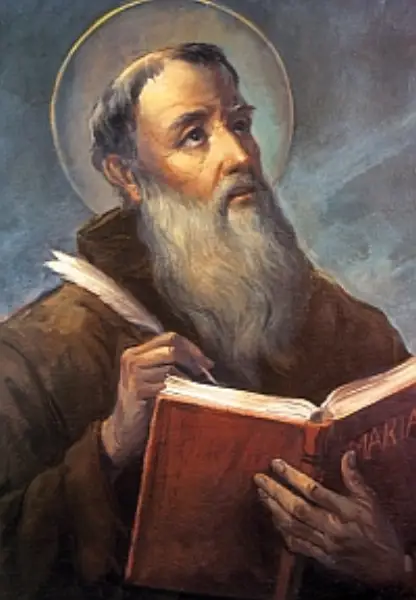
Lawrence of Brindisi, born Giulio Cesare Russo, was an Italian Capuchin friar, theologian, and diplomat who became one of the most commanding figures of the Counter-Reformation. Born at Brindisi in the Kingdom of Naples on 22 July 1559 to a family of Venetian merchants, he was educated by the Conventual Franciscans, lost his father at twelve, and continued his studies in Venice before joining the Capuchins at Verona. A prodigious linguist, his reading and speech embraced Latin, Hebrew, Greek, German, Spanish, Czech, and French — seven tongues in addition to his own. Ordained a priest at twenty-three, he preached the Lenten sermons in Venice while still a deacon, was elected superior of the Tuscan province at thirty-one, and served as definitor general in Rome, where Pope Clement VIII set him to preaching to the Jews, aided by his Hebrew. From 1599 he founded Capuchin houses across Germany, Austria, Vienna, Prague, and Graz, winning Protestants back to the faith. In 1601 he was named imperial chaplain to the army of Rudolph II and led troops at the siege of Székesfehérvár armed only with a crucifix. Twice elected vicar general of the Capuchins, he later served as papal nuncio to Bavaria and Spain, dying in Lisbon on his sixtieth birthday in 1619.
The Complete Life
The Merchant's Son from Brindisi
The child born Giulio Cesare Russo at Brindisi on 22 July 1559 came into a family of Venetian merchants settled in the Kingdom of Naples, and his education was entrusted to the Conventual Franciscans of the city. An early gift for oratory showed itself at once: according to the Italian custom of the day, the task of addressing his compatriots with a brief Christmas sermon on the Infant Jesus always fell to the boy — an apprenticeship in preaching before the Christ Child that seems, in hindsight, to have foretold both the preacher and the Marian devotion of the friar he became. His childhood was struck early by loss: his father died when he was twelve years old. His education continued far from home at Venice's Saint Mark's College, where an uncle oversaw his studies. Venice, one of the great crossroads of the Mediterranean, gave the orphaned student both his broader education and his first sight of the multilingual world — Turkish, Greek, German, and Slavic — in which his future ministry would be conducted.
§ Biography
The Capuchin and the Languages
As a young man Giulio Cesare joined the Capuchins at Verona, taking the name Brother Lawrence, and pursued further studies that drew on the University of Padua. There he acquired the extraordinary linguistic equipment that distinguished him all his life: in addition to Italian, his mother tongue, he read and conversed readily in Latin, Hebrew, Greek, German, Spanish, Czech, and French. None of these gifts was kept kept for the classroom. While still a deacon he was entrusted with preaching the Lenten sermons in Venice, and he was ordained to the priesthood at the age of twenty-three. Recognition followed quickly. At thirty-one the province of Tuscany chose him as its Capuchin superior, and 1596 brought appointment as definitor general in Rome, one of the Order's key offices. There Pope Clement VIII gave him a task perfectly suited to his talents: preaching to the Jews of the city, for which his command of Hebrew was of great help. The pattern of his life was set — a friar whose scholarship, languages, and preaching would be deployed wherever the Church's needs were greatest, from the pulpits of Italy to the frontiers of the German-speaking world.
§ Biography
Missions North and the Crusader's Crucifix
Beginning in 1599 Lawrence founded Capuchin monasteries in the lands of modern Germany and Austria, extending the Counter-Reformation into Protestant territory and working to bring many who had broken with Rome back to the Catholic faith. He established friaries in Vienna, Prague, and Graz, planting the Order in the very cities where confessional conflict was sharpest. His public life turned on the founding of the Prague convent in 1601: on that occasion he was named imperial chaplain to the army of Rudolph II, Holy Roman Emperor. In that role he successfully recruited Philippe Emmanuel, Duke of Mercœur, to the imperial cause against the Ottoman Turks, and then — the image for which he is best remembered — he led the army during the siege of Székesfehérvár in Hungary, armed with nothing but a crucifix. In 1602 his Order elected him vicar general, at that time the highest office among the Capuchins; a second election came in 1605, which he declined; until his death he remained the best adviser of those who held it. Later he entered the service of the Holy See as papal nuncio to Bavaria and then to Spain.
§ Biography
Envoy and Death in Lisbon
After his diplomatic service in Bavaria and Spain, Lawrence withdrew in 1618 to a monastery, seeking the silence of the friary after decades of preaching, building, and negotiation. The retreat was brief. In 1619 the Holy See recalled him as a special envoy to the King of Spain, charged with addressing the conduct of the Viceroy of Naples — a final mission in the courts where he had long been trusted. Having completed the assignment, he died in Lisbon on 22 July 1619, his sixtieth birthday, dying on the same date on which he had been born. He was laid to rest in the Poor Clares' Convento de la Anunciada — the Convent of the Annunciation — at Villafranca del Bierzo in Spain, today his major shrine. It was a far place for a Neapolitan friar to end his journey — carried by the logic of obedience from the pulpit of Venice to the imperial camp in Hungary to the court of Spain — and fitting that the wandering diplomat of the Capuchins found his rest not in Italy but in the land of his final embassy.
§ Biography
Beatification, Canonization, Doctor of the Church
Lawrence's cause moved through the centuries with steadily growing honor. He was beatified by Pope Pius VI on 1 June 1783 in Saint Peter's Basilica, and canonized by Pope Leo XIII on 8 December 1881, likewise in Saint Peter's. The culminating recognition came in the twentieth century: in 1959 Pope John XXIII declared him a Doctor of the Church, bestowing on him the title "Apostolic Doctor" — an apt designation for the tireless preacher and missionary whose apostolic journeys spanned half of Europe. His feast is celebrated on 21 July, and he is invoked in iconography with the Infant Jesus, recalling the Christmas sermons of his boyhood, or depicted leading soldiers against the Turks, recalling Székesfehérvár. He is numbered among the patron saints of his native city of Brindisi. His liturgical memorial and his doctorate together place him in the first rank of Counter-Reformation churchmen, alongside Bellarmine and Canisius, as a figure who combined sanctity, scholarship, and action in the Church's struggle for renewal.
§ Veneration
The Apostolic Doctor's Works
Lawrence's written legacy is immense. His complete works were published in a critical edition of fifteen volumes between 1926 and 1956, comprising the Mariale on the Blessed Virgin, the Lutheranismi hypotyposis against Protestant theology, the Explanatio in Genesim on Genesis, four books of Lenten sermons (the Quadragesimale, in four parts), the Adventus, the Dominicalia, the Sanctorale, and the Sermones de tempore. His original manuscripts, filling thirteen parchment volumes, are preserved at the Archivio dei Cappuccini di Mestre. As a Doctor of the Church he stands among the few religious order friars — Franciscans Bonaventure, Anthony of Padua, and Lawrence of Brindisi among them — whose teaching the Church holds up for the whole people of God. Historians of the Capuchin missions, such as Andrew J. G. Drenas, have studied him as the standard bearer of the Roman Church in the Holy Roman Empire between 1599 and 1613. In devotional memory he lives above all through his favourite blessing — "Nos cum prole pia benedicat Virgo Maria" — and through the image of the friar general advancing on an Ottoman fortress with a crucifix in his hand.
§ Works
Timeline
- 22 Jul 1559
Born at Brindisi in the Kingdom of Naples as Giulio Cesare Russo, to a family of Venetian merchants
§ Biography
- 1596
Made definitor general in Rome for the Capuchins; Clement VIII entrusts him with preaching to the city's Jews
§ Biography
- 1599
Sets about founding Capuchin houses across modern Germany and Austria, advancing the Counter-Reformation
§ Biography
- 1601
At the foundation of the convent of Prague, named imperial chaplain to the army of Rudolph II; recruits the Duke of Mercœur against the Ottoman Turks and leads the army at the siege of Székesfehérvár, armed only with a crucifix
§ Biography
- 1602
Elected vicar general of the Capuchin friars, then the highest office in the Order
§ Biography
- 1605
Elected vicar general a second time, but refuses the office
§ Biography
- 1618
Enters the service of the Holy See as papal nuncio to Bavaria, later nuncio to Spain, then retires to a monastery
§ Biography
- 22 Jul 1619
Recalled as special envoy to the King of Spain over the actions of the Viceroy of Naples; dies in Lisbon on his sixtieth birthday
§ Biography
- 1 Jun 1783
Beatified by Pope Pius VI in Saint Peter's Basilica
§ Veneration
- 8 Dec 1881
Canonized by Pope Leo XIII in Saint Peter's Basilica
§ Veneration
- 1959
John XXIII names him a Doctor of the Church, bestowing the title "Apostolic Doctor"
§ Veneration
In Their Own Words
Nos cum prole pia / benedicat Virgo Maria. — Mary, with Her loving Son, / bless us each and every one.
The Record
- Major works
- Mariale·Lutheranismi hypotyposis·Explanatio in Genesim·Quadragesimale primum, secundum, tertium, and quartum·Adventus·Dominicalia·Sanctorale·Sermones de tempore
- Patron of
- patron of Brindisi
- Symbols
- leading soldiers against the Turks·with the Infant Jesus
- Canonization
- Beatified by Pope Pius VI on 1 June 1783; canonized by Pope Leo XIII on 8 December 1881; declared Doctor of the Church by Pope John XXIII in 1959
Prayer
Bibliography
Show 7 sources
- Candide, Henri. "St. Lorenzo da Brindisi." The Catholic Encyclopedia Vol. 9. New York: Robert Appleton Company, 1910.
- "Saint Lawrence of Brindisi", Franciscan Media. Archived from the original on 2020-10-07. Retrieved 2018-07-28.
- Drenas, Andrew J.G. The Standard Bearer of the Roman Church: Lawrence of Brindisi and Capuchin Missions in the Holy Roman Empire (1599-1613). Washington, DC: The Catholic University of America Press, 2018. ISBN 978-0-8132-3037-5.
- "Heritage", Villafranca del Bierzo. Archived from the original on 2012-06-15. Retrieved 2021-12-12.
- "Closing prayers said at the Rosary Vigils and Sunday Holy Hours". St Michael's World Apostolate. Archived from the original on 2016-06-30. Retrieved 2018-12-31.
- Britannica, The Editors of Encyclopaedia. "St. Lawrence of Brindisi". Encyclopedia Britannica.
- "Saint Lawrence of Brindisi", Capuchin Friars, Province of St. Mary.
Profile text adapted from the Wikipedia article, licensed CC BY-SA 4.0.
Pray with this saint every day
Save St. Lawrence of Brindisi to your favorites, read the full profile, and get feast-day reminders in the Saints app.
Get the Saints AppFree on the App Store for iPhone and iPad