
c. 1329 – 1389·Feast June 28
St. Lazar of Serbia
Prince Martyr of Kosovo and Builder of Ravanica
Overview
Lazar Hrebeljanović was a medieval Serbian prince who built the greatest and strongest of the states that arose on the ruins of the Serbian Empire, and who fell with his army on the Kosovo Field in 1389. Born around 1329 in the Fortress of Prilepac, the son of a court chancellor of Tsar Stefan Dušan, he rose from the junior court rank of stavilac to become, after the collapse of the Nemanjić dynasty in 1371, the mightiest lord of the Serbian lands. Historians call his realm Moravian Serbia: the basins of the Great, West, and South Morava, governed from Kruševac. Lazar presented himself as heir in a direct line to the Nemanjićs, calling himself autocrator of all the Serbs, and enjoyed the full support of the Serbian Orthodox Church, whose schism with Constantinople he helped heal in 1375. He endowed monasteries — Ravanica above all — and repelled Ottoman advances at Dubravnica and Pločnik. On 15 June 1389 he led a Christian coalition against Sultan Murad I at Kosovo and was killed; both sides suffered devastating losses. The Church venerates him as a martyr, and Serbian epic remembers him as Tsar Lazar, who chose a heavenly kingdom over an earthly one.
The Complete Life
The Lord's Son from Prilepac
Lazar was born around 1329 in the Fortress of Prilepac, some thirteen kilometers from Novo Brdo, then among the most important mining towns of the Serbian Kingdom. His house held Prilepac as its hereditary lordship; with the neighboring Fortress of Prizrenac it stood guard over the mines and settlements about Novo Brdo. His father, Pribac, was a logothete — a chancellor — at the court of Stefan Dušan, who ruled Serbia as king from 1331 and as emperor from 1346. The rank was relatively modest in the court hierarchy, but Pribac owed it to the fortunes of his master: Dušan had won the throne by dethroning his own father, King Stefan Uroš III, and had rewarded the petty nobles who backed his rebellion, Pribac among them. According to the sixteenth-century Ragusan historian Mavro Orbin, father and son bore the surname Hrebeljanović, a claim made without a cited source but universally accepted in historiography. Dušan repaid Pribac once more by obtaining for his son Lazar a place at court as stavilac — the lowliest rung of the court hierarchy, yet a prestigious one, for it placed its holder close to the person of the ruler himself.
§ Life
Courtier of Two Tsars
As stavilac — literally the "placer", an officer of the royal table's ceremony — Lazar served first Dušan and then, after the tsar's sudden death in 1355, the young Stefan Uroš V. Around 1353 he had married Princess Milica Nemanjić, whom later genealogies make the daughter of Prince Vratko and a descendant of the founding Nemanjić line. The marriage bound the modest courtier to the dynasty he would one day claim to succeed. His rise at court was slow and never spectacular: by the time he was about thirty-five he had advanced no further than his boyhood rank. Yet his standing was real enough that the Ragusans, seeking peace in their war with Prince Vojislav Vojinović, applied to him in 1362 and made him a gift of three bolts of cloth; a document of July 1363 records him as a witness to a land exchange approved by the tsar. In 1363 or 1365 Lazar left the court of Uroš for good. The Serbian Empire was disintegrating around him — Epirus and Thessaly gone by 1359, the mighty Vojislav dead in 1363, the Mrnjavčević brothers rising in Macedonia — and Lazar set out to become a regional lord himself.
§ Courtier
The Rise of Moravian Serbia
Between 1363 and 1371 Lazar built, in poorly documented years, a territory whose nucleus lay between the Mrnjavčevićs to the south, Nikola Altomanović to the west, and the Rastislalićs to the north. In 1370 he took the mining town of Rudnik from Altomanović, and on 22 April 1371 a Ragusan document first styled him Comes Lazarus — Prince Lazar. That December Tsar Uroš died childless, extinguishing the Nemanjić dynasty after two centuries, and while King Marko held the formal title, Lazar seized Priština and Novo Brdo and recovered his ancestral Prilepac. In 1372 he allied with Ban Tvrtko of Bosnia, and in 1373 the two defeated and captured Nikola Altomanović, dividing his lands; Lazar accepted the suzerainty of King Louis of Hungary. After the Ottoman annihilation of the Mrnjavčevićs at the Battle of Marica in September 1371 opened the Balkans to the Turks, Lazar emerged as the most powerful lord of the former empire. His Moravian Serbia — the Morava river basins, with the capital Kruševac, Niš, Užice, and the mining towns Novo Brdo and Rudnik — was better organized and governed than any rival domain, a refuge for monks fleeing the Turks and a beacon of hope on Mount Athos.
§ Rise to power
The Church's Prince
Lazar's power rested in part on an extraordinary partnership with the Serbian Orthodox Church. The Serbian Patriarchate of Peć had been in schism with Constantinople since 1350, and the Athonite monk and writer Isaija encouraged the prince to work for reconciliation. Through the efforts of Lazar and Isaija a delegation went to the Ecumenical Patriarch, and in 1375 the Serbian Church was readmitted to communion — the prince convening a synod at Peć that October which installed Patriarch Jefrem, a compromise candidate. Jefrem's abdication in 1379 in favor of Spiridon, who cooperated excellently with Lazar, has been read by historians as the doing of a Church current sympathetic to the prince. The Church owed him its reunion, and repaid him with support for his political program: the gathering of the Serbian lands beneath himself as heir of the Nemanjićs. In charters from 1379 through 1388 he signed as Stefan Lazar — Stefan being the name every Nemanjić ruler had borne — and styled himself autocrator of all the Serbs. His piety took stone as well as parchment form: Ravanica, completed in 1381; Lazarica, the church of St Stephen in Kruševac; Gornjak; Tismana and Vodiţa; and building works at Hilandar and St Panteleimon on Athos.
§ Major lord in Serbia
Kosovo
After Pločnik in 1386, Lazar knew that the Ottomans would come with overwhelming force. Peace with the newly crowned Sigismund of Hungary secured his north, and he assembled every man he could: his own host, Vuk Branković's troops, and a detachment from King Tvrtko commanded by Vlatko Vuković. In June 1389 the great Ottoman host of Sultan Murad I — reckoned at 27,000 to 30,000 — reached the Kosovo Field near Priština, where Serbian forces reckoned at 12,000 to 30,000 awaited it. The engagement, the most celebrated of medieval Serbian arms, took place on 15 June 1389. Both commanders died in its course: Lazar fell on the field, and Murad was slain after the fighting by the Serbian noble remembered as Miloš Obilić. Tactically the battle was a draw, but the losses devastated only the Serbs, who had brought nearly all their fighting strength to the field. Lazar was succeeded by his adolescent son Stefan Lazarević, under the regency of his widow Milica, who five months later repelled a Hungarian attack and in the summer of 1390 accepted Ottoman suzerainty, sending her daughter Olivera to the sultan's household.
§ Battle of Kosovo
Martyr and Saint
After the battle Lazar was first buried in the Church of the Ascension in Priština, and in 1390 or 1391 his relics were translated to the Ravanica Monastery he had built for his own burial, in a ceremony organized by the Serbian Church and his family and attended by the highest clergy, including Patriarch Danilo III. It was most likely there and then that he was canonized, though no account of the act was written. He was the first lay person raised to the saints of Serbia after two centuries in which nearly every Nemanjić ruler had been canonized, and the Church ranked his death with that of the early martyrs slain by pagans. Between 1389 and 1420 ten cultic writings spread his veneration — among them Patriarch Danilo's Narration about Prince Lazar, the most historically informative, and nun Jefimija's Encomium, embroidered in gilded thread on the silken shroud covering his relics, the finest in literary quality. His cult was joined to those of Saint Simeon and Saint Sava, consolidating the Serbs into one religious and political body, and his feast was set on 15 June, kept today on 28 June, the feast of Vidovdan.
§ Under Serbian rulers
The Relics and the Epic
Lazar's relics became the living center of his cult through five centuries of exile. When the Great Serb Migration of 1690 carried the Ravanica monks north before the Ottoman advance, they took the relics with them to Szentendre, and in 1697 to the Monastery of Vrdnik-Ravanica on Mount Fruška Gora, which became the centre of the cult and was popularly believed to have been founded by the prince himself. Engravers in Habsburg service, Hristofor Žefarović in 1741 and Zaharije Orfelin in 1773, spread his image among the Serbs, often as a cephalophore holding his severed head. The prince had reached even the court of Ivan the Terrible, who venerated him and whose Kremlin cathedral fresco of 1565 depicted him among the few non-Russians granted that honor. In 1941 the relics were moved ahead of the Nazi invasion to Bešenovo, in April 1942 to the Belgrade Cathedral Church, and in 1989, on the six hundredth anniversary of Kosovo, back to Ravanica. In Serbian epic he is Tsar Lazar, who was offered an earthly kingdom and chose a heavenly one — a covenant remembered each Vidovdan — and towns, villages, churches, and missions across the world bear his name.
§ After the Great Serb Migration
Timeline
- 1329
Born around 1329 in the Fortress of Prilepac, southeast of Novo Brdo, into the family of the hereditary lords of Prilepac
§ Life
- 1353
Around 1353, as a courtier of the rank of stavilac, marries Princess Milica Nemanjić
§ Courtier
- 1355
Tsar Dušan dies without warning; Lazar continues as a stavilac at the court of his successor, Stefan Uroš V
§ Courtier
- 1362
The Ragusans present him with three bolts of cloth, testifying to his perceived influence at the court of Tsar Uroš
§ Courtier
- 1363
Named as witness to a July charter in which Tsar Uroš sanctioned a swap of lands
§ Courtier
- 1369
According to Mavro Orbin's doubted account, he withdraws early from the clash of Serbian lords on the Kosovo Field
§ Minor regional lord
- 1370
Takes the rich mining town of Rudnik from Nikola Altomanović
§ Minor regional lord
- 22 Apr 1371
First attested with the title of knez (prince) in a Ragusan document in Latin that calls him Comes Lazarus
§ Prince
- Dec 1371
Tsar Uroš dies childless, ending the Nemanjić dynasty; Lazar takes Priština and Novo Brdo and recovers his patrimony of Prilepac
§ Prince
- 1372
Forms an alliance with Ban Tvrtko of Bosnia against Nikola Altomanović
§ Rise to power
- 1373
With Tvrtko, defeats and captures Nikola Altomanović at Užice, then accepts the suzerainty of King Louis of Hungary
§ Rise to power
- 1375
Through his efforts and those of the monk Isaija, the Serbian Church is readmitted into communion with the Patriarchate of Constantinople
§ Major lord in Serbia
- Oct 1375
With Djuradj Balšić, convenes a synod of the Serbian Church at Peć, which selects Patriarch Jefrem as its new head
§ Major lord in Serbia
- 1379
Patriarch Jefrem abdicates in favour of Spiridon; Lazar extends his domain to the Danube, taking Kučevo and Braničevo
§ Major lord in Serbia
- 1381
His greatest legacy as a church builder, the Monastery of Ravanica, is completed
§ Major lord in Serbia
- 1381
His nobles Crep Vukoslavić and Vitomir rout a Turkish raiding party at the Battle of Dubravnica near Paraćin
§ Major lord in Serbia
- 1386
Sultan Murad I takes Niš from him; Lazar rebuffs Murad at Pločnik southwest of the city
§ Major lord in Serbia
- 1387
Makes peace with the newly crowned Hungarian king Sigismund, sealed by the marriage of his daughter Teodora to Nicholas II Garay
§ Major lord in Serbia
- 15 Jun 1389
Leads his army against Sultan Murad I at the Battle of Kosovo on Kosovo Field and is killed in the fighting
§ Battle of Kosovo
- 1390
In 1390 or 1391 his relics are transferred to the Ravanica Monastery, where he is most likely canonized
§ Under Serbian rulers
- 1690
During the Great Serb Migration the Ravanica monks flee north with his relics and settle at Szentendre in Habsburg lands
§ After the Great Serb Migration
- 1697
The monks move to the Monastery of Vrdnik-Ravanica on Mount Fruška Gora and enthrone his relics there
§ After the Great Serb Migration
- 14 Apr 1942
Threatened by war, his reliquary is moved from Bešenovo to the Belgrade Cathedral Church
§ After the Great Serb Migration
- 1989
On the six hundredth anniversary of the Battle of Kosovo, his relics are returned to the Ravanica Monastery
§ After the Great Serb Migration
In Their Own Words
It is better to die in battle than to live in shame. Better it is for us to accept death from the sword in battle than to offer our shoulders to the enemy. We have lived a long time for the world; in the end we seek to accept the martyr's struggle and to live forever in heaven. ... Sufferings beget glory and labours lead to peace.
We die with Christ, to live forever.
The Record
- Major works
- Monastery of Ravanica, completed 1381·Church of St Stephen (Lazarica) in his capital, Kruševac·Gornjak Monastery in Braničevo, built after 1379·Co-founding of the monasteries of Tismana and Vodiţa·Funding of construction at Hilandar and St Panteleimon on Mount Athos
- Patron of
- venerated as the martyred defender of Christian Serbia·churches, missions, and towns such as Lazarevac bear his name
- Symbols
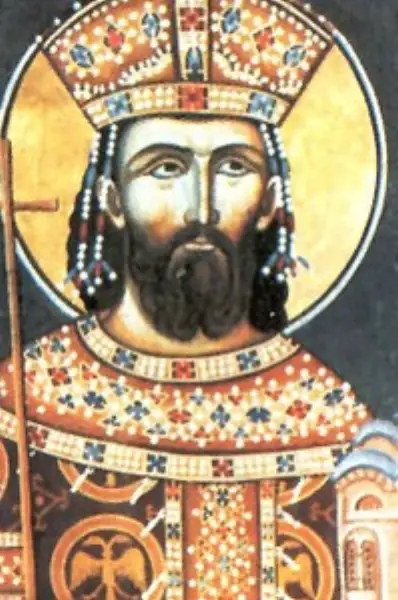
- cephalophore holding his severed head·princely regalia and crown·halo·sword and cross
- Canonization
- Most likely canonized at the translation of his relics to Ravanica in 1390 or 1391; venerated in the Eastern Orthodox Church as a martyr
Prayer
Bibliography
Show 7 sources
- Fine, John Van Antwerp Jr. (1994) [1987]. The Late Medieval Balkans: A Critical Survey from the Late Twelfth Century to the Ottoman Conquest. Ann Arbor, Michigan: University of Michigan Press. ISBN 0472082604.
- Mihaljčić, Rade (2001) [1984]. Лазар Хребељановић: историја, култ, предање (in Serbian). Belgrade: Srpska školska knjiga; Knowledge. ISBN 86-83565-01-7.
- Emmert, Thomas A. (1991). "The Battle of Kosovo: Early Reports of Victory and Defeat". In Vucinich, Wayne S.; Emmert, Thomas A. (eds.). Kosovo: Legacy of a Medieval Battle. Minneapolis: University of Minnesota. ISBN 978-9992287552.
- Ćirković, Sima (2004). The Serbs. Malden: Blackwell Publishing. ISBN 9781405142915.
- Orbini, Mauro (1601). Il Regno de gli Slavi hoggi corrottamente detti Schiavoni. Pesaro: Apresso Girolamo Concordia.
- Duijzings, Ger (2000). Religion and the Politics of Identity in Kosovo. New York: Columbia University Press. ISBN 0-231-12099-0.
- Jireček, Konstantin Josef (1911). Geschichte der Serben (in German). Vol. 1. Gotha, Germany: Friedriech Andreas Perthes A.-G.
Profile text adapted from the Wikipedia article, licensed CC BY-SA 4.0.
Pray with this saint every day
Save St. Lazar of Serbia to your favorites, read the full profile, and get feast-day reminders in the Saints app.
Get the Saints AppFree on the App Store for iPhone and iPad