
died 449·Feast February 11
St. Lazarus of Milan
Archbishop of Milan Against the Manichaeans
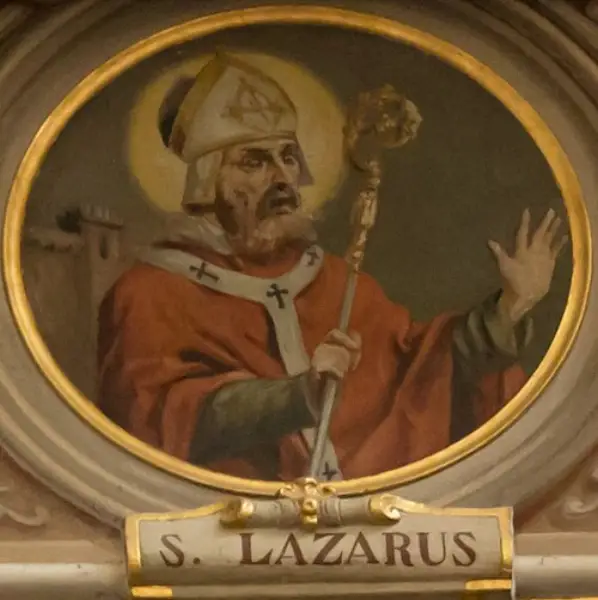
Overview
Lazarus, in Italian Lazzaro, was Archbishop of Milan from 438 to 449, in the last decades of the Roman occupation of the old imperial city. A native Milanese, he probably studied in his own city and succeeded Bishop Glycerius in the ancient Ambrosian see. Little has survived to document his life and episcopate: the tradition reports that he had a stern appearance, and records that, following the example of Pope Leo the Great, he may have taken measures against the Manichaeans, the dualist sect then active in northern Italy. He died at Milan on 14 March 449 and was buried in the Church of Saint Nazarius and Celsus, one of the city's ancient foundations. His cult is of great antiquity, and he is honored as a saint both by the Catholic Church and by the Eastern Orthodox Church, which counts him among the Orthodox saints of the pre-schism see of Rome. His feast is kept on 11 February, a date adjusted from the anniversary of his death because it fell within Lent. A late tradition linking him to the Milanese family of the Beccardi has no historical basis, and the outlines of the man remain those of a fifth-century bishop remembered chiefly for his holiness.
The Complete Life
A Milanese Bishop
The sources have preserved remarkably little about Lazarus, and what they record is largely character rather than chronicle. He was born at Milan in the course of the fourth century, when the city still ranked among the capitals of the Roman Empire, and he probably pursued his studies in his native city, in the shadow of the great Ambrosian tradition of learning that had made Milan a school of bishops. Report describes a man of stern countenance — a detail that endured precisely because it suited the severity with which he was thought to have guarded his flock's faith. A late tradition sought to give him a patrician pedigree by associating him with the Milanese family of the Beccardi, but historians have found no historical basis for the connection. When the see of Milan fell vacant with the death of Bishop Glycerius in 438, Lazarus was chosen to succeed him, becoming the head of a church whose succession ran back through Ambrose to the apostolic age, and whose city, though no longer an imperial residence, remained one of the great sees of the Latin West.
§ Life
Following Leo the Great
The one episode of Lazarus's episcopate that the tradition records belongs to the doctrinal struggles of the mid-fifth century. The Manichaeans, adherents of the dualist religion that Christianity had long combated, were active in northern Italy, and Pope Leo the Great made their suppression a hallmark of his Roman pontificate. Following Leo's lead, Lazarus may have taken measures against the Manichaeans in his own diocese — the cautious phrasing of the sources reflecting how little documentation survives — but the alignment itself is telling. It places the archbishop of Milan in the company of the most vigorous defender of orthodoxy of his generation, and it shows the Ambrosian see acting in concert with Rome at a moment when the bonds between the two churches were being consciously strengthened. For the rest, his eleven years as archbishop, from 438 to 449, were years of quiet governance in a period when the western empire was visibly failing around its Italian heartland, and the fact that his church endured them without recorded crisis may be the best measure of his stewardship.
§ Life
Death and Burial
Lazarus died at Milan on 14 March 449, after an episcopate of about eleven years. He was buried in the Church of Saint Nazarius and Celsus, one of Milan's most ancient Christian foundations, associated with the Milanese martyrs Nazarius and Celsus whose cult Ambrose himself had honored; a century later another sainted bishop of the city, Lawrence I, would renovate that same church and have the figures of twelve of his predecessors painted upon its walls. The choice of burial placed Lazarus among the confessors of the Ambrosian line and made his tomb a point of devotion for the faithful of the city. His successor was Eusebius, another of the sainted bishops of Milan. The date of his death, 14 March, originally marked his feast; because it falls within the season of Lent, when the Ambrosian church observed its penitential rites with particular austerity, his celebration was shifted to 11 February, the day on which the Catholic and Orthodox calendars commemorate him today.
§ Life
Veneration
Lazarus is honored as a saint in the Catholic Church and in the Eastern Orthodox Church alike — a rare double memory that testifies to the antiquity of his cult, which predates the schism between the churches and belongs to the undivided Christianity of the fifth century. Modern Orthodox hagiography counts him among the Orthodox saints of the pre-schism see of Rome, keeping his feast of 11 February alongside the Catholic West. His memorial in the Ambrosian tradition links him to the long golden chain of holy bishops of Milan — from Barnabas and Anathalon through Ambrose and Simplician down to Lazarus himself — whose common feast gathers them into a single act of thanksgiving. The historical record of his deeds is nearly empty, and his cult rests not on documented achievement but on the unbroken memory of the Milanese church that he served; a late and baseless tradition apart, nothing in that memory ever attached to him but severity of aspect, fidelity to Rome, and the holiness that made the city bury him among its martyrs.
§ Life
Timeline
- 438
Appointed Archbishop of Milan, succeeding Glycerius
§ Life
- 14 Mar 449
Dies at Milan on 14 March 449 and is buried in the Church of Saint Nazarius and Celsus
§ Life
The Record
- Major works
- Measures against the Manichaeans in Milan, following Pope Leo the Great
- Symbols
- bishop's vestments
- Canonization
- Pre-congregation canonization; venerated as a saint in the Catholic and Eastern Orthodox Churches
Prayer
Bibliography
Show 3 sources
- Hutchison-Hall, John (Ellsworth) (2012-2026). "11th February: Lazarus of Milan". Orthodox Saints of the Pre-Schism See of Rome.
- Cazzani, Eugenio (1996). Vescovi e arcivescovi di Milano (in Italian). Milano: Massimo. pp. 27-28. ISBN 88-7030-891-X.
- Ruggeri, Fausto (1991). I Vescovi di Milano (in Italian). Milano: NED. p. 15. ISBN 88-7023-154-2.
Profile text adapted from the Wikipedia article, licensed CC BY-SA 4.0.
Pray with this saint every day
Save St. Lazarus of Milan to your favorites, read the full profile, and get feast-day reminders in the Saints app.
Get the Saints AppFree on the App Store for iPhone and iPad