
1st century AD·Feast July 29 (Roman Catholic); Lazarus Saturday and March 17 (Orthodox)
St. Lazarus of Bethany
The Four-Days-Dead Friend Whom Christ Raised
Overview
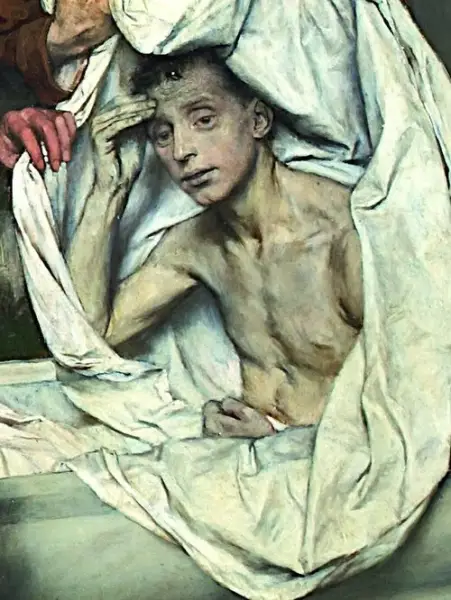
Lazarus of Bethany is the New Testament figure whom Jesus restores to life four days after his death, as the Gospel of John recounts in its longest single narrative apart from the Passion. He lived at Bethany near Jerusalem with his sisters Mary and Martha, and John identifies him as a follower whom Jesus loved. When word reached Jesus that Lazarus was ill, he deliberately delayed two days before setting out, declaring that the sickness would serve the glory of God. Arriving to find his friend already entombed, Jesus wept at the graveside, then commanded the stone rolled away and called Lazarus forth, still bound in his grave-cloths. John presents the miracle as the climactic sign of Jesus' power over death, drawing such crowds that the chief priests plotted to kill Lazarus himself. The Gospels fall silent thereafter, but later tradition carried his memory in two directions: Eastern churches remember him as the first bishop of Kition in Cyprus, appointed by Barnabas and Paul, while a medieval Provençal legend makes him the first bishop of Marseille, martyred under Domitian. His reputed tomb at Bethany — the town now called Al-Eizariya, 'the place of Lazarus' — remains a place of pilgrimage, and the Eastern churches keep his resurrection each year on Lazarus Saturday, the day before Palm Sunday.
The Complete Life
The Household at Bethany
The Gospel of John introduces Lazarus as a man of Bethany, a small town on the slopes near Jerusalem whose modern heir, Al-Eizariya, still carries his name — 'the place of Lazarus'. He belonged to a household of three: himself and his sisters Mary and Martha, whom John presents as followers of Jesus and friends of unusual closeness. When Lazarus fell gravely ill, the sisters sent Jesus a message of terse confidence, telling him that the one he loved was sick. John's account makes much of what followed: Jesus announced that the illness would not end in death but would serve the glory of God, and then, contrary to every expectation, remained where he was for two further days before beginning the journey to Judea. The disciples, knowing how recently hostile authorities had faced him down in Jerusalem, feared the trip; Jesus answered with the cryptic words that their friend had fallen asleep and that he was going to wake him. Only when he told them plainly that their friend had died, and that he was glad for their sakes to have been away, so that their faith might grow, did the company go down with him toward Bethany and its tombs. In John's telling, the whole scene is the last of the great signs performed before the Passion, given a prominent place in the Gospel precisely because it sets Christ's power against humanity's most irresistible enemy, death itself.
§ Narrative
The Fourth Day
Jesus reached Bethany to find what Martha already knew: her brother had lain four days in the tomb. To her reproach — that had he come sooner, her brother would not have died — he replied with one of the most quoted declarations in the Gospel, that he is the resurrection and the life, and that whoever believes in him will live even though he dies. Martha answered with a complete confession of faith, naming him the Christ, the Son of God. Meeting Mary, Jesus was moved to the shortest verse in the English Bible: Jesus wept. At the tomb, a cave closed with a stone and surrounded by mourning neighbors, he ordered the stone taken away despite Martha's practical objection, prayed aloud to the Father for the sake of the crowd, and then called into the darkness: Lazarus, come out. The dead man emerged still wrapped in his grave-cloths, and Jesus directed the bystanders to unbind him and let him go. John records that many of the witnesses believed; others reported the event to the religious authorities in Jerusalem. The miracle's consequences were immediate and mortal: crowds thereafter sought Jesus partly because of Lazarus, and the chief priests, so the Gospel says, considered putting the raised man to death as well. Commentators from Moloney and Harrington onward have read it as the pivotal miracle that set the Crucifixion in motion.
§ Raising of Lazarus
Cyprus and Provence
Scripture says nothing more of Lazarus after the supper at Bethany six days before the Passover, but two great traditions carry his story onward. According to Eastern Orthodox memory, he was forced to flee Judea because of plots against his life — the Gospel itself notes earlier plots of this kind — and reached Cyprus, where Barnabas and Paul made him the first occupant of the episcopal seat at Kition, the town now called Larnaca. Tradition adds that the Virgin Mary wove his episcopal omophorion with her own hands, an apostolic credential the bishops of Kition invoked for centuries in their claims to self-government, granted at last in 431. There, it is said, he lived thirty more years and was buried a second and final time. The West preserves a rival medieval tradition centered on Provence: that Lazarus, Mary, and Martha were cast onto the sea by hostile Jews in a boat stripped of sails, oars, and rudder, and were carried by miracle to the Saintes-Maries, after which Lazarus preached at Marseille, became its first bishop, and was imprisoned and beheaded in a cave during Domitian's persecution, his body later translated to Autun. A gentler detail bridges both worlds: tradition says Lazarus went thirty years without a single smile once he had been raised, his spirit weighed down by the sight of unredeemed souls that his four days in Hades had shown him — except once, at a thief stealing a pot, when he said that the clay was stealing from clay.
§ Bishop of Kition
The Friend of Christ Remembered
Few gospel figures have left so large a footprint on Christian memory. The Eastern churches keep Lazarus Saturday, the day before Palm Sunday, as a glad day set between the austerities of the Lenten fast and the grief of Passiontide; its hymns read the miracle as a foreshadowing both of Christ's own resurrection and of the general resurrection promised to all; the baptismal hymn replaces the Trisagion that day, and in Russia it is customary to eat caviar. The Orthodox also keep 17 March as his fixed feast and 17 October for the translation of his relics to Constantinople in 898. On the Roman calendar he is celebrated with his sisters on 29 July, while Cuba's vibrant San Lázaro festival on 17 December shows how deeply the figure has entered popular devotion. His first tomb at Bethany draws pilgrims still, reached by rock-cut steps past churches ancient and modern, and rival claims to his remains crowd the West — the cathedral of Autun, Vézelay Abbey, and Marseille's claimed possession of his head. In Islam he appears as a pious companion of Jesus, and in art the raising of Lazarus stands among the most painted subjects in Christian history, treated by Caravaggio, Sebastiano del Piombo, Rembrandt, and Van Gogh, with scenes of it already adorning the Roman catacombs in the second century.
§ Liturgical commemorations
Timeline
- 390
Jerome speaks of a Bethany church honoring St Lazarus, the Lazarium, which was probably erected at some point between 333 and 390
§ Tomb of Lazarus
- 431
At the Third Ecumenical Council the church of Kition, which traced its apostolic standing to Lazarus, is declared self-governing
§ Bishop of Kition
- 890
A tomb is found at Larnaca in Cyprus bearing the inscription 'Lazarus the friend of Christ'
§ Bishop of Kition
- 898
Emperor Leo VI has Lazarus' remains translated from Cyprus to Constantinople, an event the Orthodox Church keeps each 17 October
§ Bishop of Kition
- 1143
King Fulk and Queen Melisende of Jerusalem acquire the tomb site and its lands, raising a great Benedictine convent in honor of Mary and Martha beside it
§ Tomb of Lazarus
- 1965
A Greek Orthodox church is constructed just west of Lazarus' tomb at Bethany
§ Tomb of Lazarus
- Nov 1972
Human remains are discovered in a marble sarcophagus beneath the altar of the Church of St Lazarus in Larnaca during renovations, and identified as relics of the saint
§ Bishop of Kition
- Jun 2012
The Church of Cyprus transfers a portion of St Lazarus' relics to the Russian Orthodox Church; they are enshrined at Moscow's Conception Convent
§ Bishop of Kition
In Their Own Words
Of all the dead which our Lord raised, he was most helped, for he had lain dead four days, when our Lord raised him to life.
not only did Christ give a remarkable proof of his Divine power in raising Lazarus, but he likewise placed before our eyes a lively image of our future resurrection.
the clay steals the clay.
The Record
- Patron of
- lepers·beggars
- Symbols
- Vested as an apostle or as a bishop·Bound tightly in mummified grave-cloths resembling swaddling bands in scenes of his resurrection
- Canonization
- Pre-congregation; venerated as a saint since Christian antiquity in East and West
Prayer
Bibliography
Show 5 sources
- Great Synaxaristes: "Ἀνάστασις τοῦ Λαζάρου." ΜΕΓΑΣ ΣΥΝΑΞΑΡΙΣΤΗΣ.
- Great Synaxaristes: "Ὁ Ἅγιος Λάζαρος ὁ Δίκαιος, ὁ φίλος τοῦ Χριστοῦ." 17 ΜΑΡΤΙΟΥ. ΜΕΓΑΣ ΣΥΝΑΞΑΡΙΣΤΗΣ.
- Great Synaxaristes: "Ἀνακομιδὴ καὶ Κατάθεσις τοῦ Λειψάνου τοῦ Ἁγίου καὶ Δικαίου Λαζάρου." 17 Οκτωβρίου. ΜΕΓΑΣ ΣΥΝΑΞΑΡΙΣΤΗΣ.
- Bishop Nikolaj Velimirović. "October 17 – The Prologue from Ohrid." Serbian Orthodox Church Diocese of Western America. Retrieved 17 April 2013.
- "St. Lazarus' relics brought to Moscow from Cyprus." Interfax-Religion. 13 June 2012.
Profile text adapted from the Wikipedia article, licensed CC BY-SA 4.0.
Pray with this saint every day
Save St. Lazarus of Bethany to your favorites, read the full profile, and get feast-day reminders in the Saints app.
Get the Saints AppFree on the App Store for iPhone and iPad