
810 – 865·Feast February 23 (Roman Catholic); November 17 (Orthodox)
St. Lazarus Zographos
Byzantine Iconographer and Confessor under Iconoclasm
Overview
Lazarus, surnamed Zographos ('the Painter'), was born in Armenia on 17 November 810 and became a monk while still young. Tradition holds that he learned the painter's craft at the Stoudios Monastery in Constantinople, and after ordination to the priesthood he won wide renown for his frescoes, which contemporaries regarded as fruit of a gift from God rather than mere technique. Living through the second wave of Byzantine Iconoclasm, he refused Emperor Theophilos' repeated commands to abandon holy images and kept restoring those his opponents had defaced. For this he was imprisoned and tortured so brutally that hot metal was pressed to his palms, yet he survived and continued producing icons even from his cell. Freed at the urging of the empress Theodora, he found shelter at the church of Tou Phoberou on the Bosporus, and after the iconoclast emperor's death in 842 he restored the celebrated Christ Chalkites over the Chalke Gate of the imperial palace. In 856 Emperor Michael III dispatched him to Pope Benedict III as an envoy seeking reconciliation between the Roman and Orthodox churches, and he died at Rome on 28 September 865 during a second such mission. He was buried at the Monastery of Evandros near Constantinople.
The Complete Life
A Monk of the Brush
Lazarus entered monastic life at an early age, and it was presumably within that disciplined world that his two great commitments took shape: the ascetical struggle of the monk and the craft of the icon painter. Tradition connects his artistic training with the Stoudios Monastery in Constantinople, the great center of Byzantine monasticism, and it was there or in circles formed by it that he acquired the technical command that would make his name. Contemporaries praised in him a cluster of virtues that the sources enumerate with care: love for Christ, asceticism, prayer, and a deliberate turning away from the world's vanities. To these his biographers add self-control, discipline, and generosity in alms-giving, so that his character appeared as finished as his panels. Ordained a priest, he combined the clerical office with his artistic vocation, and in his own lifetime he became widely known for his frescoes. What set his work apart was the conviction that painting could be an act of prayer. He employed faith and liturgical ritual as the means by which his inner contemplation was transferred onto the images he made, and those who watched him work concluded that his gift for rendering icons was one bestowed by God rather than merely acquired by study. In a culture that defended icons as theology in color, Lazarus embodied the argument: the painter's life and the painter's art were a single witness.
§ Life and times
Confessor under Theophilos
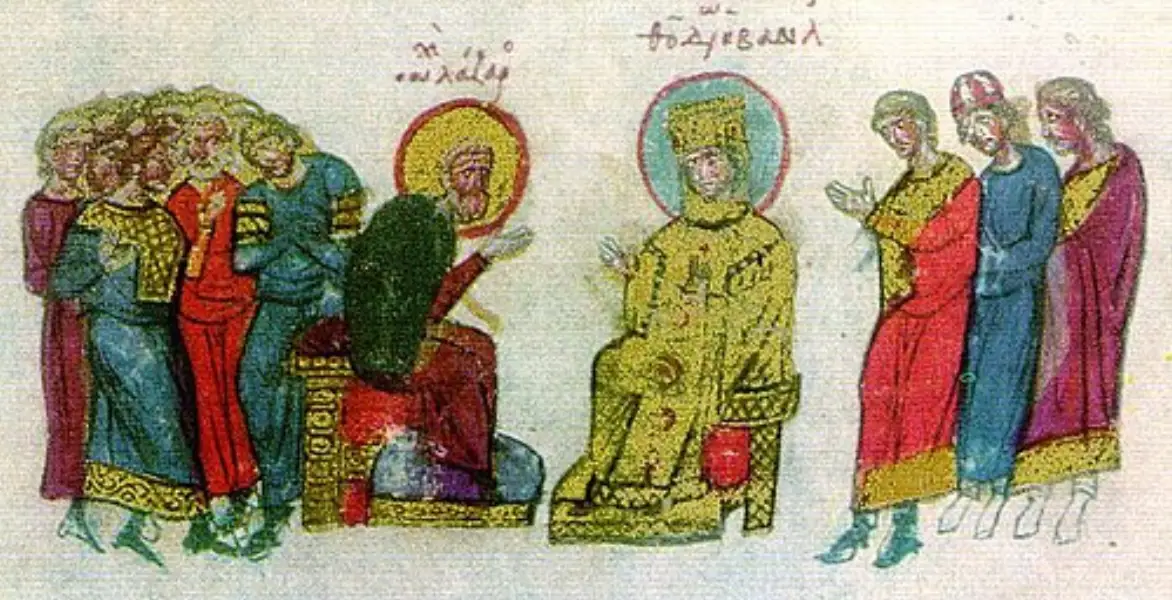
The second period of Byzantine Iconoclasm opened under Emperor Theophilos, who reigned from 829 to 842 and opposed the veneration of holy images. Lazarus, already famous for his painting, refused to stop. He continued to produce icons and began restoring the images that iconoclasts had defaced, a quiet act of defiance performed in the open. Summoned before the emperor after repeated warnings, he declined to destroy a single one of his works. Theophilos discovered that neither flattery nor bribery could move him, and when threats of death proved equally useless — for a man in holy orders could not lawfully be executed — he threw the monk into prison instead. There the persecution took a savage turn. Lazarus was tortured so severely that the sources describe his flesh as melting away with his blood; left to die of his wounds, he instead recovered, and from his cell he resumed painting sacred images on panels. When word of this reached the emperor, he ordered sheets of red-hot iron pressed against the confessor's palms. Lazarus lost consciousness and lay half dead; another account says his hands were burned with heated horseshoes until the flesh melted to the bone. He had answered the empire's whole machinery of coercion with a brush, and neither prison nor fire could close that hand.
§ Life and times
Restoration and Embassy
As Lazarus lay apparently dying, the empress Theodora herself, a supporter of the holy images, prevailed on Theophilos to release him. His refuge became Tou Phoberou, a lonely church honoring St John the Forerunner that stood on the Asian bank of the Bosporus, an establishment thought to have formerly been an imperial monastery that had room for a hundred and seventy monks at its peak. When Theophilos died in 842, Theodora asked the tortured confessor to forgive her husband's conduct; his celebrated reply held forgiveness and firmness together, insisting that God would not forget the love and labor of those who had suffered for him. Once the holy images were restored in 843, Lazarus went back to his craft with undiminished force. Despite his ruined hands he painted a great fresco of St John at the Phoberos Monastery, an image credited with the power to work cures and miracles, and in that same year he famously restored the portrait of Christ known as the Christ Chalkites above the ceremonial gate of the Great Palace. His final years took a diplomatic turn: in 856 the young emperor Michael III sent him to Pope Benedict III to discuss healing the rupture between Rome and the Orthodox churches, and he died at Rome on 28 September 865 while engaged on a second mission to the Pope.
§ Ambassador to Rome
First of the Iconographer Saints
Lazarus was buried in the Monastery of Evandros near Constantinople, and his memory settled into the calendars of both the Orthodox and Roman Catholic churches, kept on 17 November in the East and 23 February in the West. His distinction is singular: he stands as the first saint raised to the altars expressly for being an iconographer, a distinction repeated only much later by St Catherine of Bologna. Later pilgrim tradition attached his name to still grander works — Antony, Archbishop of Novgorod, visiting Constantinople around 1200, reported that the apse mosaic of Hagia Sophia, showing the Mother of God with the Child flanked by angels, was attributed to Lazarus, though that account belongs to a date centuries after his death. Neither the Phoberos fresco nor the restored Christ Chalkites survives today, so his art reaches us only through testimony. Yet the testimony is eloquent. For the generation that had endured iconoclast persecution, Lazarus served as a living model of perseverance: a man whose flesh had been burned for images of Christ and who, with those same wounded hands, went on painting them. His witness helped seal the settlement of 843, and the images he defended have never again been formally questioned in the churches of the East.
§ Attributed artworks
Timeline
- 17 Nov 810
Born in Armenia
§ Lazarus Zographos
- 829
Under the iconoclast Emperor Theophilos he keeps painting icons and repairs images defaced by the heretics, drawing the emperor's attention
§ Life and times
- 842
The empress Theodora persuades Theophilos to free the dying Lazarus, who takes refuge at the church of Tou Phoberou near the Bosporus
§ Life and times
- 843
After the restoration of the holy images he paints a fresco of St John at Phoberos and renews the Christ Chalkites portrait above the Chalke Gate
§ Attributed artworks
- 856
Sent by Emperor Michael III as emissary to Pope Benedict III to explore reconciliation between Rome and the Orthodox Church
§ Ambassador to Rome
- 28 Sep 865
Dies at Rome on his second diplomatic mission to the Pope, a date Raymond Janin disputes
§ Ambassador to Rome
In Their Own Words
God is not so unjust, O, Empress, as to forget our love and labors on his behalf, and attach greater value to that mans hatred and extraordinary insanity.
The Record
- Major works
- Fresco of St John the Forerunner at the Phoberos Monastery (843)·Restored icon of the Christ Chalkites over the Chalke Gate, Constantinople (843)·Apse mosaic of Hagia Sophia attributed to him in later pilgrim accounts
- Canonization
- Pre-congregation; the first saint canonized specifically as an iconographer
Prayer
Bibliography
Show 9 sources
- Ramsgate, St Augustine's Abbey. The Book of Saints: A Dictionary of Servants of God Canonized. NP: Adam and Charles Black, 1966
- Bigham, Steven. "Chapter 3." In Heroes of the Icon: People, Places, Events, 87-89. Torrance: Oakwood, 1998.
- Cutler, Anthony; Kazhdan, Alexander (1991). "Lazaros". In Kazhdan, Alexander (ed.). The Oxford Dictionary of Byzantium. Oxford and New York: Oxford University Press. pp. 1197–1198. ISBN 0-19-504652-8.
- O'Connell, Monique, Olenka Z. Pevny, and Alice-Mary Talbot. "Perceptions of Byzantium and Its Neighbors (843-1261)." Sixteenth Century Journal 33, no. 4 (2002): 24-25.
- Athanassiadis, Antony, trans. Synaxarion of Saint Nicodemus the Hagiorite. Vol. 2. Athens, 1868. 125-126.
- Mango, Cyril. The Art of the Byzantine Empire: 312-1453: Sources and Documents. Englewood Cliffs New Jersey: Prentice-Hall, 1972. 158-60.
- Jordan, Robert, trans. "30. Phoberos: Rule of John for the Monastery." In Byzantine Monastic Foundation Documents: A Complete Translation of the Surviving Founders' "Typika" and Testaments, Vol. 35. Washington, DC: Dumbarton Oaks, 2000, 872-79.
- Brubaker, Leslie. The artisanal production of second Iconoclasm (815-843). In: Monastères, images, pouvoirs et société à Byzance. Paris: Publications de la Sorbonne, 2006, 135-152.
- Mango, Cyril, and Ernest J. W. Hawkins. "The Apse Mosaics of St. Sophia at Istanbul. Report on Work Carried out in 1964." Dumbarton Oaks Papers, 1964, 142.
Profile text adapted from the Wikipedia article, licensed CC BY-SA 4.0.
Pray with this saint every day
Save St. Lazarus Zographos to your favorites, read the full profile, and get feast-day reminders in the Saints app.
Get the Saints AppFree on the App Store for iPhone and iPad