
c. 534 – 13 March 600 or 601·Feast March 13 (Roman Catholic and Orthodox); February 27 (Vetus Ordo); November 13 (Spain)
St. Leander of Seville
Bishop Who Converted the Visigoths from Arianism
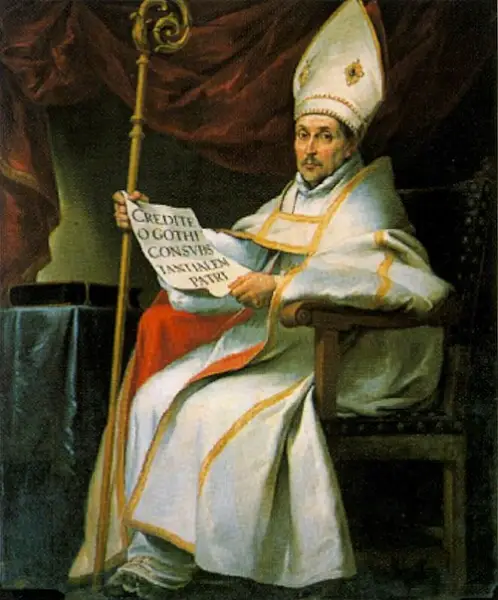
Overview
Leander of Seville was a Hispano-Roman prelate, born around 534 at Carthago Spartaria (Cartagena) into an elite Catholic family that would become one of the most remarkable in Spanish church history: his brother Fulgentius headed the see of Astigi, his sister Florentina governed forty convents with a thousand nuns, and his younger brother Isidore succeeded him as bishop of Seville and became the great encyclopedist of the early Middle Ages. After the family moved to Seville around 554, Leander took up the monastic life as a Benedictine around 576, founded a celebrated school that grew into a center of Catholic learning, and in 579 was named bishop of the city. His episcopate was shaped by the struggle against Arianism, the faith of the Visigothic kings. He helped bring Prince Hermenegild to Catholic communion, was exiled by King Liuvigild when the prince's rebellion collapsed, and spent roughly 579 to 582 in Byzantium, where he wrote against the Arians and formed a lasting friendship with the future Pope Gregory the Great. Recalled from exile, he guided the heir Reccared toward conversion and in 589 convoked the Third Council of Toledo, at which Visigothic Hispania abjured Arianism. He died at Seville on 13 March in 600 or 601, leaving two surviving works and a church transformed.
The Complete Life
Four Saints of One House
Leander came of an Hispano-Roman family of consequence at Carthago Spartaria, the Roman port on Spain's southeastern coast now known as Cartagena. His hagiographers styled his father Severianus a dux or governor of the city, though Isidore himself, who knew the family best, says only that his father was a citizen — the grander title seems to belong to legend rather than record. What is certain is the family's religion: like most of the Romanized population of southern Spain they were staunch Catholics, at a time when the Visigothic nobility and their kings professed Arianism. Around 554 the household moved to Seville, and the children's careers soon reflected both their standing and their faith. Leander himself rose to the bishopric of Hispalis; his brother Fulgentius was appointed Bishop of Astigi; his sister Florentina became an abbess entrusted with the direction of forty convents and a thousand nuns; and his younger brother Isidore followed him as bishop of Seville and wrote the encyclopedic works that made him the most learned man of his age. All four siblings came to be honored as saints by the Catholic Church and the Eastern Orthodox Church alike — an extraordinary outcome for a single household, and one that made the Leander-Isidore circle the intellectual and spiritual engine of Spanish Christianity in the generations after the Visigothic conquest.
§ Life
Monk and Bishop of Seville
Leander's early public life unfolded within the tolerated Catholic culture of Seville, a city inside the Visigothic kingdom but in contact with the Byzantine province the emperor still held in the far south of the peninsula, a foothold won when King Athanagild had invited imperial forces decades before. Within that secure environment Leander made his decisive commitments. Around 576 he embraced monastic life as a Benedictine, joining the rule that linked him to the broader monastic movement of the sixth-century West. He had already founded a school in the city that soon earned renown as a center of Catholic learning, giving the Spanish church an institutional base of formation at precisely the moment the contest with Arianism was sharpening. In 579 his standing bore its natural fruit: he was appointed bishop of Seville, metropolitan of the province and one of the leading Catholic prelates of the Visigothic realm. The combination was potent — the ascetical discipline of a monk joined to the administrative reach of a bishop — and his access to court circles soon followed. As bishop he could reach the Catholic Merovingian princess Ingunthis, who had come north as bride to the kingdom's heir, and through her he would touch the fate of the royal house itself.
§ Life
A Convert Prince, an Angry King, and a Friend in Byzantium
Leander's great cause was the conversion of the Visigothic royal house. He assisted Princess Ingunthis in bringing her husband Hermenegild, eldest son of King Liuvigild, into the Catholic communion — an achievement whose political dimensions the sources acknowledge candidly, since the faith of the heir carried dynastic weight. When Hermenegild took up arms against his father amid cruel reprisals, Leander defended the convert, and Pierre Suau judged that in striving to deliver his country from Arianism he proved both orthodox Christian and far-sighted patriot. The rebellion failed, and Leander was exiled, withdrawing to Byzantium — perhaps hurriedly — from 579 to 582. Perhaps he hoped to move Emperor Tiberius II Constantine to make war on the Arian ruler; if so, nothing came of it. In any case the exile yielded other gains: there he composed works against Arianism, and there he met the future Pope Gregory the Great, then papal legate at the imperial court, who would later send him a copy of the Pastoral Care. A close friendship joined the two men for life, and portions of their correspondence survive. In 585 Liuvigild put his intransigent son to death; Hermenegild is honored as a martyr and saint. The king himself died in 589, and Leander, back from exile at an uncertain date, turned his influence to the new heir, Reccared, whom he helped bring to the Catholic faith.
§ Life
The Creed in the Mouths of the People
Leander's pastoral mind showed itself in a liturgical innovation of lasting consequence: he introduced the recitation of the Nicene Creed at Mass, so that the Catholic faith confessed at the council fathers' tables would also be confessed weekly by ordinary worshipers. The measure was aimed squarely at Arianism, which denied the full divinity of the Son, and it armed the faithful with the exact words of orthodoxy in their own voices. The same concern for formation shaped his writings. For his sister Florentina he composed De institutione virginum et contemptu mundi, a rule of monastic life written to form the communities of consecrated women under her direction — the fullest surviving expression of his spiritual teaching, with its insistence on the contempt of the world that anchors the virgin's life. His anti-Arian treatises, written during his Byzantine exile, have not survived, but their purpose is clear from the friendship that exile produced: Gregory the Great, who sent him the Pastoral Care as a gift, shared his conviction that pastoral office meant teaching as well as governing. When the council of 589 was over, Leander called his provincial bishops to synod at his metropolitan see of Seville, and from that day forward he gave himself without rest to tearing the last remnants of Arianism out of his province, a labor his brother and successor Isidore would carry to completion.
§ Life
Toledo and the Triumph of the Church
The climax of Leander's career came in 589, when he convoked the Third Council of Toledo, the assembly at which Visigothic Hispania formally abjured Arianism and accepted the Catholic faith. It was the act toward which his whole episcopate had tended: the conversion of Hermenegild, the exile at Byzantium, the patient influence over Reccared all issued here in a public, corporate reversal of the kingdom's religious allegiance. Leander delivered the closing sermon in person, a discourse of triumph which Isidore handed down under a Latin title rendering it as the homily preached on the Church's triumph at the conversion of the Gothic people; the text remains one of only two works of his to survive. On returning from Toledo he summoned a synod in Seville, his metropolitan city, to consolidate the victory in his own province, and from that point he labored without pause to extirpate the remaining traces of Arianism from the Spanish church. His death came at Hispalis on 13 March, in either 600 or 601 — the sources leave the year in doubt — while the work of completion passed to Isidore, whose own writings would carry the converted Goths' church to its golden age.
§ Life
Memory of the Apostle of the Visigoths
Leander's memory settled quickly into the church's calendars. The Catholic and Eastern Orthodox Churches keep his feast on both 27 February and 13 March according to particular observances — the former date belonging to the older Roman use, the latter shared by the Novus Ordo and the Mozarabic Rite — while Spain's national liturgical calendar commemorates him on 13 November. His cult flourished where he lived and worked: the city of San Leandro in California bears his name, a testament to Spanish devotion carried across the Atlantic, and in Seville itself his supposed likeness and crosier appear on the crest of Sevilla Fútbol Club, an emblem of civic pride. Intellectual heirs proved as durable as institutional ones. Isidore's tribute to his brother — a man of suave eloquence and eminent talent, shining equally in virtue and doctrine, by whose faith and zeal the Gothic people were converted — fixed his reputation as the decisive figure in Spain's turn from Arianism, and the church he left behind, conciliar in structure and Catholic in creed, shaped Iberian Christianity for centuries. Of his writings only the monastic rule for Florentina and the Toledo homily survive, but they, with the letters he exchanged with Gregory the Great, suffice to mark him as among the formative minds of sixth-century Europe.
§ Legacy
Timeline
- 534
Born at Carthago Spartaria into a Hispano-Roman family of standing, son of Severianus
§ Life
- 554
The family relocates from Cartagena to Seville
§ Life
- 576
Enters monastic life as a Benedictine monk, having earlier founded a school that became a hub of Catholic learning
§ Life
- 579
Appointed Bishop of Seville; later that year withdraws to Byzantium in exile under King Liuvigild
§ Life
- 582
His Byzantine sojourn ends; he returns having written against Arianism and befriended the papal legate Gregory the Great
§ Life
- 585
Liuvigild executes his own son Hermenegild, Leander's royal convert, who is honored as a martyr
§ Life
- 589
Convokes the Third Council of Toledo at which the Visigothic kingdom abjures Arianism; he preaches the closing homily of triumph
§ Life
- 13 Mar 600
Dies at Hispalis (Seville); some sources give 601 for his death
§ Leander of Seville
In Their Own Words
This man of suave eloquence and eminent talent shone as brightly by his virtues as by his doctrine. By his faith and zeal the Gothic people have been converted from Arianism to the Catholic faith.
In endeavoring to save his country from Arianism, Leander showed himself an orthodox Christian and a far-sighted patriot.
The Record
- Major works
- De institutione virginum et contemptu mundi (a monastic rule written for his sister Florentina)·Homilia de triumpho ecclesiae ob conversionem Gothorum·Now-lost treatises against Arianism composed at Byzantium
- Symbols
- Episcopal attire·Crosier and likeness on the crest of Sevilla Fútbol Club
- Canonization
- Pre-congregation; venerated as Bishop and Confessor, 'Apostle of the Visigoths', in the Catholic and Eastern Orthodox Churches
Prayer
Bibliography
Show 9 sources
- "Liturgical Calendar — Spain (2023)." www.gcatholic.org.
- Suau, Pierre. "St. Leander of Seville." The Catholic Encyclopedia Vol. 9. New York: Robert Appleton Company, 1910.
- "Κοίμηση Ἁγίου Λεάνδρου Ἐπισκόπου Σεβίλλης: 13 ΜΑΡΤΙΟΥ" [Dormition of Saint Leandro, Bishop of Seville: March 13]. ΜΕΓΑΣ ΣΥΝΑΞΑΡΙΣΤΗΣ [Great Synaxaristes] (in Greek).
- Collins, Early Medieval Spain: Unity in Diversity 400-1000, second edition (New York: St. Martins, 1995), p. 39.
- "St. Leander of Seville." FaithND.
- "Saint Leander of Seville." Franciscan Media. 13 March 2022.
- Martyrologium Romanum (Libreria Editrice Vaticana 2001 ISBN 88-209-7210-7).
- "Orthodox Europe: Spain." www.orthodoxengland.org.uk. Retrieved 2020-07-06.
- Baring-Gould, Sabine (1897). "S. Leander, B. of Hispala." The Lives of the Saints. Vol. 2: February. London: J. C. Nimmo. pp. 445−447.
Profile text adapted from the Wikipedia article, licensed CC BY-SA 4.0.
Pray with this saint every day
Save St. Leander of Seville to your favorites, read the full profile, and get feast-day reminders in the Saints app.
Get the Saints AppFree on the App Store for iPhone and iPad