
died c. 775·Feast November 12
St. Lebuinus
English Missionary, Apostle of the Frisians
Overview
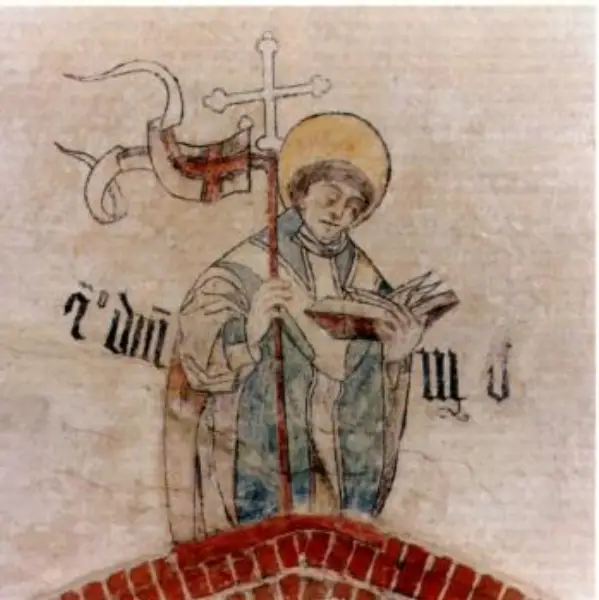
Lebuinus — also called Lebuin, Lebwin, or Liafwin — was an English monk who became known as the Apostle of the Frisians and the patron saint of Deventer in the Netherlands. Born in England to Anglo-Saxon parents at an unknown date, he entered monastic life at Ripon in the monastery founded by Wilfrid. The exploits of Boniface, Willibrord, and the other great English missionaries stirred him to consecrate his own life to the conversion of the Germans. Ordained a priest, he crossed to the continent in 754, reaching Utrecht, where Gregory, the acting bishop, assigned him the mission territory of Overijssel along the borders of Westphalia and gave him Marchelm, a disciple of Willibrord, as a companion. Preaching among the tribes of that district, Lebuinus built a small chapel at Wilp on the IJssel, and his learning and winning character brought many, even nobles, to the faith, so that a larger church soon rose at Deventer. Pagan hostility answered his success: accused of witchcraft, he saw his church burned and his converts scattered, after which he famously confronted the Saxon national assembly at Marklo. He returned to rebuild Deventer, where he was buried after his death around 775, and where the great church later consecrated in his name still stands.
The Complete Life
From Ripon to the Rhine Frontier
The man the Frisians would remember as their apostle began as a monk of Ripon, within the monastery that Wilfrid had built in the English north. His birth in England to Anglo-Saxon parents cannot be dated; the sources are silent about his childhood and formation, and preserve only the decisive fact that he took the monastic habit at Ripon. What moved him onward was the example of the great English missionaries of his century — Boniface among the Germans, Willibrord among the Frisians — whose labors had made the conversion of the continent a living vocation for ambitious English monks. Fired by their example, Lebuinus pledged his own life to winning the German peoples for the faith; once ordained, he journeyed in 754 to Utrecht. There Gregory, the acting bishop of that mission station, received him warmly and assigned him the territory of Overijssel, the district along the borders of Westphalia, and attached to him a companion, Marchelm (also called Marcellinus), a disciple of Willibrord, so that the older Frisian mission would continue in the younger man's work. The pattern was the classic one of the Anglo-Saxon mission: cloister training at home, ordination, then deployment along the pagan frontier under an established bishop's authority.
§ Life
Preaching on the IJssel
Lebuinus worked his mission among the tribes of Overijssel with striking results. He raised a small chapel at Wilp on the west bank of the IJssel as a base, and his preaching, joined to a personality the sources call venerable and a learning that impressed his hearers, drew many to Christianity — even among the nobles of the district. Conversions multiplied to the point that a larger church became necessary, and it was built across the river at Deventer on the east bank, the settlement whose patron saint he remains to this day. Success, however, provoked the pagans. Unable to answer his teaching, they attributed his conversions to witchcraft and formed an alliance with the anti-Christian Saxons; the church at Deventer was burned and the converts dispersed, while Lebuinus himself escaped only with difficulty. Rather than withdraw, he resolved to argue Christianity's case at the highest forum available: the national assembly, the Allthing, of the Saxon people at Marklo near the Weser. The Vitae describe his appearance before that assembly in dramatic detail — how he exposed the powerlessness of the Saxon deities and warned that a powerful king would destroy them unless they accepted the faith. Through the intercession of the nobleman Buto he not only escaped with his life but won permission to preach unmolested in the territory assigned to him.
§ Life
Rebuilding and Burial at Deventer
Returning from the Saxon assembly to Friesland, Lebuinus rebuilt the burned church at Deventer, and there, after his death around 775 — the exact date is unknown, though it almost certainly fell before 776 — he was buried. The sequel proved the depth of the hostility he had overcome: in 776 the Saxons attacked and set fire to the church at Deventer once more, yet after three days of searching they could not identify his remains inside the building. His body, together with a copy of the Gospels thought to have flowed from his own pen, stayed at Deventer, kept in a church under his patronage, until Norman raiders burned the building down once more in 882. A few years later St Ludger rebuilt the church and, in the course of the work, rediscovered the saint's remains beneath the site, restoring to the Christian community the relics that fire and raiders had hidden. The Life of Lebuinus may even have inspired the cult of Livinus of Ghent — a complication of memory, since the relics kept under Livinus' name, whose feast falls on the same day as Lebuinus', are probably Lebuinus' own.
§ Death
Apostle and Patron of Deventer
The church keeps Lebuinus' memory on 12 November, observed principally in the Netherlands, where his role as the apostle of the Frisians made him a foundational figure of Dutch Christianity. The Roman Catholic Church, the Eastern Orthodox Church, and the Anglican Communion all venerate him. Deventer honors him as its patron, and the great Lebuïnuskerk — the Gothic church consecrated in his name that dominates the city's skyline — stands as his most visible monument, heir to the humble structures he first raised on the banks of the IJssel. His written memory survives in two Lives: the Vita antiqua, the earliest account, from the ninth or early tenth century, and a Life composed by Hucbald of Saint-Amand between 918 and 930, both testifying to how vividly the story of the monk who faced down the Saxon assembly gripped medieval imagination. That episode, in which a single unarmed preacher challenged the armed counselors of a pagan nation and walked away alive under the protection of one nobleman's intercession, made him a model for later missionaries and, quite possibly, the literary seed of another Frisian cult, that of Livinus of Ghent, whose feast shares his date of 12 November.
§ Veneration
Timeline
- 754
Proceeds to Utrecht after his ordination and is entrusted by Bishop Gregory with the mission of Overijssel, with Marchelm as companion
§ Life
- 775
Dies at Deventer about this year and is buried in the church he rebuilt there
§ Death
- 776
Saxon raiders burn the church at Deventer but fail after three days to find the saint's remains inside it
§ Death
- 882
Norman raiders destroy the Deventer church that held his body and the Gospel book believed copied in his own hand
§ Death
The Record
- Major works
- Chapel at Wilp on the west bank of the IJssel·Church at Deventer, twice destroyed and twice rebuilt after his death·A copy of the Gospels believed to have been written in his own hand
- Patron of
- Deventer, Netherlands
- Canonization
- Pre-congregation; venerated as the Apostle of the Frisians and patron of Deventer by the Catholic, Orthodox, and Anglican churches
Prayer
Bibliography
Show 4 sources
- Kennedy, Thomas (1913). "St. Lebwin." In Herbermann, Charles (ed.). Catholic Encyclopedia. New York: Robert Appleton Company.
- Howorth, H.H., "The Ethnology of Germany", Journal of the Royal Anthropological Institute of Great Britain and Ireland, Volume 9, 1880, p. 434.
- "Lebuinus", The Medieval Liturgy of the Low Countries.
- Hunt, William (1892). "Lebwin." In Lee, Sidney (ed.). Dictionary of National Biography. Vol. 32. London: Smith, Elder & Co.
Profile text adapted from the Wikipedia article, licensed CC BY-SA 4.0.
Pray with this saint every day
Save St. Lebuinus to your favorites, read the full profile, and get feast-day reminders in the Saints app.
Get the Saints AppFree on the App Store for iPhone and iPad