
c. 710 – 782·Feast September 28
St. Leoba
Anglo-Saxon abbess and missionary to Germany
Overview
Leoba, baptized Leofgyth, was born around 710 into a noble West Saxon family and given as an oblate to the double monastery of Wimborne Minster, where Abbess Tetta oversaw her formation. When her kinsman Boniface sought English nuns to assist his missionary work among the German peoples, Leoba was among those chosen. She crossed to the continent in the 740s and was placed at the head of the convent Boniface founded at Tauberbischofsheim, exercising authority not only over her own house but, as Rudolf of Fulda records, over all the women religious cooperating with Boniface. A learned woman credited with the first poetry known from an English woman's pen, she helped establish convents at Kitzingen and Ochsenfurt and took a leading part in evangelizing her region. Bishops at Fulda sought her counsel on monastic discipline, and she enjoyed the favor of the Carolingian court. In old age she withdrew to an estate at Schornsheim near Mainz, granted her by Charlemagne, and died there on 28 September 782. Miracles reported at her burial place led to two translations of her remains and a formal life written by Rudolf of Fulda.
The Complete Life
A Child of Promise from Wessex
Leoba first bore the Old English name Leofgyth, a compound meaning beloved and battle, and she was the only child of parents advanced in years, Dynne and Aebbe. Her mother, a relative of Boniface, recounted a dream before the child's birth in which she learned that her offspring would be chosen by Christ, would pursue a spiritual path, and would devote her life to the church. Some accounts hold that the girl received early training from Abbess Edburga at Minster-in-Thanet, though modern students of her life consider the evidence for a prolonged stay there slight, allowing only that she may have visited the community from time to time. What is certain is her entrance into the double monastery of Wimborne Minster, first as an oblate entrusted to the care of Abbess Tetta and later as a professed nun. Wimborne was a school of remarkable accomplishments: its sisters copied and ornamented manuscripts and produced the celebrated English embroidery worked in gold and silver thread upon rich velvet or linen, wares in keen demand across Europe. There, amid scholarship and fine needlework, the future abbess acquired the learning and discipline that would mark her whole career.
§ Early life
The Dream of the Purple Thread
Boniface kept up correspondence with religious houses throughout Britain, and at some point Leoba wrote asking his prayers for her parents. Years afterward he resolved to bring English nuns to the mission field and wrote to Abbess Tetta asking that Leoba and companions be sent to help spread Christianity in Germany; he asked for her specifically, judging that many would profit from her holiness and example. Her own sense of calling had been confirmed in a striking dream: she saw a purple thread issuing from her mouth, which she drew out again and again until she had wound it into a ball, waking exhausted from the labor. Curious about the vision, she asked a sister gifted in interpreting such things, who told her that the thread signified a life of leadership awaiting her, that she was destined to become a wise teacher and a great counselor. Willibald likewise records that women as well as monks attended the lectures Boniface gave at Nhutscelle, not far from Wimborne, so her preparation joined cloistered craft with doctrinal instruction. In 748 she traveled to Germany with Thecla and others, ready for apostolic work.
§ Early life
Abbess and Evangelist in Franconia
Boniface founded a convent in the Franconian town of Tauberbischofsheim and set Leoba over it as abbess, entrusting her with exceptional authority. Rudolf of Fulda indicates that her charge extended beyond her own community to all the nuns laboring alongside Boniface, and in 754, as he prepared a missionary journey into Frisia, he gave her his monastic cowl as a sign that while he was away she stood in his place. In the years that followed she helped establish convents at Kitzingen and Ochsenfurt and played a leading role in evangelizing the surrounding region. Her renown rose to the very top of society: Pippin III's court received her with favor, and she counted Hildegard, Charlemagne's wife, among her personal friends. Bishops gathered at Fulda consulted her, and she remains striking as the only woman permitted to enter the monasteries there in order to confer with ecclesiastical leaders on questions of monastic rule. She commanded a storm to cease, and it obeyed. Learned, connected, and revered, she governed as much by wisdom as by office, a woman whose counsel mattered to bishops, queens, and missionaries alike in the young German church.
§ Life as a missionary
Strength Wrought Through Prayer
The miracles credited to Leoba were, without exception, the fruit of prayer rather than display. When a village stood threatened by fire, her intercession was credited with sparing it; when a town faced a terrible storm, her command joined to prayer brought it to nothing. She was remembered for shielding the good name of the sisters in her convent when it came under threat, and for obtaining the recovery of a fellow nun who lay gravely ill. These deeds, recounted by her biographers, present a spirituality of confident intercession: she believed that God answered the petitions offered in faith, and her communities learned to bring their terrors and troubles to her knees as much as to her authority. The dream of the purple thread that had marked her youth found its meaning in this labor, thread by thread, year by year, of teaching, governing, and praying for the churches entrusted to her. Later generations would treasure the account of the storm stilled at her word, not as a tale of power but as evidence of a life so united to God that creation itself seemed to heed her quiet requests.
§ Miracles
Retirement at Schornsheim
When age advised a gentler pace, Leoba withdrew with a small company of fellow Anglo-Saxon nuns to an estate at Schornsheim near Mainz, which Charlemagne granted for her exclusive use. There the veteran missionary passed her final years in the same prayerful rhythm that had governed her life, a living link between the English cloisters that had formed her and the German church she had helped to build. Her death came on 28 September in the year 782, or within a day or two of that date. Boniface's testament had originally directed that Leoba should be laid to rest in his own tomb, a remarkable testimony to the esteem in which he held her; when the time came, however, her body was placed in a grave near his rather than within it. Even in burial she remained close to the missionary whose invitation had carried her across the sea, their resting places adjoining in the Frankish church that both had served. The arrangement fulfilled in its own way the old prophecy of leadership and counsel: hers was a grave that pilgrims would seek, beside the great apostle of Germany, in a land transformed by their shared labor.
§ Later years
Honored at the Grave
Devotion to Leoba crystallized quickly at her burial place. According to Rudolf of Fulda, her grave became the scene of many miracles: a man bound in tightly fastened iron rings about his arms was freed there, and a sufferer from Spain found his twitching disorder cured. Rudolf records that he witnessed some of these wonders himself, which lent his testimony weight. Because of the crowds these signs attracted, and doubtless for the safety of the remains, her relics were translated twice. Today her remains lie behind an altar at Petersberg, close to Fulda, within a church honoring Mary and the virgins of Christ. About five decades after her burial, when her relics were moved a second time, Rudolf received the commission to compose her acta, the Vita Leobae, still the chief written witness to her life. Through that commission the church that had venerated her in popular devotion gave her cult a stable literary form, preserving for posterity the story of the West Saxon nun whose wisdom had counseled bishops and whose prayers had stilled storms. Her feast is kept on 28 September in the Roman Catholic Church, and she is honored as well in the East.
§ Veneration
Teacher, Poet, and Model
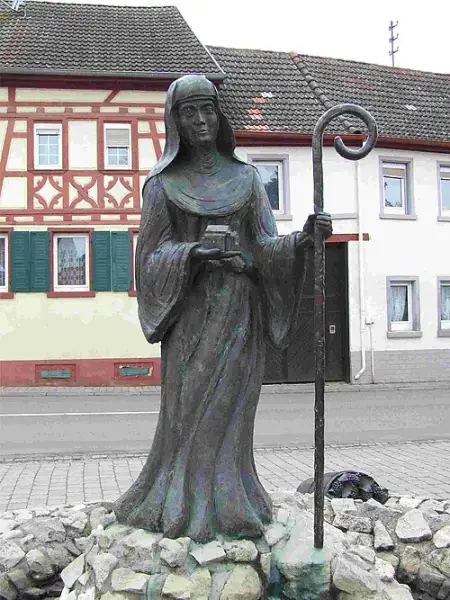
Leoba's influence outlasted the convents she governed. Her first letter to Boniface preserves the earliest poetry known to have flowed from an English woman's pen, a fact that has secured her a permanent place in literary as well as ecclesiastical history. As the woman entrusted with authority over all the nuns of Boniface's mission, she stands among the founders of female religious life in Germany, and the houses at Kitzingen and Ochsenfurt descended from her leadership. Her admission to the monasteries of Fulda to advise on monastic rule remains a singular mark of respect from a rigorously male institution. Popular devotion kept her memory in homely forms as well: a beer and mushroom soup bears her name, an unusual culinary tribute among the saints. Artists depict her with the Rule of Saint Benedict, a crozier, and a model of a church, emblems of the legislator, the shepherdess, and the builder that she was. For later Benedictine women she became a patron and pattern, proof that the mission field of the eighth century was opened by prayerful, learned women as surely as by preaching men, and that holiness and intellect strengthened rather than hindered one another.
§ Veneration
Timeline
- 710
Born Leofgyth in Wessex, the only child of the elderly Dynne and Aebbe.
§ Early life
- 746
Set out from Wimborne Minster with companions to assist her kinsman Boniface among the German peoples.
§ Leoba Anglo-Saxon Benedictine nun and saint
- 748
Journeyed to Germany together with Thecla and other nuns dispatched at Boniface's request.
§ Early life
- 754
Received Boniface's monastic cowl before his Frisian journey, designating her as his delegate.
§ Life as a missionary
- 28 Sep 782
Died at Schornsheim near Mainz and was laid to rest close to Boniface's tomb.
§ Later years
The Record
- Major works
- Foundation of Benedictine convents at Kitzingen and Ochsenfurt·First poetry known to have been written by an English woman, in her first letter to Boniface
- Patron of
- Tauberbischofsheim·Benedictines of St. Lioba
- Symbols
- Rule of Saint Benedict·crozier·model of a church
- Canonization
- Pre-congregation; acclaimed as a saint after miracles reported at her tomb
Prayer
Bibliography
Show 12 sources
- Cavell, Megan; Watt, Diane (15 August 2009). "Literary Women in the Middle Ages: An Interview with Diane Watt". The Public Medievalist.
- "Saint Lioba, Abbess. September 28. Rev. Alban Butler. 1866. Volume IX: September. The Lives of the Saints". www.bartleby.com.
- Wybourne, Catherine (1996). "Leoba: A Study in Humanity and Holiness". In Schmitt, Miriam; Kulzer, Linda (eds.). Medieval Women Monastics. Liturgical Press. pp. 81-98. ISBN 9780814622926.
- "Leoba, abbess of Tauberbischofsheim", Epistolae: Medieval Women's Latin Letters, Columbia Center for New Media Teaching and Learning, Columbia University.
- Brownlow, Canon. "The Brother and Sister and Saint Willibald", Report and Transactions - The Devonshire Association for the Advancement of Science, Literature and Art, Vol. 23, 1891, p. 228.
- Ellsberg, Robert. Blessed Among Us: Day by Day with Saintly Witnesses, Liturgical Press, 2016, p. 559. ISBN 9780814647455.
- Noble, Thomas F.X. Soldiers of Christ: Saints and Saints' Lives from Late Antiquity and the Early Middle Ages. Penn State University Press, 1995.
- Farmer, David (2011). "Lioba". The Oxford Dictionary of Saints (5th revised ed.). Oxford University Press. ISBN 978-0-19-959660-7.
- Harrington, Joel F. (2001). A Cloud of Witnesses: Readings in the History of Western Christianity. Houghton Mifflin. p. 122.
- Monks of Ramsgate. "Lioba". Book of Saints, 1921. CatholicSaints.Info. 8 November 2014.
- Yorke, Barbara (2004). "Leoba [St Leoba, Lioba, Leofgyth] (d. 782), abbess of Tauberbischofsheim". Oxford Dictionary of National Biography. Oxford University Press. doi:10.1093/ref:odnb/39268.
- Rudolf of Fulda: Life of Leoba, Medieval Sourcebook.
Profile text adapted from the Wikipedia article, licensed CC BY-SA 4.0.
Pray with this saint every day
Save St. Leoba to your favorites, read the full profile, and get feast-day reminders in the Saints app.
Get the Saints AppFree on the App Store for iPhone and iPad