
died 14 March 557·Feast March 14
St. Leobinus
Hermit, abbot, and Bishop of Chartres
Overview
Leobinus, known in French as Lubin, rose from a peasant family to become one of the bishops of the Frankish church in the sixth century. His early path followed the monastic instincts of his age: he first embraced the solitary life of a hermit, then joined the community at Micy Abbey, where he was formed in monastic discipline and eventually ordained a priest. His abilities brought him election as abbot of Brou, and in 544 his career culminated in elevation to the see of Chartres, where he succeeded Bishop Etherius with the consent of King Childebert I. As bishop he shepherded one of the principal churches of the Frankish kingdom until his death on 14 March 557. In Christian iconography he appears lying on the bed where he died, taking the final sacrament at the hands of Caletric, the bishop who followed him. His feast is kept on 14 March, though an older observance fell on 15 September, and he is venerated in both the Roman Catholic and Orthodox churches. The surviving record of his life is brief, but it preserves the outline of a humble man whose holiness carried him from solitude to the government of a great diocese.
The Complete Life
From the Fields to the Cloister
The sources sketch Leobinus's origins in a single phrase: he came from a peasant family. Whatever the circumstances of his childhood, his heart turned early toward the stricter forms of Christian life. He first sought God as a hermit, embracing the solitude that sixth-century Gaul honored as a school of holiness, and from solitude he passed into community, becoming a monk of Micy Abbey, the celebrated monastery near Orleans that formed so many of the churchmen of the era. There his vocation matured to the point of ordination as a priest. His reputation for wisdom and discipline did not remain hidden within the cloister: he was elected abbot of Brou, charged with governing a community of his own. The progression is telling, for it traces the classic itinerary of the Merovingian church, in which the hermit, the monk, the priest, and the abbot were successive deepenings of a single consecration. By the time the church of Chartres needed a new chief shepherd, Leobinus had been tested in every state of religious life, and the qualities each state cultivates, recollection, obedience, pastoral charity, and governance, were already his.
§ Leobinus French saint, hermit, abbot and bishop
Bishop of Chartres
In 544 Leobinus was raised to the episcopal throne of Chartres, succeeding Bishop Etherius. His appointment carried the consent of King Childebert I, the Frankish ruler whose approval mattered in the selection of bishops within his dominions, and it placed a former peasant and monk at the head of one of the ancient churches of Gaul. The surviving record tells us little of his administration, but the office itself was demanding: a sixth-century Bishop of Chartres shepherded a wide diocese, reconciled a Christian population still absorbing the legacy of a pagan past, and stood between his flock and the power of the crown. He led the see for more than a decade, until his death on 14 March 557, the date his feast still commemorates. Christian art keeps a moving image of that passing: the saint pictured on the bed of death, given the church's final sacrament by the very man who would take up his labors, his successor Caletric. It is a fitting final portrait of a bishop whose whole life had been a preparation, from hermit's cell to abbey to cathedral, for the moment when he would render his account in peace.
§ Leobinus French saint, hermit, abbot and bishop
A Saint Remembered in Two Calendars
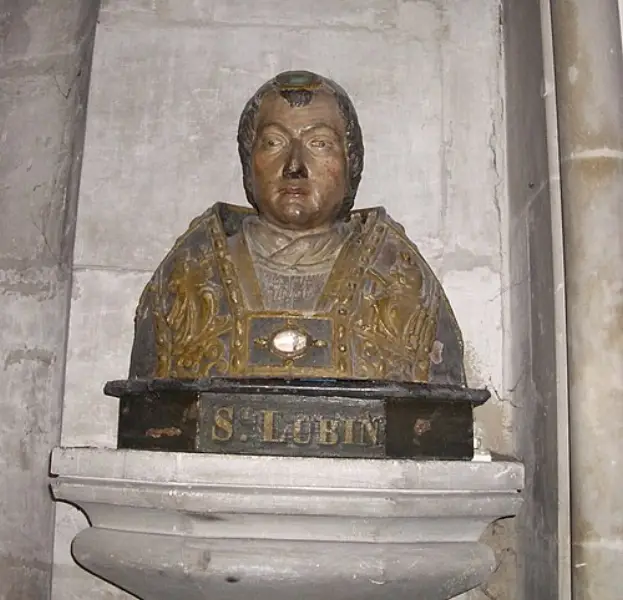
Veneration of Leobinus took root early in the region he had served, and it has endured across the divisions of Christian history: he is honored today both in the Roman Catholic Church and in the Orthodox Church. The Roman Martyrology and related calendars keep his feast on 14 March, the anniversary of his death in 557, while an older tradition had observed his memory on 15 September, a displaced date that testifies to the antiquity and the local variations of his cult. His memory is also bound to the art and architecture of the churches that grew up around his grave and his story: a sculpted bust of the saint is preserved in the church of Notre Dame de Louviers, in the lands of his former diocese, where the faithful could look upon the face their bishops handed down. The historical record of his episcopate is thin, a stub rather than a chronicle, yet the essentials survive with clarity: a poor boy who became a hermit, a monk of Micy, a priest, an abbot of Brou, and for thirteen years the bishop of Chartres, dying as he had lived, in the hands of the church.
§ Leobinus French saint, hermit, abbot and bishop
Timeline
- 544
Became Bishop of Chartres, succeeding Etherius with the consent of King Childebert I.
§ Leobinus French saint, hermit, abbot and bishop
- 14 Mar 557
Died after leading the diocese of Chartres for over a decade.
§ Leobinus French saint, hermit, abbot and bishop
The Record
- Symbols
- Depicted on his death-bed receiving the last rites from his successor, Saint Caletric
- Canonization
- Pre-congregation; venerated from antiquity in the Roman Catholic and Orthodox churches
Prayer
Bibliography
Show 4 sources
- Watkins, Basil (2015). The Book of Saints: A Comprehensive Biographical Dictionary. Bloomsbury Publishing. ISBN 978-0-567-66415-0.
- "Latin Saints of the Orthodox Patriarchate of Rome".
- "Saints of March 14: Leobinus".
- "Saint Lubin" (in French).
Profile text adapted from the Wikipedia article, licensed CC BY-SA 4.0.
Pray with this saint every day
Save St. Leobinus to your favorites, read the full profile, and get feast-day reminders in the Saints app.
Get the Saints AppFree on the App Store for iPhone and iPad