
died c. 304·Feast December 9
St. Leocadia
Virgin martyr of Toledo under Diocletian
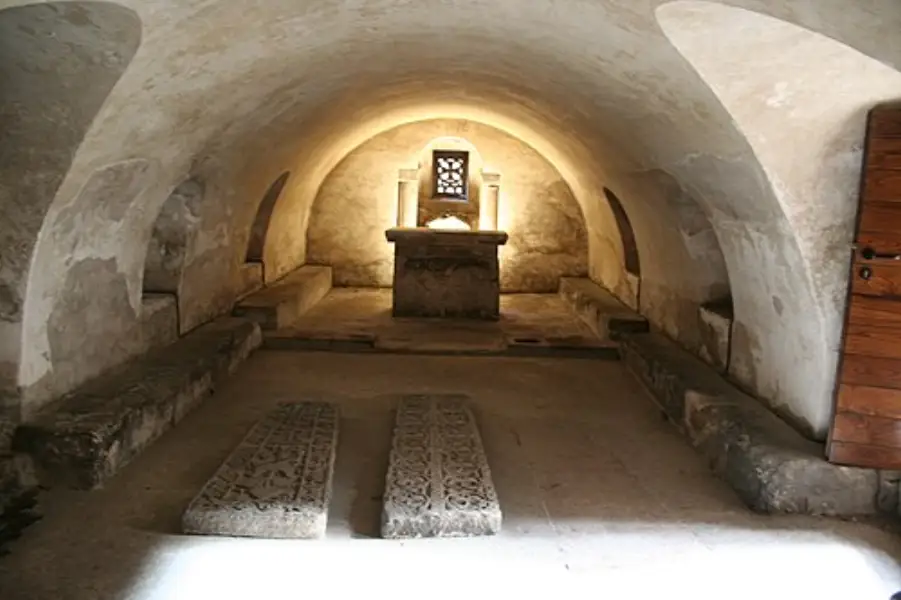
Overview
Leocadia is a Spanish virgin martyr whose cult is among the most ancient on the Iberian peninsula. The later acts of her passion tell how the story of Eulalia's triumph awakened in her the longing for a like witness; and when the governor Decianus, whom the martyrology brands as Spain's most savage persecutor of believers, ordered her arrest, she endured savage torture meant to break her confession of Christ. She stood firm, was returned to prison, and there died of the injuries inflicted upon her, on December 9 around the year 304, in the persecution of Diocletian. Her body was buried in a cemetery near the Tagus, and devotion gathered quickly at her grave. By the ninth century her feast appeared in the historical martyrologies under December 9, and in the seventh century the church bearing her name at Toledo served as the meeting place of three provincial synods. Her relics, moved to Oviedo during ninth-century persecutions and later carried into Flanders, were restored to Toledo in a solemn ceremony presided over by Philip II in April 1587. She is honored in the Roman Catholic and Eastern Orthodox churches.
The Complete Life
A Calling Kindled by Another's Witness
The later acts of Leocadia's passion open not with her own story but with someone else's: Eulalia's martyrdom, recounted to the young woman of Toledo, planted in her the longing to suffer as that saint had suffered. In the age of Diocletian, when the church of Spain was undergoing its fiercest trial, the courage of one confessing Christian became the seed of another's resolve, and the young woman of Toledo determined that she too would not shrink if called. This spiritual kinship between the martyrs of Spain, one inspiring the next in an unbroken chain of witness, helps explain why her memory took root so deeply in the peninsula. The tradition preserved at Toledo made the church itself her monument: a place of Christian worship dedicated to her stood there from very early times, and though the great hymn writer Prudentius, cataloguing the martyrs of Spain, never mentions her name, the silence of the poet matters less than the stones of the city. What the acts suggest is a young woman formed by the stories of the saints into readiness, a heart prepared so thoroughly that when the persecutor came, desire and duty were already one.
§ Leocadia 1st/2nd-century Spanish saint and martyr
Torture and Prison under Decianus
The instrument of her trial was the governor Decianus, whom the martyrology brands the most furious persecutor of the Christians in Spain. By his order Leocadia was seized and subjected to cruel torture, the explicit purpose being to force her to apostatize, to deny Christ and so break the witness she had made her own. She did not yield. Her steadfastness under torment frustrated the design of her judges, and rather than grant them the renunciation they sought, she was sent back to prison to await a fate her torturers had not succeeded in deciding. There, from the effects of the injuries inflicted upon her, she died. The tradition assigns her death to December 9, around the year 304, within the Diocletianic persecution that ravaged the Spanish church. In art she is represented with a tower, the enduring symbol of the confinement in which her witness was completed. The Christian community of Toledo recovered her body and buried it in the local cemetery near the Tagus, and there, at a grave that had cost the empire nothing to dig and the church everything to honor, the devotion of centuries began.
§ Leocadia 1st/2nd-century Spanish saint and martyr
The Ancient Glory of Toledo
Recognition of Leocadia's martyrdom required no formal process; it was written in the worship of the city that treasured her. For the Catholic Encyclopedia the very existence of her Toledo church proves that public veneration of the martyr long antedated the synods convened there, and that the basilica stood, plainly, upon the place of her burial. During the seventh century's early decades, her church at Toledo served the Spanish church at its highest moments of counsel: the Fourth Synod of Toledo convened beneath her roof in 633, the Fifth assembled there in 636, and the Sixth likewise in 638, so that the great doctrinal assemblies of Visigothic Catholicism convened beneath the name of a young woman who had died eight centuries before. Her feast, listed under the ninth day of December, shows up in the martyrologies of the 800s, settling the date of her yearly commemoration within Toledo's tradition. Besides the basilica at her grave, two other churches in the city came to bear her dedication. A martyr whose memory could gather councils, fill martyrologies, and dot a city with churches needed no other canonization than the gratitude of the faithful.
§ Leocadia 1st/2nd-century Spanish saint and martyr
The Long Journey of the Relics
Few saints' remains have traveled so far. Devotion flourished at her grave beside the Tagus, where a basilica thought to date from the fourth century was enlarged in 618 by King Sisebut, and the seventh century saw her cult flourish. During the persecutions of Abd ar-Rahman II in the ninth century her relics were moved for safety to Oviedo, where Alfonso the Chaste erected a basilica in her honor. In the 1000s a Count of Hainault, come to Spain as a Compostela pilgrim and soldiering with Alfonso VI in the Reconquista's campaigns, was paid for his service with her relics and Sulpicius's, which accordingly departed Spain for Saint-Ghislain, a Benedictine abbey in what is now Belgium. There Philip the Handsome and Joanna of Castile venerated them, recovering for Toledo a tibia of the saint. War later scattered the abbey's treasures; the Duke of Alba tried in vain to rescue the rest. In 1583 the Jesuit Miguel Hernandez rediscovered the relics, carried them to Rome by 1586, and by sea and land they returned at last to Toledo, where Philip II presided over the final translation in April 1587. A town in northern Portugal still bears her name.
§ Leocadia's Relics
Timeline
- 9 Dec 304
Suffered martyrdom at Toledo, dying in prison from the effects of torture under the governor Decianus.
§ Leocadia 1st/2nd-century Spanish saint and martyr
- 618
The basilica raised over her grave was enlarged and improved under the Visigothic king Sisebut.
§ Leocadia's Relics
- 633
The Fourth Synod of Toledo met in the church of Saint Leocadia.
§ Leocadia 1st/2nd-century Spanish saint and martyr
- 636
The Fifth Synod of Toledo assembled in the same church dedicated to her.
§ Leocadia 1st/2nd-century Spanish saint and martyr
- 638
The Sixth Synod of Toledo likewise gathered in her church.
§ Leocadia 1st/2nd-century Spanish saint and martyr
- 1583
Miguel Hernandez, a Jesuit from Toledo Province, discovered her relics after their loss in the wars of the previous century.
§ Leocadia's Relics
- 1586
Following long travels, Hernandez brought the recovered relics to Rome.
§ Leocadia's Relics
- Apr 1587
Philip II of Spain presided over the solemn ceremony marking the final return of her relics to Toledo.
§ Leocadia's Relics
In Their Own Words
There is no doubt of the historical fact of her martyrdom, whilst the date of 9 December for her annual commemoration obviously rests on the tradition of the Church of Toledo.
There still existed, and we touched it, a sign of the cross impressed in the stone because the martyr constantly touched the walls with her fingers that sign of our redemption.
The Record
- Patron of
- Archdiocese of Toledo
- Symbols
- A tower, signifying that she died in prison
- Canonization
- Pre-congregation; publicly honored as a martyr at Toledo from the earliest Christian centuries
Prayer
Bibliography
Show 5 sources
- Kirsch, Johann Peter. "St. Leocadia." The Catholic Encyclopedia. Vol. 9. New York: Robert Appleton Company, 1910.
- "Russian Church officially adds saints of Spain, Portugal to liturgical calendar". orthochristian.com.
- "La diocesis de Toledo celebra el Ano Jubilar de santa Leocadia". Archived from the original on 2007-09-27.
- "Leocadia at the Catholic Encyclopedia".
- "Patron saints: Leocadia". CatholicSaints.
Profile text adapted from the Wikipedia article, licensed CC BY-SA 4.0.
Pray with this saint every day
Save St. Leocadia to your favorites, read the full profile, and get feast-day reminders in the Saints app.
Get the Saints AppFree on the App Store for iPhone and iPad