
died 15 March 859·Feast Not recorded in the source article
St. Leocritia
Young martyr of Cordoba, convert from Islam
Overview
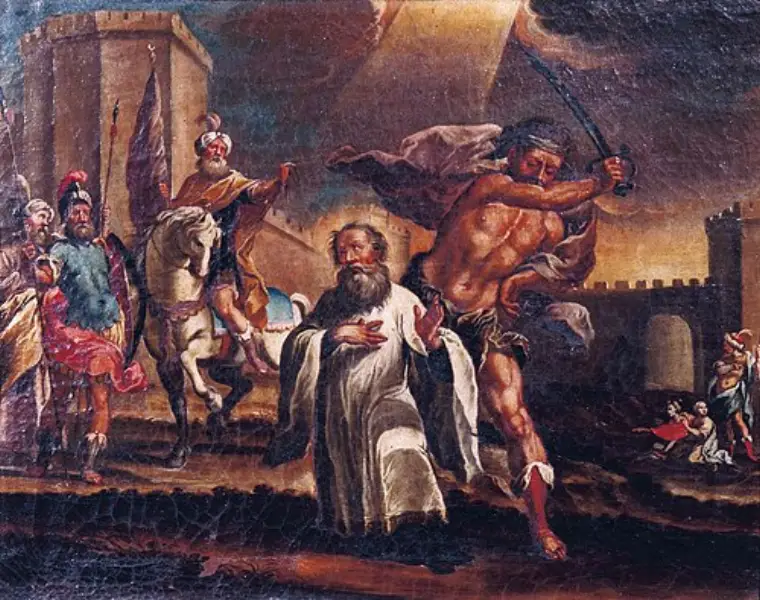
Leocritia, also known as Lucretia, was a young woman of Cordoba who died for her faith on 15 March 859, one of the forty-eight Christians executed in that city between 850 and 859 under the Muslim administration of al-Andalus. Born to Muslim parents, she was drawn to Christianity by a relative and received baptism in secret, for under the law of the emirate a child of a Muslim father was counted a Muslim from birth, and abandonment of Islam was a capital offense. When her faith could no longer be concealed, she turned for help to Eulogius, the learned priest who chronicled and encouraged the Cordoban martyrs. On his counsel, and with his active assistance, she fled her family's home and went into hiding. The fugitives were found; both were arrested, and both were brought to execution, Eulogius condemned for harboring and encouraging apostasy, Leocritia for apostasy itself. She died four days after her mentor, in the closing episode of the great wave of Cordoban martyrdom. The circumstances of her death, concealed conversion, flight, betrayal, and steadfastness before the court, made her one of the emblematic figures of that troubled and heroic decade.
The Complete Life
A Secret Christian in the Emir's City
Leocritia grew up in Cordoba at the height of the Umayyad emirate, in a household of Muslim parents, within a society where the law she lived under held that anyone whose father was Muslim was Muslim from birth and guilty of apostasy should he proclaim any other faith. Into this ordered world came a quiet disruption: a relative, himself or herself a Christian, told the girl of the gospel and brought her to conversion. Her baptism, and indeed her Christianity, had to remain hidden, for apostasy from Islam was punished by death, and the courts of Abd ar-Rahman II and his son Muhammad I enforced that penalty. She was by all accounts young, described in the sources simply as a young girl of Cordoba, and she belonged to that considerable class of Andalusian Christians whose faith was legally invisible, Iberians of mixed religious households, Morisco-like families in reverse, whose inner convictions could not be written into the public registers. How long she concealed her belief the record does not say, but the secret could not be kept forever, and when it broke, the consequence was flight.
§ Historical background
Flight with Eulogius
When her situation became untenable, Leocritia sought out Eulogius, the foremost priest of the Cordoban church, a Latinist and scholar who had made himself the historian and advocate of the martyrs. He had composed the Memoriale sanctorum and other works defending the public profession of the faith, and he regarded the Christians of al-Andalus as shepherds of a flock endangered by assimilation. Following his counsel and relying on his practical help, the young woman slipped away from her family's house and concealed herself, an act that made her patron a criminal in the law's eyes, for he knew he was sheltering one who had left Islam. The choice made by both was deliberate and mutual: the priest staked his life on the girl's liberty of conscience, and the girl staked hers on the faith she would not surrender. Whatever fears attended the fugitive in her concealment, she did not return to her family or recant to save herself. In an age when the Christian leadership of the city, including Bishop Reccafred, urged compromise with the authorities, the course taken by Eulogius and Leocritia was the road of open, costly defiance, chosen in league with one another.
§ Historical background
Discovery, Trial, and Execution
The hiding place did not hold. Once found, both Leocritia and Eulogius were arrested, and the law they had defied moved with procedure familiar from dozens of earlier cases in the same city: the charge against the priest was proselytism, aiding and abetting apostasy by concealing and protecting a convert; the charge against the young woman was apostasy, the crime of having been born a Muslim and professed Christ. Eulogius, whose final years had passed in repeated imprisonments and in urging others toward voluntary witness, went to execution on 11 March 859; the tradition ranks him among the final pair of the forty-eight to give their lives. Four days later, on 15 March 859, Leocritia followed him to death, condemned for apostasy. She was beheaded like most of her companions in witness, for the Christians of that persecution died chiefly by the sword. Her family, it may be noted, had lost her long before the executioner's work: the girl who chose hiding, trial, and death over recantation had already gone over entirely, irrevocably, to the church she would not deny. With her execution the great wave of Cordoban martyrdom effectively closed.
§ List of martyrs
Remembered Among the Forty-Eight
Leocritia is remembered as one of the Martyrs of Cordoba, the company of forty-eight Christians executed between 850 and 859 whose passio was recorded largely through the labors of Eulogius himself, whose written memorial of the saints was composed for their benefit and preserved, in a single surviving manuscript, in the Christian kingdom of Asturias. Historians still debate the movement she belonged to: Jessica Coope has suggested that, though no single motive can be ascribed to all forty-eight, their deaths reflect a protest against assimilation and a determination to assert Christian identity in a society that rendered it legally impossible. Within that company Leocritia holds a distinctive place, for she was among the last to die, a convert whose case joined the two capital categories of the era, apostasy in herself and proselytism in her protector. The church of the East as well as the West receives her among the saints, and her feast is kept in company with her mentor Eulogius and the other confessors of Cordoba, whose relics and memory were gathered by the Christian communities of al-Andalus even as their city flourished in a faith not their own.
§ Causes
Timeline
- 11 Mar 859
Eulogius, who had hidden and protected her, was executed for aiding apostasy after years of imprisonments.
§ List of martyrs
- 15 Mar 859
Leocritia was executed for apostasy, four days after her mentor Eulogius.
§ List of martyrs
In Their Own Words
Martyrdom was in fact a perfect solution... Not only did it epitomize self-abnegation and separation from the world, but it guaranteed that there would be no opportunity to sin again.
The Record
- Canonization
- Pre-congregation; venerated among the forty-eight Martyrs of Cordoba in the Roman Catholic and Eastern Orthodox churches
Prayer
Bibliography
Show 9 sources
- Sahner, Christian C. (2020) [2018]. Christian Martyrs under Islam: Religious Violence and the Making of the Muslim World. Princeton University Press. ISBN 978-0-691-17910-0.
- Fierro, Maribel (January 2008). "Decapitation of Christians and Muslims in the Medieval Iberian Peninsula: Narratives, Images, Contemporary Perceptions". Comparative Literature Studies. 45 (2). Penn State University Press: 137-164. doi:10.2307/complitstudies.45.2.0137.
- Wolf, Kenneth Baxter (1988). Christian Martyrs in Muslim Spain. Cambridge University Press.
- Coope, Jessica A. (1995). The Martyrs of Cordoba: Community and Family Conflict in an Age of Mass Conversion. University of Nebraska. ISBN 0-8032-1471-5.
- Graves, Coburn V. (November 1964). "The Martyrs of Cordoba, 850-859. A Study of the Sources (review)". The Hispanic American Historical Review. 44 (4). Duke University Press: 644. doi:10.1215/00182168-44.4.644.
- Osuna, Manuel Garcia. "Cordova." The Catholic Encyclopedia. Vol. 4. New York: Robert Appleton Company, 1908.
- Haines, Charles Reginald (1889). Christianity and Islam in Spain (756-1031). London: Kegan Paul, Trench & Company.
- Holweck, F. G., A Biographical Dictionary of the Saints. St. Louis, MO: B. Herder Book Co. 1924.
- Walsh, Michael J. (2007). A New Dictionary of Saints: East and West. Liturgical Press. p. 74. ISBN 978-0-8146-3186-7.
Profile text adapted from the Wikipedia article, licensed CC BY-SA 4.0.
Pray with this saint every day
Save St. Leocritia to your favorites, read the full profile, and get feast-day reminders in the Saints app.
Get the Saints AppFree on the App Store for iPhone and iPad