
c. 615 – 679·Feast October 2
St. Leodegar
Martyred Bishop of Autun and reformer
Overview
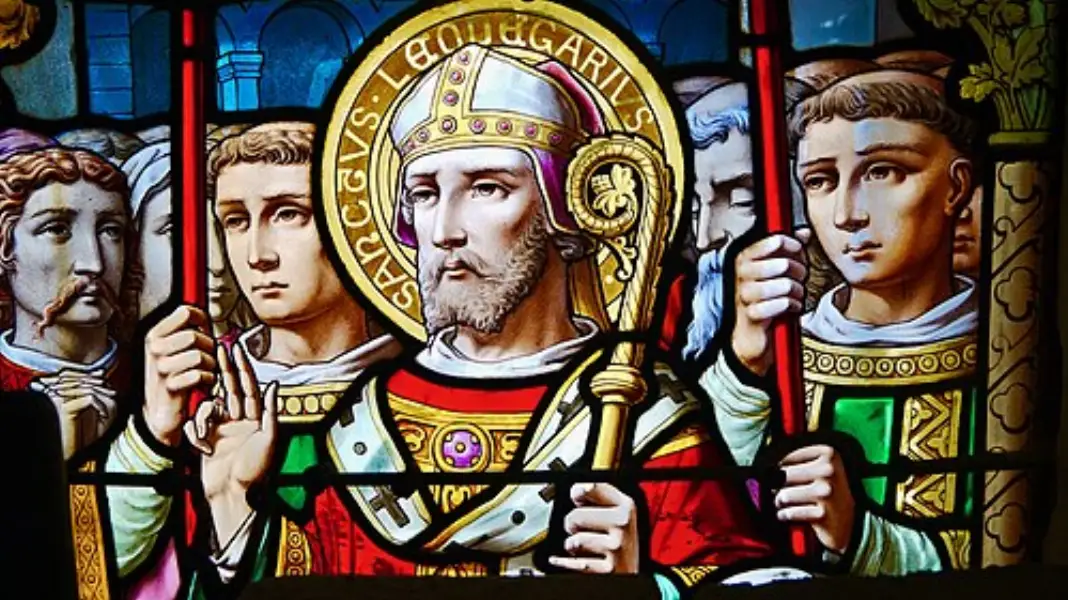
Leodegar, known in French as Leger and in Latin as Leodegarius, was a Burgundian bishop whose resistance to the Frankish mayor of the palace Ebroin cost him his sight, his tongue, and finally his life. Born around 615, the son of the nobleman Bodilon and Saint Sigrada and brother of Saint Warinus, he was raised at the palace school of Paris and trained in Poitiers under his uncle, Bishop Desiderius, who made him an archdeacon at twenty. After becoming a priest he took the monastic habit at St Maxentius in Poitou in 650 and was soon elected abbot, introducing the Benedictine rule. Summoned around 656 to the court of Queen Bathilde, he was installed as Bishop of Autun in 659 and held a reforming council there in 661. His leadership among the Franco-Burgundian nobles drew him into the fatal struggle with Ebroin. Tortured, mutilated, exiled, and finally beheaded near Sarcing on October 2, 679, he died a martyr. His relics were translated in 782 to the abbey of St Maxentius and later to Ebreuil, renamed Saint-Leger in his honor; some remain at Autun and Soissons.
The Complete Life
Born to Nobility, Raised for the Church
Leodegar came into the world around 615 as the child of two of the most prominent houses of his world: his father, Bodilon, was Count of Poitiers and Paris, a high-ranking Burgundian nobleman, and his mother was St. Sigrada of Alsace, who would end her days as a nun in the convent of Sainte-Marie at Soissons. His brother Warinus would also be numbered among the saints. His parents set him early on an ecclesiastical path. While still a child he grew up at the court of Clotaire II and received his schooling in the palace school, the finishing house of Frankish aristocracy. In later youth Poitiers became his school: its cathedral school was ancient, and there he studied beneath his mother's brother, Desiderius, called Dido, who governed that diocese as bishop. The uncle soon tested the nephew's capacities in office as well as in study: when Leodegar was twenty, Desiderius made him an archdeacon of the diocese. Formation at court, in the schools, and in the administration of a great see gave him, before he was out of his youth, every instrument the Frankish church could offer an ambitious and gifted young man.
§ Early life
Priest, Monk, and Abbot
Shortly after his ordination as a priest, Leodegar made a decision that separated him from the ordinary career of a noble churchman: in 650, with his bishop's permission, he received the monastic habit at the monastery of St Maxentius in Poitou. The community did not leave his gifts buried in the cloister for long. He was soon elected abbot, and he set about reforming the monastery, foremost among his measures the introduction of the Benedictine rule, by which the houses of the West were increasingly ordered in the seventh century. The move from archdeacon to monk to abbot marked the direction of his whole life: he was a reformer before he was a politician, a man who believed that the church's strength lay in the discipline of its own communities. The abbey of St Maxentius would remember him centuries later as its glory, for it was to this house, where he had first professed humility, that his relics were brought after his martyrdom. His reputation for holiness and competent governance traveled with him, and it was precisely this double standing, abbot's discipline joined to aristocratic birth, that drew the attention of the royal court when the queen needed such a man.
§ Early life
Reformer of the See of Autun
Around 656 Bathilde, the widowed queen, called him to the Neustrian court to help run the united kingdoms and oversee the raising of her children, proof of how far his abbey's reputation had carried. His true life's work opened in 659 with his installation as bishop of Autun in Burgundy. There he undertook reform once more, this time of a diocese: he convoked a council at Autun in 661 which denounced Manichaeism, he reformed the secular clergy and the religious communities of the city, and he built three baptisteries. Under him the church of Saint-Nazaire grew larger and more beautiful, the indigent gained a refuge, municipal buildings were mended, and Autun's ancient Roman walls rose again. This was episcopacy as the seventh century understood it at its best, worship, discipline, charity, and civic order woven together. Such vigor made him more than a diocesan bishop: his authority at Autun placed him among the leaders of the Franco-Burgundian nobles, and when the tyranny of Ebroin, mayor of the palace in Neustria, provoked resistance, Leodegar became one of the chiefs of the opposition that would cost him everything.
§ Career
Courage That Would Not Flatter
The sources present Leodegar less as a mystic than as a man of public conscience, and his spirituality was of the kind that shows itself in decisions. He had entered monastic life at the height of his prospects and governed by the Benedictine rule; he treated the reform of the church's moral condition, clergy and monasteries alike, as the first business of his episcopate. When King Childeric II surrounded himself with Austrasian advisors and took as wife his first cousin Bilichild, Leodegar criticized the union as uncanonical, though the king was the most powerful man in his world and the bishop had been his supporter. For his candor he lost the king's favor and was banished to Luxeuil, the same monastery to which his enemy Ebroin had been confined. His private correspondence bears the same character: a letter dispatched to his mother once he had been mutilated still exists, as does a testament drawn up when the Autun council met, along with that council's acts. The written traces of his life are the traces of a conscience, documents of a man who governed, legislated, and suffered by principle rather than by advantage.
§ Career
Mutilation, Exile, and Martyrdom
The struggle with Ebroin consumed the last years of Leodegar's life. Accused before King Clothar III, he outlived the proceedings only because the king died in 673; the political wheel then raised him briefly high, as the nobles called Childeric II to the throne and Ebroin was confined at Luxeuil. The wheel turned again: banished by Childeric, then freed by the murder of that king at Bondi in 675, Ebroin returned to power and to his hatred. Around 675, at Ebroin's stirring, Autun was assaulted by the Duke of Champagne together with the bishops of Chalons-sur-Marne and of Valence, and the city's bishop was taken. Ebroin had him blinded by the boring out of his eyes, their sockets seared, and deprived of his tongue. Years afterward the king, at Ebroin's urging, came to believe that Childeric's assassination had been Leodegar's doing; the bishop was arrested anew, put through a sham trial, stripped of his office, and sent into exile at Fecamp in Normandy. On October 2, 679, at Ebroin's command, he was taken into a woodland near Sarcing and there beheaded. Torture had not silenced what the knife of the executioner finally could not: his cause outlived his enemy by centuries.
§ The martyrdom of St. Leger
The Translation of the Relics
What he endured under torture and at the block made him a martyr, and the church counted him among its saints without any process of the later, formal kind. Devotion centered first on the places of his passion and then on his remains. In 782 his relics were translated from Sarcing in Artois, where he had been beheaded, to the abbey of St Maxentius near Poitiers, the monastery whose rule he had reformed and where his earliest hagiography was written. Afterwards the remains traveled by way of Rennes to Ebreuil, which renamed itself Saint-Leger for him, the very name by which France still knows him best. Some relics are kept to this day in the cathedral of Autun, his own see, and in the Grand Seminaire of Soissons, where his mother had been a nun. His feast, kept on October 2, the anniversary of his martyrdom, was established as a holy day of obligation in 1458 by Jehan Cardinal Rolin, Bishop of Autun. Two early Lives of the saint, drawn from a common lost source, together with two later ones, one in verse, transmitted his story to the modern world.
§ The martyrdom of St. Leger
Saint of Millers, Markets, and Coins
The memory of St. Leger penetrated ordinary life in ways no episcopal reformer could have planned. As the patron of millers, invoked against blindness and every disease and ailment of the eyes, he became the heavenly advocate of those whose sufferings mirrored his own mutilation, and his emblem, a bishop holding a gimlet, or the hook with two prongs, kept the story of his torture visible in the churches of France and beyond. In the financial world of a much later age his feast day fixed the calendar of the market: rich British merchants would sell their holdings as May began, pass the summer beyond London, and come home for St Leger's Day, whence the market saying that bids one sell in May, go away, and return upon his day. Swiss numismatics preserve another trace: in the fifteenth and sixteenth centuries the Canton of Lucerne minted thalers, ducats, and guldens bearing the saint's image, nimbate and mitred on a gothic throne, while a soldier gouges his right eye with a hand drill, an entire passion struck in silver. Few bishops of the seventh century entered so deeply into the coinage, the proverbs, and the devotions of later Europe.
§ Cultural significance
Timeline
- 615
Born at Autun into the noble family of Bodilon, Count of Poitiers and Paris, and St. Sigrada.
§ Early life
- 650
Became a monk at the monastery of St Maxentius in Poitou and was soon elected abbot, introducing the Benedictine rule.
§ Early life
- 656
Summoned by the widowed Queen Bathilde to the Neustrian court to aid in governing the united kingdoms and educating her children.
§ Career
- 659
Installed as Bishop of Autun, where he began extensive reforms among clergy and religious communities.
§ Career
- 661
Held a council at Autun that denounced Manichaeism.
§ Career
- 673
King Clothar III died while Ebroin's accusations against Leodegar were still before him.
§ Career
- 675
Childeric II was murdered at Bondi, and Ebroin escaped from Luxeuil to become mayor of the palace once more.
§ Career
- 675
Attackers stirred up by Ebroin took Autun; Leodegar's eyes were gouged out and his tongue cut out.
§ The martyrdom of St. Leger
- 2 Oct 679
After a mock trial and exile at Fecamp, he was led into a forest near Sarcing and beheaded on Ebroin's order.
§ The martyrdom of St. Leger
- 782
His relics were translated from Sarcing to the abbey of St Maxentius near Poitiers.
§ The martyrdom of St. Leger
- 1458
Jehan, cardinal and Bishop of Autun, decreed that his feast be kept as a holy day of obligation.
§ The martyrdom of St. Leger
The Record
- Major works
- Reform of the monastery of St Maxentius under the Benedictine rule·Council of Autun (661)·Three baptisteries erected at Autun and enlargement of the church of Saint-Nazaire
- Patron of
- Millers·Invoked against blindness, eye disease, and sore eyes
- Symbols
- A man having his eyes bored out with a gimlet·A bishop holding a gimlet·A bishop holding a hook with two prongs
- Canonization
- Pre-congregation; venerated as a martyr from earliest times
Prayer
Bibliography
Show 10 sources
- Butler, Alban. "St. Leodegarius, or Leger, Bishop and Martyr". The Lives of the Saints, Volume X: October. bartleby.com.
- MacErlean, Andrew. "St. Leodegar". The Catholic Encyclopedia Vol. 9. New York: Robert Appleton Company, 1910.
- Ewig, Eugen. "Die frankischen Teilreiche im 7. Jahrhundert (613-714)". Trierer Zeitschrift fur Geschichte und Kunst des Trierer Landes 22 (1953), 85-144.
- Breukelaar, Adriaan (1992). "Leodegar". In Bautz, Traugott (ed.). Biographisch-Bibliographisches Kirchenlexikon (BBKL). Vol. 4. Herzberg: Bautz. cols. 1466-1468. ISBN 3-88309-038-7.
- Weninger, Francis Xavier (1876). Lives of the Saints: July-Dec. P. O'Shea.
- Passio Leudegarii I & II, edited by B. Krusch and W. Levison, in MGH SS rer. Merov. vol. v.
- Herbermann, Charles, ed. (1913). "St. Leodegar". Catholic Encyclopedia. New York: Robert Appleton Company.
- Chisholm, Hugh, ed. (1911). "Ebroin". Encyclopaedia Britannica. Vol. 8 (11th ed.). Cambridge University Press. p. 844.
- Friedrich, J. Zur Geschichte des Hausmeiers Ebroin, in the Proceedings of the Academy of Munich (1887, pp. 42-61).
- Pitra, J. B. Histoire de Saint Leger. Paris, 1846.
Profile text adapted from the Wikipedia article, licensed CC BY-SA 4.0.
Pray with this saint every day
Save St. Leodegar to your favorites, read the full profile, and get feast-day reminders in the Saints app.
Get the Saints AppFree on the App Store for iPhone and iPad