
c. 815 – c. 915·Feast March 1
St. Leoluca
Wonderworker and father of Italo-Greek monasticism
Overview
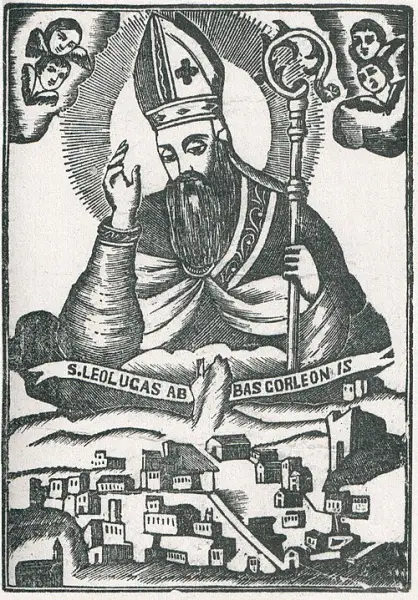
Leoluca, remembered also as Leone Luca or Leo Luke of Corleone, first saw light around 815 at Corleone in Sicily, shortly before the Saracens descended upon the island, and closed a century of life in Monteleone Calabro, today's Vibo Valentia in Calabria, having spent some eighty years under the monastic habit. Orphaned young and raised as the shepherd of his family's estate, he heard God's call in the solitude of the fields, sold everything, gave the proceeds to the poor, and entered the monastery of Saint Philip at Agira. Driven from Sicily by Saracen raids, after a pilgrimage to the tombs of Peter and Paul in Rome he crossed to Calabria, where he became a monk of the monastery of Mount Mula. With his abbot Christopher he helped found monasteries in the Merkourion and at Vena, communities that made him one of the founders of Italo-Greek monasticism in southern Italy. As abbot of Mount Mula he was renowned as a wonderworker who healed the sick and prayed without ceasing. Venerated in both the Catholic and Orthodox churches, he is patron of Corleone and of Vibo Valentia, where his feast is kept on March 1, and his relics were identified at San Gregorio d'Ippona in 2006.
The Complete Life
The Shepherd of Corleone
Leoluca was born in Corleone, a town in the Sicilian interior, around the year 815 to 818, on the eve of the Saracen invasion that would transform the island of his birth. His parents, Leo and Theoktiste, were pious and wealthy, and they baptized their son Leo in honor of his father, raising him in the discipline and instruction of the Lord. Left fatherless and motherless while still a child, he took charge of the household's lands and watched over its flocks as a shepherd. The hagiography dwells lovingly on this formation: the future abbot of a hundred monks learned patience, vigilance, and solitude among the flocks of Corleone, amid the quiet of the open country where, the Life relates, the awareness first came to him that God was summoning him to the religious state. The pattern is one of the oldest in Christian hagiography, the shepherd in the field becoming the shepherd of souls, and it anchored the saint permanently in the memory of his native town, which would one day build him a church, gather a brotherhood in his name, and acclaim him its patron after he had saved it from the plague.
§ In Sicily
Poverty, Agira, and the Tombs of the Apostles
The call perceived among the hills of Corleone was answered without reserve. Leoluca sold the estate he had inherited, distributed the money to the poor, and set out for the monastery of Saint Philip at Agira, in the province of Enna in Sicily, to take up the monastic life. How long he remained there the sources do not say, but the advancing Saracen raids that were swallowing the island made the house unsafe, and he left, one of the many monks who fled Sicily for the relative calm of the southern Italian mainland in that age. Before abandoning the island he made a detour that reveals his spirit: he went on pilgrimage to Rome to pray at the tombs of Saint Peter and Saint Paul, the apostles whose faith had carried the gospel to his ancestors. Only then did he cross to Calabria. The sequence, dispossession, monastic formation, pilgrimage, exile, reads as a deliberate divestment of every earthly attachment, and it equipped him for the wandering foundation work that would fill the rest of his hundred years: he was never again to hold property, and he never again saw the island where he had been born and baptized.
§ In Sicily
Founding Monasteries in the New Thebaid
Having reached Calabria he joined the monastery at Mount Mula, among the loftiest summits of the Orsomarso range, and for six years he shone in obedience and every virtue. Afterward he and Christopher, the monastery's hegumen, traveled into the uplands of the Merkourion, that monastic heartland of the southern Apennines near the Pollino, a district so crowded with holy communities that the vitae style it a second Thebaid, echoing the desert where Egypt's first monks withdrew. There, probably at Mormanno, they founded a new monastery and lived in asceticism for seven years. Once again they pressed onward, this time to Vena, today's Avena, giving a further decade to the ascetic contest; the house they raised there numbered above a hundred religious when Christopher died. Leoluca himself lived as a solitary nearby at Mormanno. After Christopher died, he was recalled to serve as abbot of the monastery of Mount Mula. Three houses, six years, seven, and ten, the arithmetic of his mission is the arithmetic of Italo-Greek monasticism itself, of which he is remembered as a founder, planting Byzantine monastic life in the mountains of the Italian south.
§ In Calabria
The Wonderworker of Mount Mula
Tradition credits Leoluca with the gift of wonderworking, and the crowds that flocked to him for blessing and healing gave his last decades their public character. The Life relates that he healed the sick, cast out demons, raised paralytics, and guided the lost toward the path of salvation, wonders attributed not to his own power but to ceaseless prayer. His asceticism was of the severe Italo-Greek kind: he remained standing in the cold for as long as twenty days to intensify his struggle, and he prayed without ceasing. Toward the end of his life he was said to pass his days in meditation, fasting, and ecstatic raptures, the charismatic signs that eastern hagiography reserves for its deepest contemplatives. Yet the same tradition insists that his authority within the monasteries rested on obedience and virtue rather than on marvels: he had excelled in obedience as a young monk at Mount Mula, served under Christopher for years, and chose the solitary life even while governing. The healing saint and the hidden ascetic were one man, and the monks who buried him remembered chiefly the discipline of his prayer, which they regarded as the true source of everything done through him.
§ In Calabria
A Foretold and Peaceful End
Leoluca closed a hundred years of life the way he had ordered everything else, deliberately and in peace. When age weighed on him he gathered the brethren around him and announced the approach of his death, entrusting the hegumen's office to Brother Theodore and naming Father Euthymios to stand at his side, so that the houses he had planted would not founder at his going. After Communion had been given him, Luke the Venerable went to his rest in tranquility, dying about 915 at Monteleone Calabro, the city now known as Vibo Valentia, his habit's years behind him approaching eighty. He was buried in the church of the Blessed Theotokos, the Mother of God, a detail that later generations would treasure as a clue to the whereabouts of his remains. His death was reported slowly back to Corleone, the town of his birth, which by the thirteenth century had a church dedicated to him. The two communities that claimed him, the Sicilian town that bore him and the Calabrian city that buried him, would each in time declare him their patron, bound together across the strait by one long life that began in one and ended in the other.
§ Departure
The Life Preserved and Printed
No formal process declared Leoluca a saint; the churches of East and West received him as one, and his title in the East remains that of Venerable, the honor of the monk. What preserved his memory in detail was a hagiographical tradition with a history of its own. Gaetani, a Jesuit hagiographer, brought out the saint's Life in 1657 within his martyrology of Sicily, working from three manuscripts unearthed on the island and coming respectively from Palermo, Mazara, and Corleone. The Bollandists later printed another Latin Life, found in the library of Joseph Acosta. None of the Latin manuscripts points to a Greek original, yet the Greek names of the saint's family and circle, Leone, Teotiste, Christopher, Teodoro, Eutimio, suggest that a Greek source lies behind them, and scholars judge that the Life was probably composed in Calabria soon after his death, though it may have circulated orally and in writing at later times and elsewhere. The cult at Corleone acquired institutional form when a Brotherhood of San Leoluca appears in the records of 1420, two centuries after the first evidence of a church in his name there.
§ Hagiographic sources
Patron of Two Cities
Leoluca's intercession became part of the civic history of southern Italy. When the plague of 1575 struck, Corleone credited its survival to him and formally acclaimed him its patron; in 1624 Vibo Valentia followed, honoring the saint who had died within its walls a century after his birth. On May 27, 1860, the apparition of Saint Leo Luke together with Saint Anthony was credited with turning back a Bourbon invasion of Corleone, in the very season of Garibaldi's expedition. In Vibo Valentia his feast on March 1 is kept with a ceremony all his own: the town's firefighters honor him each year by scaling the front of the cathedral of Santa Maria Maggiore e San Leoluca on a turntable ladder to set a floral crown beneath the image of their patron mounted high on the building. The most modern chapter of his cult opened on December 10, 2006, when the daily La Sicilia reported that his relics had been found in the grotto of the Church of Santa Ruba at San Gregorio d'Ippona, southeast of Vibo Valentia, their identity confirmed by paleontological analysis, and, as devotees noted, in a church dedicated to Our Lady, consistent with his burial in a church of the Theotokos.
§ Veneration
Timeline
- 815
Born in Corleone, Sicily, to the pious couple Leo and Theoktiste, shortly before the Saracen invasion of the island.
§ In Sicily
- 915
Died at Monteleone Calabro, now Vibo Valentia, after about eighty years of monastic life.
§ Departure
- 1420
Written references record a Brotherhood of San Leoluca in his birthplace of Corleone.
§ Veneration
- 1575
His intercession was credited with saving Corleone during the plague of that year, and he was made the town's patron saint.
§ Veneration
- 1624
He was named patron saint of Vibo Valentia in Calabria.
§ Veneration
- 27 May 1860
The town's deliverance from a Bourbon assault on 27 May 1860 was attributed to an apparition of the saint together with Anthony.
§ Veneration
- 1657
The Life of Leo Luke of Corleone appeared in print in the Sicilian martyrology of the Jesuit Ottavio Gaetani.
§ Hagiographic sources
- 10 Dec 2006
The newspaper La Sicilia reported that his relics had been found in the grotto of the Church of Santa Ruba at San Gregorio d'Ippona.
§ Relics
The Record
- Major works
- Founding of a monastery at Mormanno in the Merkourion·Founding of the monastery at Vena, modern Avena, which grew to more than one hundred monks·Government of the monastery of Mount Mula as abbot
- Patron of
- Corleone, Sicily·Vibo Valentia, Calabria
- Canonization
- Venerable; venerated as a saint in the Roman Catholic and Eastern Orthodox churches from remote antiquity
Prayer
Bibliography
Show 10 sources
- Gaetani, Ottavio. Vitae Sanctorum Siculorum ex antiquis Graecis Latinisque monumentis. Tomus Secundus. 1657. pp. 80-84.
- "TESTIMONIUM CORILIONENSIUM DE CULTU ET ACTIS ANTIQUIS. (S. Leo Lucas Corilionensis, Abbas Mulensis in Calabria)". In: Acta Sanctorum, Martii Tomus Primus. Parisiis et Romae apud Victorem Palme, 1865. pp. 98-102.
- Morris, Rosemary. Monks and Laymen in Byzantium, 843-1118. Cambridge University Press, 2003. p. 173.
- Sinkewicz, Robert E. "Italo-Greek". In: Encyclopedia of the Middle Ages, Volume 2 (K-Z). Routledge, 2000. p. 974.
- Lake, Kirsopp. "The Greek Monasteries in South Italy I." Journal of Theological Studies (1903) os-IV(15): 345-368. doi:10.1093/jts/os-IV.15.345.
- White, Lynn Jr. "The Byzantinization of Sicily." The American Historical Review. Vol. 42, No. 1 (Oct., 1936). p. 5.
- Epstein, Ann Wharton. "The Problem of Provincialism: Byzantine Monasteries in Cappadocia and Monks in South Italy." Journal of the Warburg and Courtauld Institutes. Vol. 42 (1979), pp. 28-46.
- Oldfield, Paul. Sanctity and Pilgrimage in Medieval Southern Italy, 1000-1200. Cambridge University Press, 2014.
- Stelladoro, Maria. "Leone Luca di Corleone (sec. IX-X) BHL 4842". Italia Medievale, 11 April 2003.
- "Trovate le spoglie di San Leoluca." La Sicilia, 10 December 2006.
Profile text adapted from the Wikipedia article, licensed CC BY-SA 4.0.
Pray with this saint every day
Save St. Leoluca to your favorites, read the full profile, and get feast-day reminders in the Saints app.
Get the Saints AppFree on the App Store for iPhone and iPad