
died 559·Feast November 6
St. Leonard of Noblac
Frankish abbot and patron of prisoners
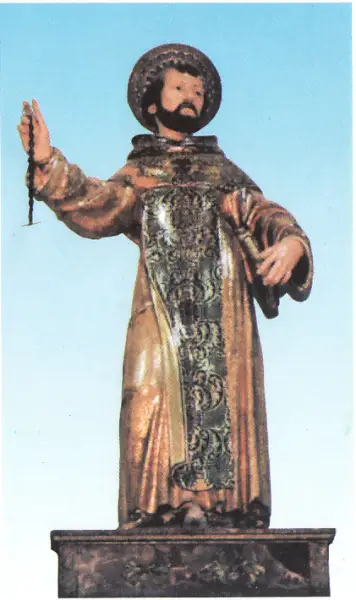
Overview
Leonard of Noblac, also called Leonard of Limoges, was a Frankish saint who died around 559 and whose memory has been bound for centuries to the town and abbey that bear his name at Saint-Léonard-de-Noblat, in the Limousin country of France. The romance preserved in an eleventh-century life portrays him as a nobleman at the court of Clovis I, converted to Christianity alongside the king at Christmas 496, with Saint Remigius of Reims as his godfather. As a disciple of Remigius he received the privilege of visiting prisons and freeing captives, and he secured the release of many prisoners before refusing a bishopric and entering the monastery of Micy near Orléans. He later withdrew as a hermit into the forest of Limousin, where followers gathered around him. Although he is absent from early liturgical books and dedications, Leonard came to rank among the most widely honored saints of the later medieval centuries: the faithful sought his help to free captives, to bring women safely through childbirth, and to heal the sicknesses of cattle, and his cult spread rapidly across Europe after 1103, when Bohemond I of Antioch attributed his release from a Turkish prison to Leonard's intercession.
The Complete Life
A Nobleman at the Court of Clovis
Almost everything transmitted about Leonard's origins comes from the romance that gathered around his name and was set down in an eleventh-century life. According to that account, he was born into the Frankish aristocracy and served as a nobleman in the household of Clovis I, the warrior king who founded the Merovingian dynasty. His life took its decisive turn at the royal court itself: he was brought to the Christian faith in the same conversion attributed to Clovis, celebrated at Christmas in the year 496, and the great Bishop Remigius of Reims, evangelist of the Franks, stood as his godfather. The chronicles of his cult present him as a disciple of Remigius, and from this spiritual fatherhood he received an extraordinary privilege — the right to enter the prisons of the kingdom and set free anyone he found held there. In an age when noble birth normally pointed toward war, land, and office, Leonard's inheritance of faith pointed instead toward mercy. The prisoners he freed became the beginning of the devotion that would one day spread across Europe, and the memory of that royal conversion remained the fixed anchor of his story.
§ Traditional biography
Declining the Bishopric, Choosing the Cloister
Leonard's position among Merovingian nobles entitled him to the highest offices of the Church, and the episcopacy was his for the asking. Yet the tradition insists that he turned down the offer of a bishopric, renouncing the advancement his rank made almost automatic. Instead he withdrew to the abbey of Micy, close by Orléans, a foundation that had become a center of the austere monastic revival in the Frankish lands. There the courtier learned the discipline of the cloister: prayer, manual work, and obedience in place of privilege. His release of prisoners, undertaken as a work of mercy from the days of his discipleship under Remigius, had already made his name inseparable from those in bondage, and it is for precisely this that later generations would invoke him. But the monastery did not prove his final resting place. Drawn to a stricter solitude, Leonard withdrew into the forest of Limousin, where he lived as a hermit. The woods that had been a refuge for outlaws became, in his keeping, a sanctuary, and the number of followers who gathered to share his way of life steadily grew into a community that endured long after his death.
§ Traditional biography
Hermits of the Forest of Limousin
In the forest of Limousin Leonard found the form of life for which he is remembered: the hermit who becomes, almost against his will, a founder. Followers gathered around him, drawn by his reputation for holiness and by the freedom he had won for captives, and the settlement that grew up around his hermitage became the nucleus of the abbey associated with his name at Noblac. His mission among his contemporaries was not that of the traveling preacher but of the intercessor and liberator: the eleventh-century life presents him as a man whose prayers and petitions opened prison doors, and the tradition of his prerogative to free prisoners gave a distinctive shape to the community's identity. After his death around 559 the place of his retreat took his name, and Saint-Léonard-de-Noblat grew up around the memory of the hermit's cell. For centuries the abbey remained a living monument to a vocation that had begun in a king's hall and matured in the silence of the woods, where a Frankish noble learned to count freedom from sin a greater treasure than any office the crown could bestow.
§ Traditional biography
Pre-Congregation Veneration and the Spread of the Cult
Leonard belongs to the company of saints who were never formally canonized; his veneration arose from the devotion of the people and was confirmed by long liturgical use. Strikingly, the written record is silent about him in early literature, liturgy, and church dedications, and his fame is essentially medieval. The turning point came in the twelfth century, in the aftermath of the First Crusade. Bohemond I of Antioch, a charismatic leader of that expedition, had been held in a Danishmend prison, and on his release in 1103 he attributed his freedom to the intercession of St. Leonard. In gratitude Bohemond visited the Abbey of Noblac and made an offering there, and Bishop Walram of Naumburg, who witnessed the visit, composed a new life of the saint incorporating posthumous miracles such as Bohemond's. The prince's example stirred countless similar gifts, which paid for the building of the great Romanesque church and its landmark bell tower. At about the same time Noblac became a staging point on the pilgrimage route to Santiago de Compostela, and from the Frankish lands Leonard's cult spread with remarkable speed across Christendom.
§ Diffusion of cult
A Saint of the Late Middle Ages and His Dedications
By the close of the Middle Ages Leonard stood among the most widely honored saints of western Europe. The wonder-working credited to his intercession touched captives awaiting release, mothers in labour, and cattle beset by disease, and his feast on 6 November was kept with a festival at Bad Tölz in Bavaria, where in the Alpine regions he is revered as the traditional patron of farmers and where communities still hold processions and rides in traditional dress. Until the Secularisation, Inchenhofen was a major pilgrimage center of his cult, promoted by the Cistercians of Fürstenfeld Abbey; the Church of England remembers him with a commemoration on 6 November; and the parish of Kirkop in Malta honors him on the third Sunday of every September. The map of Europe carries his dedications in every direction: St Leonards-on-Sea and St Leonard's Forest in Sussex, the parish church at Hythe in Kent with its famous ossuary, St. Leonard's Shoreditch in London, a cluster of churches in the West Midlands, a great Augustinian hospital at York, and in Italy alone nearly 225 places named for him, from Friuli, where the oldest Italian church bears his date of 774, to Sicily and Sardinia.
§ Veneration
Timeline
- 25 Dec 496
Converted to Christianity together with King Clovis I at the Christmas court, with Remigius of Reims as his godfather.
§ Traditional biography
- 559
Died as a hermit of the forest of Limousin, leaving a community of followers at the place later called Noblac.
§ Leonard of Noblac
- 774
Dedication of the oldest known Italian church in his name, in Friuli, marking the early spread of his cult south of the Alps.
§ Notable dedications
- 1103
Bohemond I of Antioch, freed from a Danishmend prison, credited his release to the intercession of St. Leonard.
§ Diffusion of cult
- 1350
First record of a chapel of ease dedicated to St Leonard at Newton Abbot in Devon, built near the town prison.
§ Notable dedications
- 1536
A small chapel of St Leonard at Panza d'Ischia in Italy was transformed into a church.
§ Notable dedications
- 29 May 1592
Foundation of the parish church of St Leonard at Kirkop, Malta, the island's single parish under his patronage.
§ Notable dedications
The Record
- Major works
- Hermit settlement in the forest of Limousin that grew into the abbey of Saint-Léonard-de-Noblat
- Patron of
- patron of political prisoners, prisoners of war, and captives·patron of women in labour·patron of horses·patron of farmers in the Bavarian Alps
- Symbols
- chains·fetters·locks·manacles·depicted as an abbot
- Canonization
- Pre-congregation canonization; venerated from the early medieval period, with his cult spreading widely from the twelfth century
Prayer
Bibliography
Show 6 sources
- Stracke, Richard (2015-10-20). "Saint Leonard". Christian Iconography.
- Poncelet, Albert. "St. Leonard of Limousin." The Catholic Encyclopedia Vol. 9. New York: Robert Appleton Company, 1910.
- Cassidy-Welch, M., "The cult of St. Leonard", Imprisonment in the Medieval Religious Imagination, c. 1150-1400, Springer, 2011, pp. 41-42. ISBN 9780230306400
- R. W. Mumford, St Leonard's Anglican Church 1896-1988. Denmark, W.A.: St Leonard's Anglican Church, 1991
- Ulrike Kretschmer, Frank Duffek and Bettina Schippel, Bayerischen Alpen: Traum in weiss-blau, Reader's Digest, Stuttgart, 2013, pp. 54-56. ISBN 978-3-89915-946-2
- "La vita di San Leonardo, abate di Noblat" (PDF). comelicocultura.it.
Profile text adapted from the Wikipedia article, licensed CC BY-SA 4.0.
Pray with this saint every day
Save St. Leonard of Noblac to your favorites, read the full profile, and get feast-day reminders in the Saints app.
Get the Saints AppFree on the App Store for iPhone and iPad