
1676 – 1751·Feast November 27
St. Leonard of Port Maurice
Franciscan missionary preacher of Italy
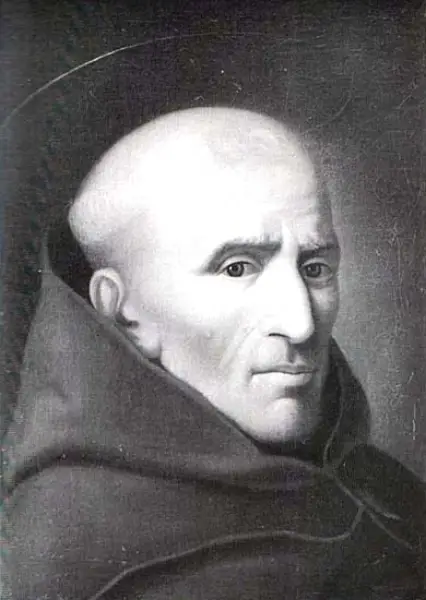
Overview
Leonard of Port Maurice (Italian: San Leonardo da Porto Maurizio) was an Italian Franciscan preacher and ascetic writer of the eighteenth century. Born Paul Jerome Casanova at Porto Maurizio on the Ligurian coast, he was sent at thirteen to study at the Jesuit Roman College in Rome, where he was being prepared for a medical career. In 1697 he abandoned medicine for the Friars Minor, receiving the habit that October and taking the name Brother Leonard. Ordained after his studies at St. Bonaventura on the Roman Palatine, he was forced by chronic illness to return to his hometown, where recovered health launched him into the preaching that would occupy him for over forty years. His parish missions across Tuscany and central and southern Italy drew enormous crowds, so that he frequently had to preach in the open air. Alphonsus Liguori called him the great missionary of the eighteenth century. He preached the Way of the Cross for forty-three years, erecting Stations in more than 500 locations, promoted devotion to the Sacred Heart and perpetual adoration, and urged that the Immaculate Conception be defined as dogma. Exhausted by his labors, he died at Rome in 1751.
The Complete Life
From a Sea Captain's Son to the Roman College
The future missionary was born Paul Jerome Casanova at Porto Maurizio on the northwestern coast of Italy, the son of Domenico Casanova, a ship captain, and his wife Anna Maria Benza. The family home in Port Maurice looked out on the Ligurian sea, but the boy's future initially pointed toward learning rather than the sea. At the age of thirteen he went to Rome to live in the household of his uncle Agostino and to attend the Jesuit Roman College, where he proved a capable student. His family and his uncle destined him for a career in medicine, and for a time he followed that path. But the young Ligurian's heart was turning elsewhere. In 1697 he made the decision that severed his old life in a single stroke: he joined the Friars Minor. The cost was immediate and personal, for when his uncle learned that he had abandoned medicine for the friary he disowned him. On 2 October of that same year the young man was clothed with the habit and took the name Brother Leonard, chosen in honor of a relative who had shown him kindness. Having made his novitiate at Ponticelli among the Sabine hills, he finished his course of studies at the friary of St. Bonaventura, which stands on Rome's Palatine hill.
§ Life
A Preacher Forged by Illness
Ordination brought Leonard to the threshold of the distant mission field he had hoped for: he remained at St. Bonaventura as lector, a professor to the young friars, and expected to be dispatched to the Chinese missions. Instead his body failed him. After ordination he contracted a bleeding ulcer, and in 1704 his superiors sent him back to his hometown, where a monastery of the Franciscan Observants stood. What looked like the end of his apostolate proved to be its beginning. Four years of slow recovery restored his health, and from the pulpit of Porto Maurizio he began to preach. When Cosimo III de' Medici transferred the monastery del Monte, on San Miniato above Florence, into the hands of the Riformella, Leonard was dispatched there at the grand duke's desire and began holding missions among the people of Tuscany. In 1710 he established the monastery of Icontro, set on a peak in the mountains roughly four miles outside Florence, a retreat where he and his assistants could withdraw between missions for spiritual renewal. Illness, which had barred him from the foreign missions, became the strange gate through which he entered the mission of Italy itself.
§ Mission work
The Great Missionary of the Eighteenth Century
For more than forty years Leonard gave himself to preaching retreats, Lenten sermons, and parish missions across the Italian peninsula, and Alphonsus Liguori honored him with the title of the great missionary of the eighteenth century. His missions lasted from fifteen to eighteen days, and he often remained an extra week simply to hear confessions. In 1720 he carried his preaching beyond Tuscany into Central and Southern Italy, and wherever he went conversions followed. The crowds that came to hear him were so vast that churches could not contain them, and in cities and countryside alike he was forced to preach in the open air. Between May and November of 1744 he undertook a preaching campaign in Corsica, a Genoese possession riven by faction, laboring to reconcile a divided people. His reputation reached the highest levels of the Church: Pope Clement XII and Pope Benedict XIV summoned him to Rome; Benedict, who prized him no less as preacher than as propagandist, bound him by a promise that his death would take place in the city, and laid on him several delicate diplomatic assignments. In Genoa, Corsica, Lucca, and Spoleto, citizens expecting a bejeweled cardinal instead met a humble, shoeless, muddy friar.
§ Mission work
Devotions He Kindled Across Italy
Leonard's preaching was inseparable from the devotional landscape he created wherever he went. He founded many pious societies and confraternities, and labored to advance two great devotions above all: the love owed to the Sacred Heart of Jesus, and the unbroken adoration kept before the Blessed Sacrament. He was also among the first voices to insist that the Immaculate Conception of Mary be proclaimed a dogma of the faith, a petition the Church would grant two centuries after his death. But no devotion bears his mark more deeply than the Way of the Cross. Since 1343 the Franciscans had kept in their care the holy places of the Holy Land, the Way of the Cross among them, and though many saints cherished the Stations, no one pressed their cause more tirelessly than Leonard. Across forty-three years he preached the Way of the Cross on his missions, and he is reported to have erected Stations in more than five hundred locations throughout Italy, among them the Colosseum in Rome, which he reclaimed as a theater of martyrdom. Alongside his preaching he left a body of ascetic writing, offering the faithful and priests alike a treasury of devotional instruction.
§ Life
The Promise Kept in Rome
By the end of 1751 the strain of decades of missionary labor and self-imposed mortification had reduced Leonard's body to exhaustion. He was in Bologna that November, preaching to the Bolognese, when Pope Benedict XIV summoned him to Rome, for signs of his rapidly approaching death were already visible. The summons allowed him to fulfill the promise the pope had long exacted of him: that his final days would be spent in Rome. He reached the city on the evening of 26 November 1751 and made his way to the friary of St. Bonaventura on the Palatine, the house he loved best, where he had studied and taught as a young friar more than fifty years before, and there, on the same night at eleven o'clock, he expired at the age of seventy-four. The circle of his life closed where it had opened after his novitiate: not in the foreign missions of China he had once hoped for, but in the Roman friary that had sent him out along the roads of Italy. His death, coming at the close of six months of preaching in Corsica and a final mission at Bologna, was in effect the last station of a journey that had lasted more than four decades.
§ Mission work
Honors of the Church
The Church moved to recognize the holiness of the barefoot missionary within two generations of his death. On 19 June 1796, Pope Pius VI pronounced his beatification at Saint Peter's Basilica in the Papal States, and on 29 June 1867, Pope Pius IX canonized him in the same place. His liturgical memory settled on 27 November, the date kept widely outside his order, while the Franciscans celebrate his feast on 26 November, the anniversary of his death. Physical veneration centered on the place of his passing: his partly incorrupt remains rest in the high altar of the church at Rome's St. Bonaventure monastery, the friary where he died on that November night in 1751. The process that led to his canonization drew on the testimony of the missions themselves, recorded in contemporary lives and in the Summarium of his cause published at Rome in 1781, well before his beatification. The dates of his elevation to the altars bookend a century in which his written works continued to circulate in ever new editions, so that the preacher who had filled the piazzas of Italy went on instructing the faithful from the page long after his voice had fallen silent.
§ Veneration
An Apostolate That Outlived the Preacher
Leonard's legacy has been carried by pen as much as by memory. His many works — homilies, correspondence, ascetic treatises, and devotional manuals for laypeople and clergy alike, missionaries especially — were translated into many languages and republished constantly. His Via Sacra spianata ed illuminata made the Way of the Cross simple and luminous for ordinary Christians, while his Il Tesoro Nascosto opened the treasure of the Holy Mass. His celebrated Proponimenti, his program of resolutions for climbing toward ever greater Christian perfection, recorded the rigors he practiced on himself. The Diary of his missions was written by the friar Diego da Firenze. Complete editions of his works appeared at Rome in thirteen volumes between 1853 and 1884, and in Venice in 1868 and 1869, with French translations of the whole corpus at Paris and Tournai. On the other side of the Atlantic, St. Leonard's Church in Boston, founded in 1873, became the first Roman Catholic church in New England built by Italian immigrants, standing on Boston's Freedom Trail in the historic North End. Alphonsus Liguori's verdict has proved durable: the great missionary of the eighteenth century remains, through his stations, his books, and his confraternities, a working force in the Church.
§ Works
Timeline
- 20 Dec 1676
Born at Porto Maurizio in Liguria, son of the ship captain Domenico Casanova and Anna Maria Benza.
§ Leonard of Port Maurice
- 2 Oct 1697
Received the Franciscan habit and took the name Brother Leonard, having abandoned the study of medicine.
§ Life
- 1704
Sent to his hometown, where a monastery of the Franciscan Observants stood, after contracting a bleeding ulcer.
§ Life
- 1710
Founded the monastery of Icontro in the mountains near Florence as a place of spiritual renewal after missions.
§ Mission work
- 1720
Crossed the borders of Tuscany and began his celebrated missions in Central and Southern Italy.
§ Mission work
- May 1744
Began six months of preaching in Corsica, then part of the Republic of Genoa and torn by party strife.
§ Mission work
- 26 Nov 1751
Died at eleven o'clock that night in the St. Bonaventura friary on the Palatine hill in the city he loved, aged seventy-four.
§ Mission work
- 19 Jun 1796
Beatified by Pope Pius VI at Saint Peter's Basilica.
§ Veneration
- 29 Jun 1867
Canonized by Pope Pius IX at Saint Peter's Basilica.
§ Veneration
- 1873
Foundation of St. Leonard's Church in Boston, the first Roman Catholic church in New England built by Italian immigrants.
§ Veneration
The Record
- Major works
- Via Sacra spianata ed illuminata (the Way of the Cross simplified and explained)·Il Tesoro Nascosto (on the Holy Mass)·Proponimenti, resolutions for the attainment of higher Christian perfection·Sermons, letters, and ascetic treatises·Foundation of the monastery of Icontro near Florence·Erection of Stations of the Cross in over 500 locations, including the Colosseum in Rome
- Patron of
- patron of missionaries·patron of preachers·patron of Imperia
- Symbols
- Franciscan habit
- Canonization
- Beatified by Pope Pius VI on 19 June 1796; canonized by Pope Pius IX on 29 June 1867, both at Saint Peter's Basilica
Prayer
Bibliography
Show 6 sources
- "St. Leonard of Port Maurice", Catholic News Agency. Retrieved 27 March 2014.
- Foley, Leonard. "St. Leonard of Port Maurice", from Saint of the Day. Retrieved 27 March 2014.
- Bihl, Michael. "St. Leonard of Port Maurice" The Catholic Encyclopedia. Vol. 9. New York: Robert Appleton Company, 1910.
- "Leonard of Port Maurice", Saints Resource, RCL Benziger
- "Pietro Messa", The Via Crucis of Saint Leonard of Porto Maurizio, Nomely, the Via Sacra Spianata ed Illuminata, in Spirit + Life. Journal of Franciscan Culture n. 124 (2018), p. 18-24.
- Rafaello da Roma, Vita del P. Leonardo da P.M. (Rome, 1754)
Profile text adapted from the Wikipedia article, licensed CC BY-SA 4.0.
Pray with this saint every day
Save St. Leonard of Port Maurice to your favorites, read the full profile, and get feast-day reminders in the Saints app.
Get the Saints AppFree on the App Store for iPhone and iPad