
1828 – 1900·Feast March 30
St. Leonardo Murialdo
Apostle of Turin's apprentices and workers
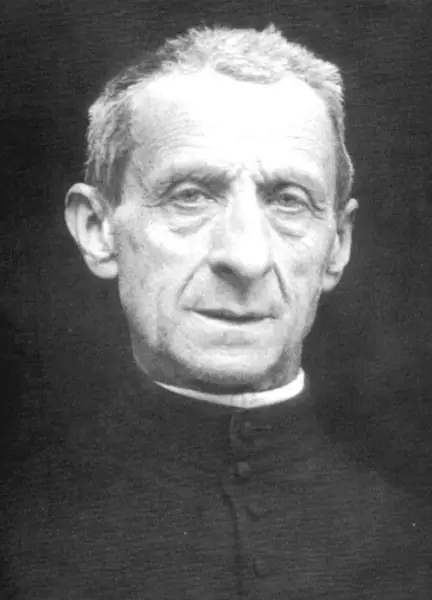
Overview
Leonardo Murialdo was an Italian Catholic priest, co-founder with Eugenio Reffo of the Congregation of Saint Joseph, whose members are known as the Murialdines. Born in Turin in 1828, the seventh of nine children of an upper middle-class family, he lost his stockbroker father in childhood and was educated at a Piarist boarding school in Savona. His call to the priesthood surfaced late in his education; a Lenten sermon on hell in 1844 decided him to consecrate himself to God, and he was ordained in 1851. He gave himself to social work among the poor and with adolescent men in Turin, directing oratories and the Artigianelli Boarding School, where boys learned a trade, and collaborating with Giovanni Bosco and Giuseppe Cafasso, who held him in high esteem. In 1873 he brought the Congregation of Saint Joseph into being, a body meant to assist apprentices and workingmen. He founded an agricultural school, a centre for delinquents, an agricultural centre at Rivoli, and the Association of the Good Press, and campaigned against the exploitation of factory workers. He died in Turin on 30 March 1900, revered for deep personal holiness, and was canonized in 1970.
The Complete Life
A Childhood of Loss in Turin and Savona
Leonardo Murialdo was born at Turin on 26 October 1828, the seventh of nine children of Leonardo Franchino Murialdo, a stockbroker, and his wife Teresa Rho. Baptized the next day in the San Dalmazzo parish church and nicknamed Nadino as a small boy, he grew up in an upper middle-class household shadowed by early deaths: his father died in 1833, and a sister, Clementine, had died in childhood. In 1836 Leonardo and his younger brother Ernesto were sent by coach to the Piarist boarding school in Savona, where he studied the humanities and grammar under priests including Atanasio Canata and Giovanni Solari. The years at Savona were formative but troubled. From 1842 to 1843 he passed through a deep personal crisis brought on by his fellow pupils' poor behaviour and tendencies, and in September 1843 the brothers returned to Turin, where Leonardo's first Confession was made to the abbot Pullini. That November he went back to Savona to begin a philosophical course, choosing also to study ancient historical sciences in order to keep away from the bad companions who had forced his earlier departure. As a boy he had dreamed of an army career, then of civil law, then of engineering.
§ Education
A Late and Unexpected Call
Murialdo's call to the priesthood did not show itself early, and he recorded afterward that the thought of priesthood had never once entered his mind — the family had assumed his brother Ernesto would take that path. The turning point came in the spring of 1844, when he heard the Capuchin friar Vincenzo Oliva preach a Lenten sermon on hell. The sermon struck him so deeply that he resolved to consecrate himself to God, and for a time he felt drawn to the Capuchins, whom he admired for their detachment from worldly things. Canon Lorenzo Renaldi, a close friend, dissuaded him and suggested he become a diocesan priest instead. His confessor at Savona was Marcantonio Durando, who would later lead the retreat preparing him for ordination. Having finished his philosophical course in November 1845, he was vested in the cassock after Abbot Pullini blessed it in the Santa Chiara church, and returned to Turin to begin his ecclesial studies as an external cleric student. His theological course, from 1845 to 1850 under the theologians Augusto Berta and Pietro Baricco, ended on 8 May 1850 with excellent results, and on 20 September 1851 he was ordained priest in the Church of the Visitation.
§ Education
Turin's Poor Neighborhoods and Oratories
From his ordination Murialdo's field was the city itself. His first assignment lay in the working-class quarter of Vanchiglia, beside the Oratorio dell'Angelo Custode, which his cousin Roberto Murialdo directed, a house that stood among the earliest oratories of the city to care for poor, abandoned boys at the margins of life. From 1857 to 1865, at the request of John Bosco, he directed the Oratorio di San Luigi, conferring and collaborating with Don Bosco and with Joseph Cafasso, who held him in great esteem. In 1858 he had accompanied Bosco to a private audience with Pope Pius IX. After a year of studies in Paris at Saint-Sulpice, cut short by the superior Henri Icard's discouragement of his Sulpician ambitions, he returned to Turin in October 1866 and was given oversight of the Artigianelli Boarding School, a house where teenage boys were schooled and trained in a craft. He became director of the Oratorio di San Martino in 1870, organized the Union of Catholic Workers in 1871 for the women and others employed in factories, promoted the popular Catholic libraries, and in 1873 founded the Congregation of Saint Joseph with Eugenio Reffo, adding an agricultural school and a centre for delinquents.
§ Priesthood
Abandonment to Providence
The spirituality that carried Murialdo through a lifetime of social work was one of trusting surrender to God's mercy. Pope Benedict XVI, speaking of him at the General Audience of 28 April 2010 during the Year of Priests, drew out this inner logic: the pope dwelt on the loving way Murialdo answered God by doing His will, and on his unshaken conviction that God's love is mercy. Alongside these went what Benedict described as a keen, serene sense of his own limitations — an honesty about himself that ran from his education through his priesthood and into his social apostolate, which the pope described as the tireless zeal of action. This combination of humility and energy explains much in his outward life: his willingness to take on unglamorous work among apprentices and factory workers, his persistence through grave illness, and his grief borne with faith when his last surviving siblings, Aurelia and Ernesto, died in 1890, leaving him without a single friend or relative of his own generation. Benedict XVI closed by saying that Murialdo surrendered himself, full of trust, into the hands of Providence, and that this surrender, more than any strategy, was what motivated his life and profoundly shaped his social apostolate in Turin.
§ General Audience
Sickness, Sorrow, and a Quiet Death
Murialdo's last decades were marked by illness endured without ceasing his work. In 1877 he contracted a grave illness, and his friend Don Bosco assured him that he would live much longer and would not die of it — a prophecy borne out by the decades that followed. In 1885 an attack of bronchitis kept him gravely ill from New Year's Day until 17 February, so severe that he believed he was dying; Don Bosco came to visit and bless him. The years also brought bereavement: in 1890 the last two of his brothers and sisters still living, Aurelia and Ernesto, passed away, and the loss weighed on him keenly, for at that stage all his friends and relatives had gone before him. His public concerns remained vivid to the end; in 1892, in the spirit of Pope Leo XIII's encyclical Rerum Novarum, he sent the municipal council a letter denouncing the way workers were being exploited, presenting a reform project that asked for compulsory schooling up to a child's fourteenth year and an end to night labor. He died in Turin on 30 March 1900 of pneumonia, aged seventy-one, his final words being I'm waiting. After his funeral his remains were buried after the funeral and later moved to the Santa Barbara church in Turin.
§ Declining health and death
From Servant of God to the Altars
Murialdo's reputation for deep personal holiness, especially prevalent in the northern Italian cities where he and his order worked, moved the Church to open his cause in the early twentieth century. The diocesan inquiry into his life and fame for sanctity was conducted at Turin between 1910 and 1913, and his writings passed their theological examination on 13 December 1916. Benedict XV formally opened the cause on 23 November 1921, bestowing on him the title of Servant of God, and the Congregation for Rites gave its validation of the Turin inquiry on 2 March 1932. The long process culminated on 26 April 1961, when Pope John XXIII, having confirmed his heroic virtue, proclaimed him Venerable. Paul VI beatified him on 3 November 1963 in Saint Peter's Basilica and, less than a decade afterward, canonized him on 3 May 1970 in Saint Peter's Square. His feast is kept on 30 March, the day of his death, while the Salesians, who claim him as a close collaborator of Don Bosco, observe his memory on 18 May. He is honored with the attributes of a priest's attire and a book.
§ Sainthood
The Murialdines and His Enduring Works
The most lasting fruit of Murialdo's life is the Congregation of Saint Joseph, which he founded in 1873 with Eugenio Reffo as his collaborator, taking Saint Joseph as a model for labourers. The Murialdines continue the work of educating the young that he began at the Artigianelli Boarding School, and their institutions carry his name across the world: the San Leonardo Murialdo parish in Milan, the Instituto Leonardo Murialdo at Albano Lazio, which the congregation manages to provide education to children, and the Oratorio di San Leonardo Murialdo in Popesti Leordeni, Romania, for adolescents. In Rome, the San Leonardo Murialdo church on Via Salvatore Pincerle rose in 1978 and received its consecration ten years on, in 1988. His social vision also endured beyond his lifetime: his appeals for an end to worker exploitation and for further rights for factory workers anticipated the social teaching that Pope Leo XIII would frame in Rerum Novarum, and his popular Catholic libraries, good-press association, and workers' newspaper showed a priest who understood that forming public opinion was part of forming souls. Patron of apprentices and of his congregation, he remains an apostle of Turin's working world.
§ Namesakes
Timeline
- 26 Oct 1828
Born in Turin, the seventh of nine children of Leonardo Franchino Murialdo and Teresa Rho.
§ Education
- 27 Oct 1836
Arrived with his brother Ernesto at the Piarist boarding school in Savona for his schooling.
§ Education
- Sep 1843
Returned to Turin with his brother after a year of personal crisis at school caused by his fellow pupils' behaviour.
§ Education
- 6 Nov 1845
Completed his philosophical course in Savona and began ecclesial studies, receiving the cassock after its blessing by Abbot Pullini.
§ Education
- 20 Sep 1851
Ordained to the priesthood in the Church of the Visitation by Monsignor Giovanni Domenico Ceretti.
§ Priesthood
- 1857
Appointed director of the Oratorio di San Luigi at the request of John Bosco, serving in that post until 1865.
§ Priesthood
- 1858
Met Pope Pius IX in a private audience, accompanying Don Bosco to the pontiff.
§ Priesthood
- 28 Sep 1865
Left Turin for further studies at the Saint-Sulpice church in Paris in moral theology and canon law.
§ Priesthood
- Oct 1866
Returned to Turin and was placed in charge of the Artigianelli Boarding School for adolescent tradesmen.
§ Priesthood
- 1871
Organized the Union of Catholic Workers on behalf of factory workers and promoted the popular Catholic libraries.
§ Priesthood
- 1873
Founded, with Eugenio Reffo, the Congregation of Saint Joseph for the benefit of apprentices and workingmen.
§ Priesthood
- 1876
Founded the Association of the Good Press and, with Pio Paolo Perazzo, the newspaper The Voice of the Worker.
§ Priesthood
- 1878
Founded an agricultural centre at Rivoli to extend his work of training young labourers.
§ Priesthood
- 1892
Wrote to the local council, in the spirit of Pope Leo XIII's Rerum Novarum, denouncing the exploitation of workers and proposing schooling for children up to fourteen and an end to night labor.
§ Priesthood
- 30 Mar 1900
Died in Turin of pneumonia, with the words "I'm waiting" as his last.
§ Declining health and death
- 23 Nov 1921
Formal cause of canonization opened under Pope Benedict XV, conferring the title of Servant of God.
§ Sainthood
- 26 Apr 1961
Declared Venerable by Pope John XXIII, who proclaimed his life of heroic virtue.
§ Sainthood
- 3 Nov 1963
Beatified by Pope Paul VI at Saint Peter's Basilica.
§ Sainthood
- 3 May 1970
Canonized by Pope Paul VI in Saint Peter's Square, less than a decade after his beatification.
§ Sainthood
In Their Own Words
I'm waiting
abandoned himself with trust to Providence
The Record
- Major works
- Congregation of Saint Joseph (the Murialdines), co-founded with Eugenio Reffo·Union of Catholic Workers·Association of the Good Press·Newspaper The Voice of the Worker, later the diocesan paper The Voice of the People·Agricultural school and agricultural centre at Rivoli·Centre for delinquents·Promotion of the popular Catholic libraries
- Patron of
- patron of the Congregation of Saint Joseph·patron of apprentices
- Symbols
- priest's attire·book
- Canonization
- Beatified by Pope Paul VI on 3 November 1963 at Saint Peter's Basilica; canonized by Pope Paul VI on 3 May 1970 in Saint Peter's Square
Prayer
Bibliography
Show 6 sources
- Daniele Bolognini (29 March 2007). "San Leonardo Murialdo". Santi e Beati. Retrieved 19 December 2017.
- "Saint Leonardo Murialdo". Saints SQPN. 29 March 2015. Retrieved 10 April 2015.
- "Saint Leonardo Murialdo". All Saints & Martyrs. 30 March 2014. Retrieved 19 December 2017.
- "General Audience". Holy See. 28 April 2010. Retrieved 19 December 2017.
- "St. Leonard Murialdo". Salesians UK. 11 February 2014. Archived from the original on 14 January 2018.
- Index ac status causarum beatificationis servorum dei et canonizationis beatorum (in Latin). Typis polyglottis vaticanis. January 1953. p. 132.
Profile text adapted from the Wikipedia article, licensed CC BY-SA 4.0.
Pray with this saint every day
Save St. Leonardo Murialdo to your favorites, read the full profile, and get feast-day reminders in the Saints app.
Get the Saints AppFree on the App Store for iPhone and iPad