
died 202·Feast April 22
St. Leonides of Alexandria
Martyr father of Origen of Alexandria
Overview
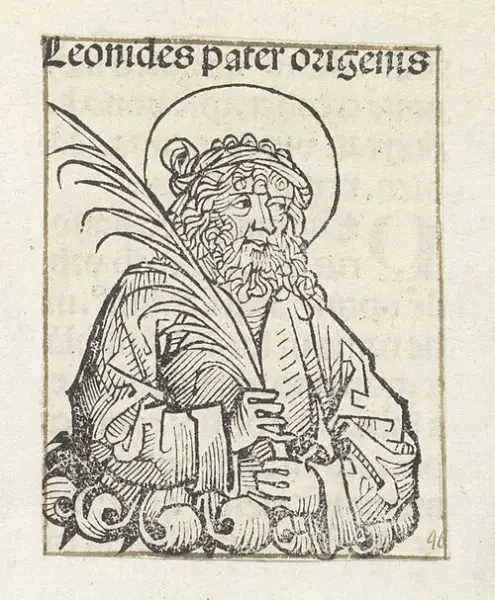
Leonides of Alexandria was a Greek early Christian martyr of the second and early third centuries, remembered chiefly as the father of the great Church father Origen. According to the Christian historian Eusebius, whose testimony preserves nearly all that is known of him, Leonides raised his children in the faith and catechized them well, guiding the household with a father's teaching while Christianity stood under the suspicion of the Roman state. During the persecution waged by the emperor Septimius Severus, Leonides was sentenced by the Egyptian prefect Lactus and beheaded at Alexandria in the year 202; his estate was confiscated at the same time. His son Origen, then still a youth, wished to follow his father to martyrdom and was restrained only because his mother hid his clothes so that he could not leave the house. Leonides' wife, whose name has not survived, bore at least six more children after Origen. The Neoplatonist Porphyry claimed that Origen's parents were pagans, a claim at odds with the Christian tradition of Leonides. The Church celebrates his feast on 22 April, and he has become a patron of large families.
The Complete Life
A Greek Father of the Alexandrian Church
Almost everything known of Leonides comes through the testimony of the Christian historian Eusebius, writing about the generation that followed him. Eusebius records that Leonides was of Greek nationality and that he lived in Alexandria, the great intellectual capital of the eastern Mediterranean, in the late second century. He was a family man of some substance, the father of what became a very large household: his wife, whose name history has not preserved, bore at least six children after their firstborn son. That son was Origen, who would grow into one of the most consequential figures of the early Church, and it was from Leonides that the boy received his first formation. Eusebius notes that Leonides catechized his children well, and in a city teeming with philosophical schools and competing doctrines, the faith taught at home proved decisive. One discordant note comes from the Neoplatonist Porphyry, who claimed that Origen's parents were pagans; the Christian tradition, resting on Eusebius, has never received that claim. The household of Leonides thus stands in the tradition as a school of belief, where a Greek father of Alexandria made his own house the first church his children ever knew.
§ Biography
Martyrdom Under Septimius Severus
In the year 202 the persecution of the Roman emperor Septimius Severus reached Alexandria, and Leonides was arrested as a Christian. Sentenced by Egypt's prefect Lactus, he lost his head to the executioner's sword, and the state confiscated his estate — stripping his family of its goods along with its head of household. The martyrdom made an orphan of the young Origen, who wished to walk the same road himself: he attempted to follow his father in martyrdom, presenting himself for arrest, and was detained only because his mother hid his clothes so that he could not leave the house. The episode, preserved by the tradition, shows what kind of father Leonides had been — one whose children had learned from his example that confessing Christ was worth more than life. He died in the province of Egypt of the Roman Empire, in the city where he had raised his family, leaving behind a widow, a household of children, and a son whose genius would carry the faith of his father's teaching into the theology of the whole Church. The date of his heavenly birthday, as the ancients called the day of martyrdom, is fixed at 202.
§ Biography
Feast, Patronage, and the Fruit of His House
The Church has never forgotten the father through whom Origen first learned the faith. The Catholic feast of Leonides is celebrated on 22 April, and he is venerated in both the Roman Catholic Church and the Eastern Orthodox Church as a martyr of the age of the persecutions, ranked among the saints who died before the era of formal canonization. His patronage of large families flows naturally from his own story: the father of at least seven children, he is invoked by households blessed — and burdened — with many mouths, as a witness that the Christian raising of children is itself a work worthy of heaven. His most illustrious legacy, however, is his son. Eusebius introduces Leonides in his Church History precisely as the father of Origen, the early Church father whose biblical scholarship and theology shaped Christian thought for centuries; the martyr's instruction of his boy at Alexandria proved to be seed sown for the whole tradition. The Neoplatonist Porphyry's contrary claim about the family's paganism has done nothing to dislodge the memory of the believing household. Leonides stands among the martyrs of the third century as the model of the Christian parent whose quiet faithfulness bore fruit a hundredfold.
§ Feast
The Record
- Major works
- The Christian catechesis of his children, among them the future Church father Origen
- Patron of
- patron of large families
- Canonization
- Pre-congregation canonization; venerated as a martyr since antiquity
Prayer
Bibliography
Show 5 sources
- Eusebius Pamphilius, Church History, Book VI, Chapter I
- Kirsch, Johann Peter. "St. Leonidas." The Catholic Encyclopedia Vol. 9. New York: Robert Appleton Company, 1910
- Crouzel, H. trans. A. S. Worrall, Origen (Edinburgh: T&T Clark, 1989)
- "Origen's father". Archived from the original on 2011-10-07. Retrieved 2012-07-12.
- Butler, A., Lives of the Saints: St. Leonides, Martyr, accessed 23 December 2016
Profile text adapted from the Wikipedia article, licensed CC BY-SA 4.0.
Pray with this saint every day
Save St. Leonides of Alexandria to your favorites, read the full profile, and get feast-day reminders in the Saints app.
Get the Saints AppFree on the App Store for iPhone and iPad