
1377 – 1452·Feast December 11
St. Leontius of Monemvasia
Byzantine aristocrat turned hermit and monastery founder in Achaea
Overview
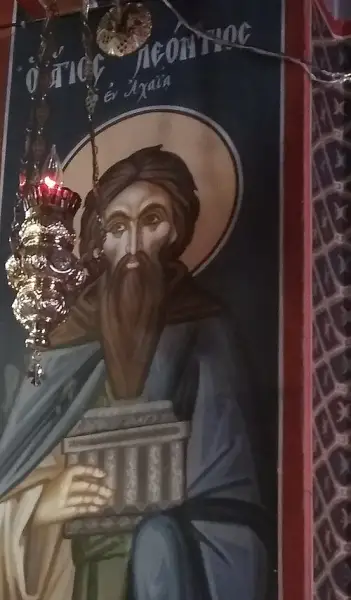
Leontius of Monemvasia, also honored as Leontius of Achaia, was born in 1377 into the aristocracy of the late Byzantine world and died on 11 December 1452 at the monastery he founded in Achaea. His mother Theodora was a daughter of Emperor Andronikos II Palaiologos; his father Andrew governed the Peloponnese. Sent to Constantinople for an education in philosophy and the sciences, he gave up the career his birth promised, returned home, and received the monastic habit. A stay on the Holy Mountain of Athos deepened his ascetic resolve, and he withdrew at length to the hills of the northern Peloponnese, near the modern town of Aigio. Beside Klokos Mountain he raised a church in honor of the holy Archangels and made his home in a cave so remote that few could reach him. His uncles Thomas and Demetrios Palaiologos, moved by the holiness of their nephew, helped him establish the Monastery of the Pammegiston Taxiarchon, dedicated to the Archangels Michael and Gabriel, which the imperial family endowed with relics of the Lord's Passion. His first biographer was, by the judgment of some scholars, Gennadius Scholarius, philosopher and Patriarch of Constantinople. His relics rest in the monastery church to this day.
The Complete Life
From Constantinople to the Caves of Achaea
Few hermits began life with more than Leontius did. Through his mother Theodora, daughter of Emperor Andronikos II Palaiologos, he belonged to the imperial house itself, and his father Andrew held the governorship of the Peloponnese. His family destined him for the highest sorts of learning, and he was sent to Constantinople, where he studied philosophy and the sciences in the capital's schools. Yet the capital that trained his mind could not hold his heart. He came back to his native Monemvasia, put off the expectations of his rank, and became a monk. The customary road of Byzantine ascetics then carried him to Mount Athos, where he remained for a time, learning the discipline of the desert that had flowed from Egypt to the Holy Mountain and thence through the Orthodox world. Athos, however, was not to be his place. He discerned a call to the mountains of the northern Peloponnese, in the region of Achaea close to what is now the town of Aigio, and there he settled into an ascetic life of the older, wilder kind, far from the courts and schools his birth had prepared for him.
§ Leontius of Monemvasia
A Church to the Archangels, a Monastery from the Emperor's Kin
Arriving beneath Klokos Mountain, Leontius did for himself what a wealthy founder might have done for others: he built a small church in honor of the holy Archangels and withdrew to live in an almost unreachable hiding place among the rocks, continuing his ascetic struggle in solitude. Holiness, however, could not long remain hidden. His uncles Thomas Palaiologos and Demetrios Palaiologos, brothers of the imperial line, came to know the sanctity of their nephew's life and were impressed by it, and with their support the solitary enterprise grew into a community: a monastery honoring Michael and Gabriel, known from that day to this as the Monastery of the Pammegiston Taxiarchon, the monastery of the All-Great Taxiarchs. The imperial connection that Leontius had renounced for himself now served the house he had founded, for the Palaiologoi endowed it with relics of the saints, chief among them treasures bound to the Lord's Passion: parts of the True Cross, along with the thorny crown, the sponge, and the purple robe of the Passion. A hermitage of one man had become the keeper of the Passion of Christ in the hills of Achaea.
§ Leontius of Monemvasia
The Saint Whom a Patriarch Wrote About
Leontius died on 11 December 1452, within a few months of the fall of the Christian East that his lifetime had foreshadowed, and the church moved quickly to number him among its saints, enrolling him in the fifteenth century. His story did not depend on chance for its survival: a formal biography, an encomium titled for his feast on the eleventh of December, was composed by his first biographer, whom several scholars have identified as Gennadius Scholarius, the Byzantine philosopher who became first Patriarch of Constantinople under the Ottomans. That text, preserved in the manuscript Gr. II, 186 of the Biblioteca Marciana in Venice, gives the saint a literary pedigree rare for a provincial ascetic. His relics, the Honorable Body, are kept in a special shrine within the church of the Holy Archangels in the monastery he founded, and his memory has taken root in the towns of the region: a church stands in his name at Aigio and another at Monemvasia itself, the city of his birth. The hermitage cave where the old monastery rose can still be seen beneath the rocks above the sanctuary.
§ Leontius of Monemvasia
Timeline
- 1377
Born at Monemvasia into an aristocratic family of the declining Byzantine world.
§ Leontius of Monemvasia
- 11 Dec 1452
Died at the Taxiarchon Monastery in Achaea on 11 December.
§ Leontius of Monemvasia
The Record
- Major works
- Monastery of the Pammegiston Taxiarchon (Holy Archangels), Achaea
- Canonization
- Canonized by the Eastern Orthodox Church in the 15th century
Prayer
Bibliography
Show 4 sources
- "History of Taxiarchon Monastery and Saint Leontios." Holy Metropolis of Kalavryta and Aigialeia official website. Archived from the original on 25 December 2017.
- "Saint Leontios of Monemvasia: Life of Saint Leontios." Mystagogy Resource Center website.
- Νέον Λειμωνάριον, synaxarion-martyrologion collected by Macarius of Corinth, Metropolitan of Corinth, published in Venice, 1817.
- "List of Greek manuscripts in the collection Gr. II (Patres et scriptores ecclesiastici) of the Biblioteca Marciana." Archived from the original on 3 July 2018.
Profile text adapted from the Wikipedia article, licensed CC BY-SA 4.0.
Pray with this saint every day
Save St. Leontius of Monemvasia to your favorites, read the full profile, and get feast-day reminders in the Saints app.
Get the Saints AppFree on the App Store for iPhone and iPad