
1073 – 1136·Feast November 15
St. Leopold III of Austria
Margrave of Austria, founder of monasteries, called the Good
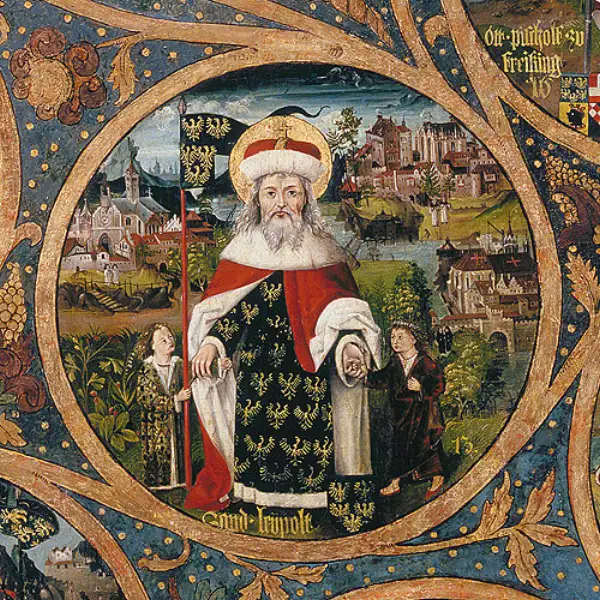
Overview
Leopold III, remembered by history as Leopold the Good, ruled the Austrian margraviate from 1095 until his death in 1136 and became the most beloved of the Babenberg dynasty. Born at Babenberg Castle in Gars am Kamp in 1073, the son of Margrave Leopold II and Ida of Formbach-Ratelnberg, he was raised in the diocese of Passau under the reforming bishop Altmann. He took over the margraviate from his father at twenty-two and, through his marriage to Agnes, widowed sister of Emperor Henry V, bound his house to the imperial Salian line, winning royal rights that raised the standing of Austria itself. He styled himself Princeps Terrae, prince of the land, and in 1125 he was even proposed as a candidate for the imperial throne, an honor he declined. His enduring work was constructive rather than martial: he founded the monasteries of Klosterneuburg, Heiligenkreuz, Kleinmariazell, and Seitenstetten, opening up forested country to settlement, and he fostered the growth of Klosterneuburg, Vienna, and Krems. His court saw the first literary works composed on Austrian soil. Canonized on 6 January 1485 by Pope Innocent VIII, he was named principal patron of Austria in 1663, and he is buried in the monastery he founded at Klosterneuburg.
The Complete Life
A Babenberg Raised by Reformers
Leopold was born in 1073 at Babenberg Castle in Gars am Kamp, into the family that had carried Austria's margraviate since the days of his great-great-grandfather Leopold the Illustrious. The Babenbergs had originally risen to prominence in Bavaria before moving into the marchland along the Danube in the tenth century. His father was Margrave Leopold II and his mother Ida of Formbach-Ratelnberg. Instead of being reared wholly in the world of castles and feuds, the boy was formed in the church of Passau, where Bishop Altmann, a leader of the Gregorian reform in the German lands, guided his youth. That formation mattered. The reforming party stood for clerical discipline, the liberation of the church from lay control, and the foundation of reformed monastic communities, and Leopold carried these instincts with him for the rest of his life. A margrave who had learned from a reform bishop would later spend his rule building monasteries rather than monuments to himself, and the union of worldly office with reforming piety that marked his career began in those Passau years.
§ Biography
Margrave, Husband, and Almost an Emperor
In 1095, aged twenty-two, Leopold took up his father's office, and the margraviate of Austria passed to him. His marriages made him a figure of European consequence. His first wife, who may have come from the von Perg family, died in 1105; the following year he wed Agnes, sister of Emperor Henry V and widow of Frederick of Hohenstaufen, whom Leopold had supported in the struggle against her own father, Henry IV. The alliance drew the Babenberg house into the orbit of both the Salian emperors and the Hohenstaufen dynasty, for Agnes's son from her first marriage would reign as Conrad III of Germany. Royal rights over the Austrian margraviate followed, strengthening the family's hold on the land. Leopold's sense of his own territory showed in the title he assumed, Princeps Terrae, prince of the land, an assertion of independence that looked forward to Austria's later sovereign identity. His stature was such that in 1125 his name stood among the candidates for election as emperor of the Holy Roman Empire; he declined the honor, preferring the country he had inherited and ruled to the burden of the imperial crown.
§ Biography
The Builder of Klosterneuburg
Leopold is remembered chiefly for the peacetime transformation of his margraviate. His most important foundation came at Klosterneuburg in 1108. Tradition recounts that our Lady appeared to the margrave and guided him to the spot where the veil Agnes had mislaid years before came to light, and there he established the monastery that still crowns the Danube near Vienna, expanding the surrounding settlement until it served as his residence. Heiligenkreuz, Kleinmariazell, and Seitenstetten followed from his hand, monasteries that opened a territory still largely covered by forest to cultivation and Christian life. His patronage reached towns as well as cloisters: he fostered the growth of Klosterneuburg, Vienna, and Krems, granting the last the right to mint coin. Under his rule Austria produced its first literature, for the writings of Henry of Melk and Ava of Göttweig, the earliest literary texts of the Austrian lands, date from his time. Churchmen of the following generations looked back on this record of foundation and settlement as the work of a saint, and it was precisely this that moved the church to canonize him in 1485.
§ Biography
Death at the Monastery He Founded
Leopold died on 15 November 1136 at Klosterneuburg, the monastery he had founded and made the center of his rule, and there he was buried, in the crypt of the church raised over the site of Agnes's recovered veil. By his two marriages he had a vast family: his son Leopold IV succeeded him as margrave, Henry II Jasomirgott would become the first Duke of Austria, Otto of Freising rose to be bishop and the great chronicler of his age, and Conrad became Bishop of Passau and Archbishop of Salzburg. The chronicle continuation of Klosterneuburg records that as many as seven further children may have been stillborn or died in infancy, a grief that lies behind his later patronage of parents who lose children and of large and blended families. His remains lie at Klosterneuburg to this day; his skull rests in an embroidered reliquary, fashioned to bare the forehead and crowned with an archducal hat, a strange and touching union of relic and regalia that still draws pilgrims to the monastery above the Danube.
§ Biography
From Margrave to Saint
The movement to honor Leopold as a saint grew from the very works of his life: the monasteries he founded became the guardians of his memory and the advocates of his cause. On 6 January 1485 Pope Innocent VIII canonized him, more than three and a half centuries after his death, and his feast was fixed on 15 November, the day of his passing. The recognition was not merely retrospective devotion. In 1663, under his namesake Emperor Leopold I, the saint was formally declared patron saint of Austria, displacing Coloman of Stockerau in that role, and the margrave who had called himself prince of the land became its heavenly patron. His cult settled deeply into Austrian religious and civic life; his attributes in art are the model of a church, the emblem of a man remembered for what he built for God. Families placed themselves under his protection, and his patronage extended to the House of Habsburg, to the provinces of Lower and Upper Austria, and to Vienna, the city whose growth he had furthered in life.
§ Biography
Feast Days, Music, and a King's Remembrance
Leopold's memory has continued to shape culture far beyond his margraviate. On his feast day the brothers Joseph and Michael Haydn, who had each sung as choirboys at St. Stephen's Cathedral in Vienna, sang in that capacity at Klosterneuburg; Joseph would become the more celebrated composer, while Michael in 1805 wrote the Missa sub titulo Sancti Leopoldi, a mass in the saint's honor. In an unexpected turn of remembrance, Belgium celebrates the King's Feast on 15 November, the feast of Leopold, a custom dating from the death of Emperor Leopold I, for whom the Belgian royal house was named. The monastery he founded still stands above the Danube, and the archaeological and genetic study of his dynasty has continued into the present: DNA testing of remains buried at Klosterneuburg and Heiligenkreuz, published in 2013, strongly supported the identification of the child Adalbert as son of Leopold and Agnes. Patron of a nation, of parents and step-parents, and of families in grief, Leopold the Good remains what his contemporaries found him: a ruler whose greatness was measured in monasteries, towns, and children rather than in conquests.
§ Biography
Timeline
- 1073
Born at Babenberg Castle in Gars am Kamp, son of Margrave Leopold II and Ida of Formbach-Ratelnberg.
§ Biography
- 1095
Became margrave of Austria at twenty-two upon his father's death.
§ Biography
- 1105
Death of his first wife, who may have belonged to the von Perg family.
§ Biography
- 1106
Married Agnes, widowed sister of Emperor Henry V, binding the Babenbergs to the Salian dynasty.
§ Biography
- 1108
Founded Klosterneuburg Monastery, later his residence and burial place, on the spot where the veil of his wife Agnes was found.
§ Biography
- 1125
Declined the honor of standing as a candidate in the election of the Holy Roman Emperor.
§ Biography
- 15 Nov 1136
Died at Klosterneuburg Monastery on 15 November and was buried there.
§ Biography
- 6 Jan 1485
Canonized by Pope Innocent VIII on 6 January.
§ Biography
- 1663
Declared patron saint of Austria, replacing Coloman of Stockerau, under Emperor Leopold I.
§ Biography
The Record
- Major works
- Klosterneuburg Monastery (1108)·Heiligenkreuz Abbey·Kleinmariazell Monastery·Seitenstetten Abbey
- Patron of
- Austria·Lower Austria·Upper Austria·Vienna·House of Habsburg·large families·step-parents·death of children
- Symbols
- model of a church
- Canonization
- Canonized 6 January 1485 by Pope Innocent VIII
Prayer
Bibliography
Show 4 sources
- Lingelbach, William E. (1913). The History of Nations: Austria-Hungary. New York: P. F. Collier & Son Company, pp. 90–91.
- "St. Leopold of Babenberg." Canons Regular of St. Augustine. Archived from the original on 2016-08-21.
- Freed, John (2016). Frederick Barbarossa: The Prince and the Myth. Yale University Press, p. xiv.
- Bauer, Christiane Maria, et al. (2013). "Molecular genetic investigations on Austria's patron saint Leopold III." Forensic Science International: Genetics 7(2), 313–315. doi:10.1016/j.fsigen.2012.10.012.
Profile text adapted from the Wikipedia article, licensed CC BY-SA 4.0.
Pray with this saint every day
Save St. Leopold III of Austria to your favorites, read the full profile, and get feast-day reminders in the Saints app.
Get the Saints AppFree on the App Store for iPhone and iPad