
1866 – 1942·Feast May 12
St. Leopold Mandić
Capuchin confessor and apostle of Christian unity
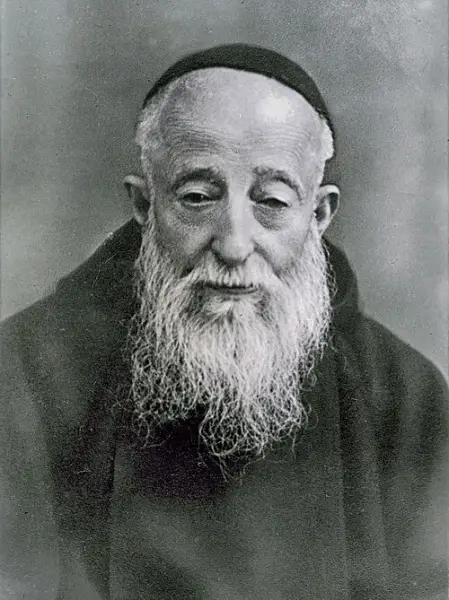
Overview
Leopold Mandić, baptized Bogdan Ivan, was born on 12 May 1866 at Herceg Novi in the Bay of Kotor, the twelfth child of a devout Catholic family of the Dalmatian coast. Small in stature, physically frail, and afflicted with a stutter, he overcame obstacles that would have ended most vocations: refused the preaching he longed for, he poured himself into the confessional instead, often spending twelve to fifteen hours a day reconciling sinners to God. A Capuchin of the Venetian Province, he was ordained a priest in Venice in 1890 and in 1906 settled at the friary of Santa Croce in Padua, where he passed the remaining thirty-six years of his life. He never abandoned the dream of reuniting the Catholic and Orthodox churches and of mission in the East, and for this he was called the Apostle of Unity; for his confessional stamina, the Apostle of Confession. Detained for a year in an Italian prison during the First World War because he would not renounce his Croatian nationality, he died of cancer on 30 July 1942, collapsing as he prepared for Mass. Beatified in 1976 by Pope Paul VI and canonized in 1983 by Pope John Paul II, he is invoked especially by those suffering from cancer.
The Complete Life
The Twelfth Child of Herceg Novi
Bogdan Ivan Mandić was born on 12 May 1866 at Herceg Novi, a town on the Bay of Kotor that then belonged to the Austrian Empire and now lies in Montenegro. He was the twelfth child born to Petar Antun Mandić, who owned an Adriatic fishing fleet, and his wife Dragica Zarević; the family had come from Zakučac in the hinterland of Omiš and, further back, from Bosnia. The household was devout in an unremarkable, daily way: his father walked the boy to church every morning for Holy Mass, and Mandić would remember his mother all his life as the one to whom he owed everything he became. The Capuchins had served the town for two centuries, dating from the era of Venetian rule, and the boy grew up in the orbit of their friary. His body, however, seemed to argue against any religious future. Physically malformed and delicate, he reached an adult height of only 1.35 meters, walked with a clumsy gait, stuttered badly, and suffered stomach ailments. In November 1882, at sixteen, he made his way to Udine for the minor seminary of the Capuchin Venetian Province; after two further years he entered the novitiate at Bassano del Grappa, received the habit, and given the name Leopold.
§ Early life
Vows Against Every Obstacle
Leopold made his first profession of vows on 3 May 1885 and was sent to prepare for Holy Orders in the Capuchin friaries of Padua and Venice, professing perpetual vows at Padua on 28 October 1888. On 20 September 1890 he was ordained to the priesthood at the age of twenty-four in the Basilica of Santa Maria della Salute in Venice, the cardinal patriarch Domenico Agostini conferring the sacrament. The early assignments that followed were humble and rotational: posts in various friaries of the Venetian region and in Croatia, teaching of seminarians, household chores such as the office of porter. Two ambitions were closed to him for good. His voice lacked the volume for the pulpit, and the missionary life among the Eastern churches that he imagined never came. Yet one duty ran through every posting and grew into his life's work: the confessional. What his voice could not do from the pulpit, his hands and his patience accomplished hour by hour in the reconciliation of penitents. When in 1906 he was assigned to the Friary of Santa Croce in Padua, he found the place where all of this would ripen; he would remain there for the rest of his life.
§ Priesthood
Apostle of Confession, Apostle of Unity
At Padua, Mandić's ministry found its full form. Confession was the constant of his priesthood, and there were days when he spent twelve to fifteen hours in the confessional, welcoming a stream of penitents with a gentleness that made the friary of Santa Croce a destination for sinners from across the region and beyond. In an era when priests of his stature were often moved to larger assignments, he stayed, and the stay became a thirty-six-year sermon on fidelity to a single post. Alongside this daily labor burned a longing he never laid down: the reunion of the Catholic and Orthodox churches and a missionary journey to the Orient that was never granted. He dreamed of the East unceasingly, and that unrealized dream earned him, together with his confessional work, the titles by which he is remembered: Apostle of Confession and Apostle of Unity. The First World War touched him directly when his refusal to renounce his Croatian nationality cost him a year in an Italian prison. The confinement did not embitter him; it belonged, with all his disappointments, to the same pattern of surrendered hopes transfigured into patient service.
§ Priesthood
Mercy Guarded in a Little Cell
The center of Leopold's spiritual life was small almost to the point of invisibility: a cell and a confessional. He understood his own disabilities not as disqualifications but as the shape his particular cross had taken, and he answered them with tremendous interior strength rather than with complaint. His life of prayer was ordered entirely to the work of reconciliation, for he believed that the mercy of God, personally applied to each penitent, was the most powerful force available for the healing of divided Christendom. The unity he longed for was not, for him, an abstraction negotiated between hierarchies but the sum of individual hearts returned to God, and so he prayed and heard confessions as though every absolution brought the churches nearer. Before his death he gave this conviction a prophetic form, predicting that the bombs of the coming war would strike his church and friary but would leave his little cell untouched, because so much mercy had been exercised there that it had to remain as a monument to God's goodness. When the bombing came, the prophecy held: the church and part of the friary were demolished, and the cell and confessional survived.
§ Veneration
Death While Preparing for Mass
In his last years Mandić suffered from cancer of the esophagus, an illness that would carry him off at the age of seventy-six. His end came as his life's rhythm would have predicted: on 30 July 1942, as he readied himself for Mass, he fell to the floor of the friary at Padua. The friars carried him to his cell, where he received the last rites, and as they gathered at his bedside they began to sing the Salve Regina. He died while they sang, as the antiphon reached its closing words of praise to Mary, clement, loving, and sweet. The war he had foreseen soon proved his prophecy about his cell: Allied bombing destroyed the church and part of the friary, but the cell and confessional where he had spent decades of mercy stood unharmed amid the ruins. The Sanctuary of Leopold Mandić was subsequently built around them, so that pilgrims to Padua today kneel in the very place where he exercised the ministry that made him famous. His body rests there, at the shrine that grew from the wreckage of the city he served.
§ Death
Raised to the Altars
The reputation for holiness that Mandić left in Padua moved the Church to formal recognition within a single generation of his death. On 2 May 1976 Pope Paul VI beatified him in Saint Peter's Basilica, and on 16 October 1983 Pope John Paul II canonized him during the General Assembly of the Synod of Bishops, holding him up to the world's bishops as a model of the reconciling ministry. In the Jubilee Year of 2015 and 2016, at the personal request of Pope Francis, his remains were carried to Rome to be venerated alongside those of his fellow Capuchin Padre Pio; the two saint-confessors were designated to inspire the faithful to reconciliation with the Church and with God through the confession of their sins. Pilgrims venerated their bodies first at the Basilica of Saint Lawrence outside the Walls, cared for by the Capuchins, and then in Saint Peter's itself. His feast is kept on 12 May, the anniversary of his birth, with 30 July, the day of his death, recorded in the Roman Martyrology. The Church hails him as the Apostle of Unity.
§ Veneration
Parishes, Sanctuaries, and the Sick Who Pray to Him
Leopold's cult took root with special strength in the Croatian lands of his family and across the Croatian diaspora. Churches, parishes, and monasteries bear his name from Victoria, British Columbia, and a Croatian Catholic mission in Auckland dedicated in 1990, to Lima, Peru, and a constellation of parishes across Croatia, including Koprivnica, Osijek, Požega, Slavonski Brod, Virovitica, and Zagreb, together with the Dragunja Donja parish in Bosnia and Herzegovina. Sanctuaries at Maglaj, at Padua, and at Zakučac near Omiš, the village of his family's roots, mark the geography of his devotion, and he is honored as patron saint of Zakučac itself. Daughters of Divine Charity serve a monastery under his patronage at Travnik, and another of his name stands in the Dubrava district of Zagreb. Beyond the Croatian world, his intercession is sought above all by those suffering from cancer, the disease that killed him, and his shrine at Padua remains a center of pilgrimage for the sick. The little friar who was refused every large stage ended with a larger one than any preacher of his century: the confessional door of the universal Church.
§ Patronate
Timeline
- 12 May 1866
Born Bogdan Ivan Mandić at Herceg Novi in the Bay of Kotor, twelfth child of Petar Antun and Dragica Mandić.
§ Early life
- Nov 1882
Left home at sixteen for the minor seminary of the Capuchin Venetian Province at Udine.
§ Early life
- 1884
Entered the novitiate at Bassano del Grappa, received the Capuchin habit, and took the religious name Leopold.
§ Early life
- 3 May 1885
Made his first profession of religious vows on 3 May.
§ Early life
- 28 Oct 1888
Professed perpetual vows at Padua on 28 October.
§ Early life
- 20 Sep 1890
Ordained a priest at the Basilica of Santa Maria della Salute in Venice by Cardinal Domenico Agostini.
§ Priesthood
- 1906
Assigned to the Santa Croce friary at Padua, his home for the remaining thirty-six years of his life.
§ Priesthood
- 30 Jul 1942
Died at Padua on 30 July as his friars sang the Salve Regina at his bedside.
§ Death
- 2 May 1976
Beatified by Pope Paul VI at Saint Peter's Basilica on 2 May.
§ Veneration
- 16 Oct 1983
Canonized by Pope John Paul II on 16 October during the General Assembly of the Synod of Bishops.
§ Veneration
- 2015
Remains brought to Rome at Pope Francis's request for veneration during the Extraordinary Jubilee of Mercy, alongside Padre Pio.
§ Jubilee Year
In Their Own Words
The church and the friary will be hit by the bombs, but not this little cell. Here God exercised so much mercy for people, it must remain as a monument to God's goodness.
to whom I owe everything that I am.
The Record
- Patron of
- cancer sufferers
- Canonization
- Canonized 16 October 1983 by Pope John Paul II at Saint Peter's Basilica
Prayer
Bibliography
Show 5 sources
- "St. Leopold Mandić, patron of those suffering from cancer." Order of Friars Minor Capuchin, 23 November 2018.
- "Veliki svetac i rodoljub, Bogdan Leopold Mandić" [Great saint and patriot, Bogdan Leopold Mandić]. hkv.hr, Croatian Cultural Committee (HKV), 23 August 2010.
- "St. Leopold Mandic, OFMCap." beafriar.com, The Capuchin Franciscans. Archived from the original on 2 February 2007.
- "Leopold of Castelnuovo." Basilica Shrine of Our Lady of the Miraculous Medal.
- "Two great confessors chosen for the Jubilee of Mercy: Saint Pio and Saint Leopold." Rome Reports, 29 September 2015. Archived from the original on 4 October 2015.
Profile text adapted from the Wikipedia article, licensed CC BY-SA 4.0.
Pray with this saint every day
Save St. Leopold Mandić to your favorites, read the full profile, and get feast-day reminders in the Saints app.
Get the Saints AppFree on the App Store for iPhone and iPad