
early 2nd century – 180·Feast January 11
St. Leucius of Brindisi
Missionary bishop and martyr, first Bishop of Brindisi
Overview
Leucius of Brindisi was a second-century missionary honored as the first bishop of the southern Italian port city of Brindisi. Tradition holds that he was born in Eastern Europe under the name Eupressius, to parents named Eudecius and Euphrodisia, and that his youth was spent in Alexandria, where he received his education. After his mother's death he embraced monastic life, and a vision experienced during the Feast of the Assumption led him to take the name Leucius. Already a bishop, he crossed the Mediterranean to Brindisi, then among the great harbors of the Mediterranean world, intending to free its pagan inhabitants from misunderstanding of the Christian faith. His preaching during a drought won a mass conversion when the long-awaited rains followed his promise that faith would bring them. As first bishop of the see he raised churches dedicated to St. Mary and St. John the Baptist. According to longstanding tradition, he sealed his witness with martyrdom around the year 180. His cult spread widely across Apulia and southern Italy, and his relics, moved several times over the centuries, remain objects of pilgrimage.
The Complete Life
A Childhood Between Two Worlds
The earliest facts of Leucius' life are wrapped in the uncertainty that surrounds many martyrs of the first centuries. Tradition reports that the child first called Eupressius was born in Eastern Europe to a couple named Eudecius and Euphrodisia, though the precise place of his birth has not been preserved. What the sources assert with more confidence concerns his formation: the boy was taken to Alexandria, the intellectual and spiritual metropolis of the eastern Mediterranean, and there he was educated and passed the decisive years of his youth. Alexandria exposed him to the full richness of Christian learning and ascetic practice in an age when the faith was spreading through the great cities of the East. The turning point of his young life came with the death of his mother. Rather than pursuing a secular career, the grieving Eupressius withdrew into monastic life, embracing a discipline of prayer and renunciation that would mark him permanently. It was within this monastic setting, at the annual feast of Our Lady's Assumption, that a heavenly vision came to him after which he took the name Leucius, the name under which he would be known to history.
§ Early life
Called to an Unknown Harvest
Leucius' vocation unfolded in stages that joined the contemplative and the apostolic. His monastic profession in Alexandria formed him in holiness, and at some point he was raised to the episcopacy, though the circumstances of his ordination as a bishop are not recorded. Even as a bishop, however, his heart turned toward mission. He resolved to undertake a missionary apostolate in Brindisi, a prosperous port on the Adriatic in what is now southern Italy. His stated aim was to liberate the pagans of that region from their misconceptions about Christianity — a mission of explanation and persuasion as much as preaching. The choice of Brindisi was significant: the city ranked among the largest ports of the Mediterranean and was a crossroads of Greek, Roman, and eastern traffic, so that a church planted there could radiate through Apulia and beyond. Leaving Alexandria behind, Leucius crossed the sea to a city where the Gospel was poorly understood, betting his life on the conviction that clear preaching and evident holiness could accomplish what force never could.
§ Early life
Rains Over Apulia
Leucius first won public attention in Apulia during a severe drought. As he preached the Gospel to gathered pagans, he made a striking claim: if they believed his message, the rains would return. When the rain in fact fell, the crowd that had listened to him was converted on the spot, and his reputation spread rapidly through the region. This baptism of the people called for structure, and Leucius became the first Bishop of Brindisi, formally founding the diocese in 165. As bishop he turned to the practical work of building: two churches rose under his direction, one dedicated to St. Mary and the other to St. John the Baptist, giving the young Christian community permanent places of worship at the heart of a great port city. His ministry combined proclamation, sacramental leadership, and construction — the full pattern of an early episcopal mission. The sources do not preserve the details of his later governing years, but the community he planted endured, and the memory of the preacher who brought rain to a parched land remained the founding story of the see.
§ Religious life
Martyrdom and First Burial
The closing chapters of Leucius' life are known only through tradition rather than continuous record. The sources frankly acknowledge that the later part of his episcopate is unknown, but the constant memory of the Church of Brindisi holds that he died a martyr around the year 180, probably under Roman persecution. Death did not end his connection to the city he had evangelized. Soon after his martyrdom his remains were brought back to Brindisi and honored there, and they remained in the city for centuries — a visible sign of the continuity between the founding bishop and the church he established. That continuity was violently interrupted in 768, when the Lombard invasion swept through Apulia and the relics were displaced. The body that had rested at Brindisi since the second century began a long migration through the churches of southern Italy, passing to Trani, where pilgrims increasingly sought it, and eventually to Benevento, the capital of the Lombard duchy. Even in death, the first bishop of Brindisi continued to travel the roads of the region he had converted.
§ Religious life
A Martyr of the Undivided Church
Leucius of Brindisi belongs to the great company of saints who were never formally canonized, because they died before the machinery of canonization existed. He is honored as pre-congregation — a martyr whose sanctity was recognized by the uninterrupted veneration of the Church from the earliest period. Both the Roman Catholic Church and the Orthodox Church keep his memory, celebrating his feast on 11 January. Popular veneration attached memorable legends to his name: at Atessa in Abruzzo, the people told how the bishop of Brindisi slew a dragon that had long terrorized them, receiving one of its ribs in witness of the deed, a relic that became part of local devotion. Rural parishes throughout Apulia still carry his name, and his cult struck firm root in Trani, Lecce, Benevento, Caserta, and Capua alike, and as devotion to him advanced through the south it coincided with the conversion of the Lombard Duchy of Benevento, attributed to Saint Barbato in 680 and to Duchess Teoderada in 706, so that the memory of the martyr became woven into the Christianization of the whole region.
§ Veneration
Relics on the Move
The material legacy of Leucius tells its own story of southern Italian history. In the late ninth century Bishop Theodosius of Brindisi and Oria managed to recover portions of the saint's relics and placed them in a new basilica built above the ancient martyrium from which they had earlier been carried off to Trani. Devotion reached even Rome, where a monastery dedicated to Leucius stood as early as the sixth century — evidence that his fame had traveled far beyond Apulia within a few generations of his death. In Brindisi itself, the great Basilica Cathedral, dedicated in 1771, guards an arm relic of the first bishop at the altar closing its left aisle, while a canvas portrait of the saint by the painter Oronzo Tiso adorns the same church. At Benevento, a depiction of Leucius by Tiso keeps his image before the faithful in the cathedral that received his remains centuries earlier. From a missionary who arrived by sea to a martyr whose bones were fought over by cities and dukes, Leucius remains the spiritual ancestor of the Church of Brindisi and one of the most widely honored early bishops of southern Italy.
§ Veneration
Timeline
- 165
Founded the Diocese of Brindisi as its first bishop after arriving from Alexandria.
§ Leucius of Brindisi
- 180
Suffered martyrdom at Brindisi, according to tradition.
§ Religious life
- 680
Official conversion of the Lombard Duchy of Benevento, credited to Saint Barbato, advanced the spread of Leucius' cult.
§ Veneration
- 706
Conversion of Duchess Teoderada further strengthened devotion to the saint in the duchy.
§ Veneration
- 768
The saint's remains, kept at Brindisi since his death, were displaced by the Lombard invasion.
§ Religious life
- 1771
The Basilica Cathedral of Brindisi was dedicated; its left-aisle altar preserves an arm relic of Leucius.
§ Veneration
The Record
- Major works
- Founding of the Diocese of Brindisi·Churches of St. Mary and St. John the Baptist at Brindisi
- Patron of
- Brindisi·Atessa
- Symbols
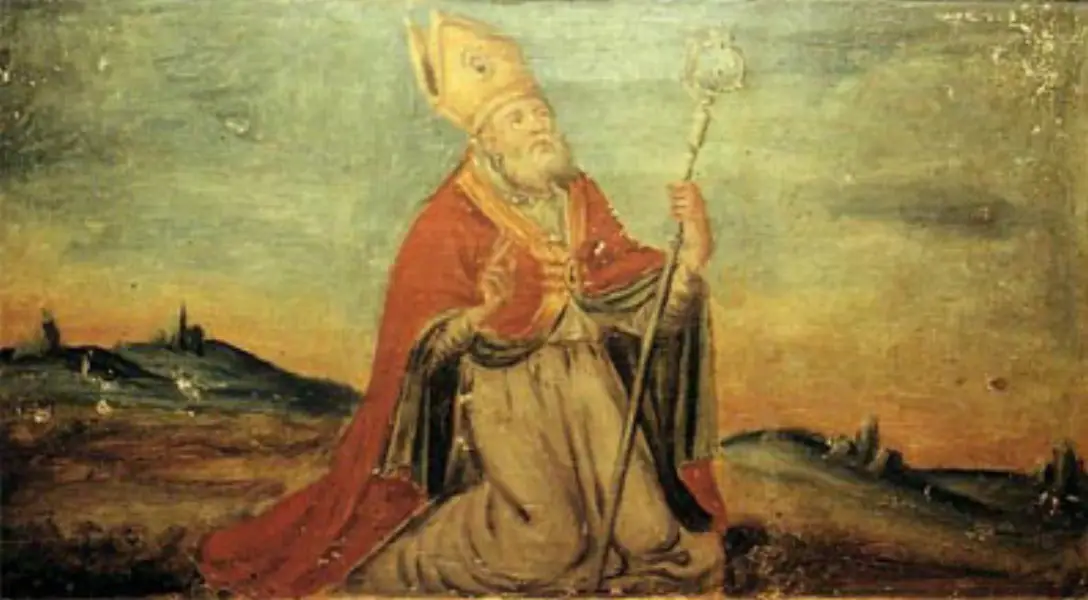
- Pastoral staff·Depicted with a dragon's rib at Atessa
- Canonization
- Pre-congregation; venerated as a martyr from the earliest centuries
Prayer
Bibliography
Show 6 sources
- St. Leucius of Brindisi, Catholic Online
- San Leucio di Brindisi Vescovo, Santi Beati e Testimoni
- Preradović, Dubraka (2021). "Donato di Zara, Teodosio di Oria ele traslazioni delle reliquie nelle città bizantine dell'Adriaticonel IX secolo". Bisanzio sulle due sponde del Canale d'Otranto. Spoleto: Fondazione Centro italiano di studi sull'alto Medioevo. pp. 100–111. ISBN 978-88-6809-355-6.
- San Leucio a Villavallelonga, Ass. Pro Loco Villavallelonga
- Pietro Degli Onofri, Vita di Santo Leucio, primo vescovo di Brindisi, Ed. Raimondi, Napoli 1789.
- E. Bove, Il lungo viaggio del beato Leucio, Ed. del Matese, 1990.
Profile text adapted from the Wikipedia article, licensed CC BY-SA 4.0.
Pray with this saint every day
Save St. Leucius of Brindisi to your favorites, read the full profile, and get feast-day reminders in the Saints app.
Get the Saints AppFree on the App Store for iPhone and iPad