
c. 660 – 722·Feast September 29
St. Leudwinus
Frankish count turned Archbishop of Treves and founder of Mettlach
Overview
Leudwinus, known in Frankish as Liutwin and also called Leodewin or Ludwin, was a nobleman of one of the most powerful clans of Austrasia who rose from secular aristocratic life to become Archbishop of Treves and Bishop of Laon. Born around 660 at Mettlach on the Saar, he was the son of Warinus, Count of Poitiers, and Gunza of Metz, and came from a family dense with saints: his father, his grandmother Sigrada, his uncle Leodegarius, and his uncle Archbishop Basinus of Treves are all honored as saints. Educated by Basinus, he initially chose the path of a lay noble, serving at the royal court and styled Count of Treves, and married Willigard of Bavaria, with whom he had several children. Only after being widowed did he embrace the monastic life at the abbey he himself had founded at Mettlach, an establishment born of the famous legend of the eagle that shaded him while he slept. Called to coadjutor of Treves in 697, he succeeded his uncle as archbishop in 705 and simultaneously held the see of Laon, making him one of the foremost churchmen of the Frankish kingdom. He died on 29 September 722 at Reims, and his relics remain at Mettlach, where they are carried in procession each Pentecost.
The Complete Life
Born Into a Family of Saints
Leudwinus entered the world around the year 660 at Mettlach, in what is now the Saarland of Germany, as a member of one of the dominant aristocratic houses of Austrasia. His pedigree joined worldly power to conspicuous holiness: his father was Warinus, Count of Poitiers, later honored as a saint, and his mother was Gunza of Metz. Through his grandmother Sigrada and his uncle Leodegarius he belonged to a network of sainted kin, and Lambert of Maastricht counted among his relatives. His education was entrusted to his maternal uncle, Saint Basinus, Archbishop of Treves, so that the future archbishop received his formation at the very see he would one day govern. As a young nobleman he did not pursue an ecclesiastical career. Instead he frequented the royal court of Austrasia, where he was accorded the title Count of Treves, and lived the life expected of a great Frankish lord. His first public act recorded in the sources is documentary rather than martial: in 697 he placed his signature on the Deed of Echternach alongside his uncle Basinus, an early sign of the intimate connection he would maintain with the monastic foundations of his region.
§ Early life
Marriage, Widowhood, and the Cloister
Leudwinus' path to the altar ran through the ordinary duties of a nobleman rather than around them. Having shown little initial interest in a church career, he married Willigard of Bavaria and raised a family that would shape the politics of the next generation. Their sons Milo and Wido became Count of Treves and Count of Hornbach respectively, and a daughter, possibly Chrotrude or Rotrude, married Charles Martel himself and became Duchess of Austrasia. Had Leudwinus died in this station, he would be remembered only as an ancestor of Carolingian greatness. Instead, the sources recount that when he became a widower he renounced his remaining worldly standing and entered as a simple monk the very monastery he had founded at Mettlach. The gesture is striking: a count who had commanded the church as a lay patron now submitted himself to its discipline as a bare religious. Within a short span he was called back out of the cloister into its highest office, when in 697 his uncle Archbishop Basinus named him coadjutor of the see of Treves, preparing the succession that would place a former monk on the archiepiscopal throne.
§ Mettlach Abbey
The Eagle of Mettlach and the Double See
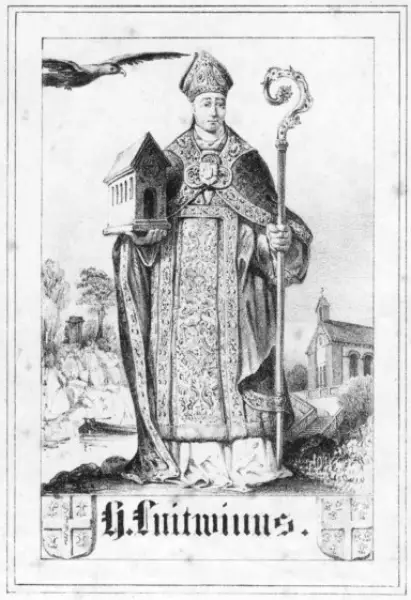
The founding of Mettlach Abbey, the great work of Leudwinus' life, was according to legend born of a moment of rest. Hunting near the Saar, he grew weary and fell asleep beneath a tree. The sun shifted while he slept and its burning rays fell upon him, but an eagle descended and spread its wings above his body, shielding him until he woke. When his servant described what had happened, and when Leudwinus realized he had been napping beside the chapel of St. Denis of Paris at the spot remembered as the Miracle Eagle, he read the event as a sign from God and established a Benedictine monastery there. The house soon grew into a center of Christian mission in the Saar region; on the site of the original chapel stands today the parish church of St. Gangolf in Mettlach. His episcopal career culminated in a rare concentration of authority. Basinus' death on 4 March 705 left the see vacant; Leudwinus succeeded to it and received consecration as Archbishop of Treves, while being appointed Bishop of Laon at the same time. Holding two sees at once, he stood among the most important church dignitaries in the entire Frankish kingdom, and the records of his governance were later gathered in the Gesta Treverorum.
§ Bishop of Triers
The Ship That Sailed Alone
Leudwinus died on 29 September 722 at Reims, far from his see. The succession revealed the entanglement of his family with the church of Treves: his own son Milo, who inherited the archbishopric, brought his father's body back toward Treves for burial. Local custom in the city, however, stood in the way, and the family resolved to let the dead saint indicate where he wished to rest. The coffin was set aboard a ship and left without a crew. According to the account, the vessel moved of its own accord, first along the Moselle, then down the Saar, until it came to dock at Mettlach, where the church bells rang out at its arrival. There the archbishop was buried in St. Mary's Church at the abbey he had founded — the simple monk returning permanently to his own monastery. The story of the uncrewed ship became one of the most cherished narratives of the Saar region, confirming in popular imagination that Mettlach, not the metropolitan city of Treves, was the place the saint had chosen for himself, and founding the tradition of pilgrimage that continues at his grave to this day.
§ Death
A Saint Before Formal Processes
Like many great churchmen of the Merovingian and early Carolingian age, Leudwinus was never subjected to a formal act of canonization; he passed into the calendar of the saints through the continuous veneration of the people among whom he had lived and died. The Church keeps his memory on 29 September, the anniversary of his death, though because that date coincides with the feast of Saint Michael the Archangel, the liturgical reform after the Second Vatican Council moved his feast to 23 September, shared with his uncle Saint Basinus. He is venerated in both the Roman Catholic and Eastern Orthodox churches, and his attributes center on the eagle that sheltered him in the founding legend of Mettlach. Reports of miracles at his tomb in Mettlach accumulated over the centuries and made the site one of the enduring pilgrimage destinations of the Saarland. As patron of the Mettlach parish, he remains a living presence in the town's devotional life: each year at Pentecost his relics are carried in procession through the streets, a custom that binds the modern community to the count-bishop who founded their abbey more than thirteen centuries ago.
§ Feast Day of St. Leudwinus
From Old Tower to Lutwinus Cathedral
The material legacy of Leudwinus traces the whole architectural history of the Saarland. Buried first in St. Mary's Church at Mettlach Abbey, he saw that church replaced in 990 by the structure known as the Old Tower, which survives today as the oldest preserved stone building in the Saar region. In 1247 his relics were moved again, into the newly constructed Leudwinus Chapel, and roughly two centuries later they were reburied once more in a chapel joined to the abbey church. The French Revolution brought the monastic complex to an end: the Boch family, later famous as porcelain manufacturers, purchased the monastery, demolished its buildings, and erected on the site the Lutwinus Cathedral of Mettlach, where the saint's relics are preserved today. His dynastic legacy was no less consequential — through his possible daughter Chrotrude, the wife of Charles Martel, he stands among the ancestors of Charlemagne. The written record of his episcopate was preserved in the Gesta Treverorum, securing the memory of his governance of Treves from 4 March 705 until his death. At Mettlach his name, his church, and his annual Pentecost procession keep the eagle-shaded founder permanently before the eyes of the community.
§ Death
Timeline
- 660
Born at Mettlach into the Frankish nobility of Austrasia, son of Count Warinus and Gunza of Metz.
§ Early life
- 697
Signed the Deed of Echternach together with his uncle, Archbishop Basinus of Treves.
§ Early life
- 697
Appointed coadjutor to his uncle Basinus, Archbishop of Treves.
§ Bishop of Triers
- 698
Cofounded the abbey at Echternach associated with Mettlach.
§ Bishop of Triers
- 4 Mar 705
Succeeded Basinus upon his death and was consecrated Archbishop of Treves, also receiving the bishopric of Laon.
§ Bishop of Triers
- 29 Sep 722
Died at Reims; his son Milo succeeded him as Archbishop of Treves.
§ Death
- 990
St. Mary's Church at Mettlach Abbey — the site of Leudwinus' grave — gave way to the structure later known as the Old Tower, now the oldest surviving stone building in the Saar.
§ Death
- 1247
His relics were translated to the newly built Leudwinus Chapel at the abbey.
§ Death
The Record
- Major works
- Founding of Mettlach Abbey·Cofoundation of Echternach Abbey·Governing of the Sees of Treves and Laon
- Patron of
- Mettlach parish
- Symbols
- Eagle
- Canonization
- Pre-congregation; venerated as a saint since the early medieval period
Prayer
Bibliography
Show 10 sources
- Weiner, Dr. Andreas. "Heiliger Lutwinus bitte für uns!". www.lutwinuswerk.de.
- "St. Ludwin". Catholic Online, Saints & Angels. Catholic.org.
- Young, Reinhold. "St. Lutwinus Mettlach Parish Church (Pfarrkirche St. Lutwinus Mettlach)". Lutwinuswerk Mettlach.
- Settipani, Christian (1989). The Ancestors of Charlemagne (Les ancêtres de Charlemagne). Biarritz. p. 172. ISBN 2-906483-28-1.
- Persch, Martin. "Heiliger Liutwin, Erzbischof von Trier". Biographisch-Bibliographisches Kirchenlexicon. Verlag Traugott Bautz.
- Georg Gresser: Geschichte des Bistums Speyer bis zum Ende des 11. Jahrhunderts. Quellen und Abhandlungen zur Mittelrheinischen Kirchengeschichte Band 89. Mainz 1998.
- Andreas Heinz: Heilige im Saarland. 2. Auflage. Saarbrücker Druck und Verlag, Saarbrücken 1991, ISBN 3-925036-44-X.
- Franz Xaver Kraus: Ludwin. In: Allgemeine Deutsche Biographie (ADB). Band 19, Duncker & Humblot, Leipzig 1884, S. 616 f.
- Friedrich Schneider: Die Trinkschale des Heiligen Lutwinus zu Mettlach. Von Zabern, Mainz 1905.
- Constantin von Briesen: Urkundliche Geschichte des Kreises Merzig-Wadern. Franz Stein, Saarlouis 1863.
Profile text adapted from the Wikipedia article, licensed CC BY-SA 4.0.
Pray with this saint every day
Save St. Leudwinus to your favorites, read the full profile, and get feast-day reminders in the Saints app.
Get the Saints AppFree on the App Store for iPhone and iPad