
died 738·Feast June 21
St. Leutfridus of Évreux
Benedictine abbot and founder of La Croix-Saint-Leufroy
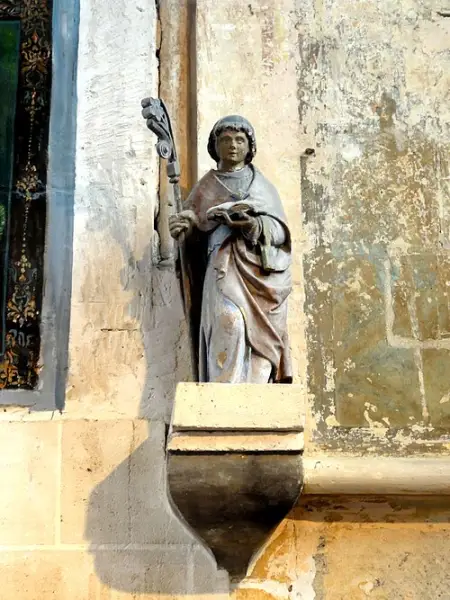
Overview
Leutfridus — in French Leufroi or Leufroy, also rendered Leutfrid — was a Benedictine monk and abbot of the early Norman church who died in 738. A native of the territory of Évreux, he studied at Condat Abbey and at Chartres and worked for a time as a teacher at Évreux before embracing the monastic life under Saint Sidonius of Saint-Saëns, whose spiritual disciple he became. After a season of hermit life passed first at Cailly and then at Rouen, he went back to his native region and about the year 690 founded the abbey of La Croix-Saint-Qu'en on the Eure a short distance from Évreux, on ground where Saint Owen had earlier raised a cross and chapel. He governed this community as its first abbot for some forty years, an exercise, in the words of his early biographer, of constant fasting, watching, and prayer. That house would in time take its founder's name, becoming Saint-Leufroy. His death came in 738; having received the viaticum, he was succeeded as abbot by his brother, Saint Agofredus. When Norman raids devastated the region in the ninth century, his monks fled to Saint-Germain-des-Prés in Paris, carrying his relics with them, and those remains remain in that abbey. He is commemorated in the Roman Martyrology on 21 June and holds an office in the new Paris Breviary.
The Complete Life
A Student of the Norman Schools
Leutfridus came from the territory of Évreux, and the first chapters of his life were devoted to study rather than to the cloister. According to Alban Butler's account, he received part of his education in the monastery of St. Taurinus at Évreux, and the main biographical notice records that he studied at Condat Abbey and at Chartres, two significant centers of learning in the Frankish church. For a period he worked as a teacher at Évreux itself, so that the man who would later be honored around that city first served it in the schoolroom. His family, too, would become known for holiness: Saint Agofredus, who eventually succeeded him as abbot, was his brother. The pattern of his youth — education in monastic schools, teaching in his home region, and contact with the great abbeys of northern Gaul — prepared him for a life that would join intellectual discipline to ascetic practice. When reports reached him of the extraordinary sanctity of Sidonius, abbot of the monastery near Rouen remembered as Saint-Saëns, he left his teaching post and sought out the holy man, whose disciple he became and from whose hands he received the monastic habit.
§ Life
The Habit from Sidonius and the Hermit Years
Leutfridus' formal entry into religious life came through Saint Sidonius of Saint-Saëns, whose reputation for holiness had drawn him away from his teaching. Receiving the monastic habit at the hands of the abbot he had chosen, he committed himself to the Benedictine tradition that would define the rest of his life. The sources also record an intervening stage of withdrawal: for a while he lived as a solitary, first at Cailly and later at Rouen. This eremitical season mattered for what followed. It was by the counsel of Saint Anshert, Archbishop of Rouen, that he finally left the solitude of the Rouen region and returned to his native country to undertake the foundation for which he is remembered. His vocation thus passed through the recognizable stages of the early medieval church — education, teaching, discipleship under a renowned abbot, solitary prayer, and only then, at the direction of his bishop, the public work of founding. That obedience to Anshert's advice gave his monastery its episcopal legitimacy and rooted it firmly in the ecclesiastical structure of the province of Rouen.
§ Butler's account
The Cross of St. Owen on the Eure
Around the year 690, on a site some two leagues from Évreux along the river Eure, Leutfridus built the monastery that became his life's work. He chose a place already marked by earlier devotion: there a cross and chapel had been raised in years past by St. Owen. In honor of that heritage he dedicated his house to the cross, naming it the Cross of St. Owen, though the passage of time gave it the name by which it is remembered — the Cross of St. Leufroi. The old records note that the site carried the ancient village name Madric, rendered in Latin as Madriacense. Leutfridus served the abbey as its first abbot and held that office for approximately forty years, a tenure of exceptional length that gave the community stable continuity through its formative decades. Under his government the house flourished as a Benedictine foundation in the lands between the Seine and the Eure. After his death the abbey came to bear his own name, Saint-Leufroy, the founder himself becoming the title of the house he had built in honor of the cross.
§ Butler's account
Forty Years of Fasting and Prayer
Alban Butler preserves a short but vivid portrait of Leutfridus' long abbacy: fasting, watching, and prayer were, he writes, the constant exercises of the abbot's whole life, and especially through the forty years in which he governed his monastery. The ascetic routine was not incidental to his leadership but constituted it — the abbot ruled by example of discipline as much as by office. He died in the year 738, and his death carried the marks of a peaceful and prepared end: Butler records that his end, coming after the holy viaticum had been given him, was a happy one. The succession at the abbey remained within his own family, for his brother Agofredus, honored likewise as a saint, took up the abbacy after him, continuing the spiritual tradition the founder had established. The long stability of his government and the orderly succession of a saintly brother suggest a community deeply shaped by its first abbot, one capable of surviving the upheavals that would soon come upon the Norman church from the sea.
§ Butler's account
In the Martyrology and the Paris Breviary
Leutfridus belongs to the ranks of saints honored before the establishment of formal canonization processes; his sanctity was received and celebrated by the church that grew up around his abbey. His commemoration became fixed on 21 June, and the Roman Martyrology enters his name on that day — the official recognition by the universal Church of a cult already ancient. His liturgical honor remained particularly alive in northern France: he is honored with an office in the new Paris Breviary, a direct consequence of the close bond between his monastery and the abbey of Saint-Germain-des-Prés, where his relics came to rest. An anonymous life of the saint written in the ninth century, preserved with the learned remarks of the Bollandist-era scholar Jean Mabillon, secured his story for later generations and testifies that his memory was already being formally recorded within a century of the Norman raids. The feast of 21 June keeps him in the calendar of the church of Évreux, the region whose schools first formed him and whose river Eure still passes the ground where he built.
§ Butler's account
Relics Carried to Paris
The ninth century brought the crisis that scattered — and paradoxically preserved — the memory of Leutfridus. When Norman incursions swept up the rivers of Neustria, the monks of Saint-Leufroy fled for refuge to the abbey of Saint-Germain-des-Prés in Paris, and they carried with them the relics of their treasures: those of St. Owen and St. Turiave alongside those of the founder and his brother Agofroi. When the danger passed and the monks returned home, they left two sets of remains at Saint-Germain in gratitude for the hospitality they had received — those of St. Leufroi himself and of St. Turiave — and those relics remain in the great Parisian abbey. The founder's bones thus came to rest in the capital, giving his cult a second home far from the Eure. The abbey he founded endured under his name for centuries, and his brother Agofredus shares his commemoration in the same region. Modern readers know him chiefly through Butler's retelling and through the ninth-century life preserved by Mabillon, while an enduring curiosity attaches to the striking title of a later lecture that remembered him as a saint of just and holy wrath.
§ Butler's account
Timeline
- 690
Founded the abbey of La Croix-Saint-Qu'en near Évreux and became its first abbot.
§ Life
- 738
Died peacefully once the viaticum had been administered; his brother Agofredus then took over the abbacy.
§ Butler's account
In Their Own Words
Fasting, watching, and prayer were the constant exercises of his whole life, especially during forty years that he governed his monastery.
The Record
- Major works
- Founding of the abbey of La Croix-Saint-Qu'en (later Saint-Leufroy)
- Patron of
- Diocese of Évreux
- Symbols
- Abbot's crosier·Cross (his abbey was dedicated to the Cross)
- Canonization
- Pre-congregation; named in the Roman Martyrology on 21 June
Prayer
Bibliography
Show 2 sources
- Goyau, Georges. "Evreux." The Catholic Encyclopedia. Vol. 5. New York: Robert Appleton Company, 1909.
- Butler, Alban (1798), The lives of the primitive fathers, martyrs, and other principal saints..., J. Moir, pp. 345–346.
Profile text adapted from the Wikipedia article, licensed CC BY-SA 4.0.
Pray with this saint every day
Save St. Leutfridus of Évreux to your favorites, read the full profile, and get feast-day reminders in the Saints app.
Get the Saints AppFree on the App Store for iPhone and iPad