
1768 – 1841·Feast October 24 (O.S. October 11)
St. Lev of Optina
Elder and founder of the Optina eldership
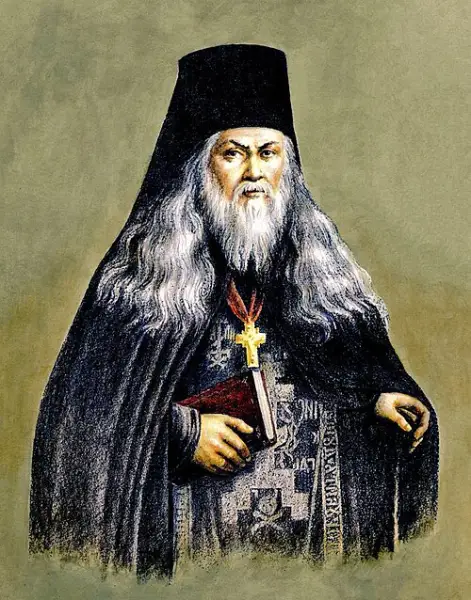
Overview
Hieroschemamonk Leonid (in the world Lev Danilovich Nagolkin; 1768–1841), also known as Leo or Lev of Optina, was a venerable elder and one of the founders of the celebrated eldership of Optina Monastery. Born in Karachev in Orlov Province to a family of ordinary parents, he spent his youth in the service of a merchant, traveling constantly and learning to deal with all kinds of people. He entered Optina Monastery in 1797 as the house was being revived, then moved to White Bluff monastery, where under Hieromonk Basil (Kiskin) he was trained in obedience and patience. Tonsured in 1801 with the name Leonid, he was ordained deacon and priest that December, and in 1804 he was appointed igumen of White Bluff. Drawn to the stricter life, he resigned his office in 1808 to join the hermit cell of Schemamonk Theodore, a disciple of St. Paisius Velichkovsky, from whom he learned the tradition of spiritual direction and the acquisition of the grace of the Holy Spirit. After years of wandering through the monasteries of northern Russia, he came to Optina in April 1829 with six disciples and there established eldership, the practice of direction by a spiritual father that made Optina the spiritual center of nineteenth-century Russia. Crowds of every social class sought his counsel until his death in October 1841.
The Complete Life
A Merchant's Apprentice from Karachev
The future elder was born Lev Danilovich Nagolkin in 1768 in the town of Karachev in Orlov Province, to parents of ordinary standing. His first formation came not from books but from business: in his early years he worked for a merchant and made frequent journeys on his employer's behalf. Those travels gave him something a village education could not — long experience of dealing with all sorts of people, reading their needs, and winning their confidence. The skills of the road would later serve the confessor, who spent decades receiving an unending stream of visitors of every rank and condition. As he reached mature manhood, Lev resolved to leave the world entirely and enter monastic life. In 1797 he entered Optina Monastery, arriving at a providential moment, for the monastery was then in the process of being reborn after long decline. His stay there proved short: two years on he moved to the White Bluff monastery of the Orlov eparchy, whose community was led by Hieromonk Basil (Kiskin). There, under a capable and experienced director, the young novice began the training in monastic virtue that would underlie everything that followed.
§ Life
Tonsure, Priesthood, and the Abbacy He Gave Up
At White Bluff, Leo underwent a thorough apprenticeship in the monastic virtues of obedience, patience, and external labor under Fr. Basil. In 1801 Fr. Basil tonsured him a monk, giving him the name Leonid, and later that same year the new monk was ordained — first a deacon on 22 December, then a priest on 24 December. He fulfilled his obediences with such earnestness that he set an example to the other monastics and attracted the notice of his superiors. During this period a stay at Cholnsk monastery brought him into contact with Schemamonk Theodore, one of St. Paisius Velichkovsky's own disciples, a Karachev man like Leonid and roughly ten years his senior. Under Theodore's direction Leonid began to learn the deeper science of spiritual struggle and the acquisition of the grace of the Holy Spirit. Recognition came quickly: in 1804, with only five White Bluff years behind him, Bishop Dorotheus of Orlov and Svensk named him Fr. Basil's successor in the abbacy. Yet the office never possessed him. In 1808, after four years as abbot, he resigned, longing for the stricter life, and received the great schema with the new name Leo at the wilderness cell Fr. Theodore had made for himself with his disciple Cleopas, a mile or so beyond the monastery.
§ Life
Years of Wandering and the Call to Optina
The little company of ascetics could not remain hidden. The fame of the three spiritual warriors drew so many visitors and distractions that they began looking elsewhere. In 1809 Theodore departed, going first to New Lake Monastery and afterwards to the Palei Island Hermitage, and in 1812 he continued to the All Saints Skete of Valaam Monastery; Leonid and Cleopas, who had made the same move that year, rejoined him there. When Hieroschemamonk Cleopas died in 1816, Leonid and Theodore transferred to the monastery of St. Alexander of Svir. Theodore's repose on Bright Friday, 7 April 1822, left Leonid without his elder, and he set out for a more secluded place, coming with his disciples to Ploschansky Hermitage. There, providentially, he made the acquaintance of Fr. Macarius. Some years afterward, on the invitation of Fr. Moses, Leonid reached Optina Monastery in April 1829, six disciples accompanying him. The group received cells in the Skete, his own standing beside the apiary. The arrival marked a new chapter in Optina's history, for the monk who had wandered from desert to desert brought with him the treasure he had received through Theodore from St. Paisius: the tradition of eldership.
§ Life
The Tradition of Eldership
Lev's enduring contribution to Russian spirituality was the transmission of eldership — the practice of entrusting one's soul to an experienced spiritual father for ongoing guidance. The teaching held that direction by an Elder is a sure and reliable path to salvation, and its lineage stretched through the Egyptian and Palestinian deserts to Mount Athos, and out of Athos into Russia. Lev had received it directly from Schemamonk Theodore, himself a disciple of St. Paisius Velichkovsky, the great restorer of patristic spiritual literature. From Fr. Leonid's hands, and those of St. Macarius — his disciple, who came after him to Optina in 1834 — the tradition took root at Optina Monastery and made it the foremost center of eldership in the empire. His method was personal rather than theoretical: he drew on the knowledge and experience gained through thirty years of asceticism to treat the spiritual afflictions of those who came to him. The crowds that flocked to Optina included people of every social class, drawn by a wisdom that neither rank nor learning could replace. The monastery's peaceful routine was disrupted by the press of visitors, and this very disruption — the abbot's cell became a public tribunal of souls — was the price of the tradition taking hold.
§ Life
Misunderstanding, Illness, and a Peaceful End
The elder's final years brought both opposition and grace. In the years 1835–1836 a party of monks with no grasp of what eldership meant lodged complaints against him with the bishop, troubled by the many visitors and the disruption of the monastery's quiet. In 1841 he became entangled in jealousies among the nuns who sought his spiritual counsel, which resulted in the expulsion of Mother Anthia and another sister from their convent on erroneous opinions; only the intervention of Metropolitan Philaret (Amphiteatrov) of Kiev secured their readmission on 4 October 1841. By then the elder himself was dying. His health began to fail in September 1841: he received Holy Unction on 15 September and from that point prepared deliberately for death. On 28 September he received Holy Communion and thereafter took no food and little water, sustained only by what the account calls the life-giving Mysteries of Christ. In the evening of that 11 October 1841 his eyes closed, and he gave his soul back to God. The burial followed two days afterward: on 13 October Fr. Moses celebrated the funeral rites, every hieromonk and hierodeacon then present joining him, and the elder found his resting place beside the principal church of the Entrance of the Theotokos, facing the chapel of St. Nicholas.
§ Life
Glorification of the First Optina Elder
Recognition of Leonid's sanctity came in stages across the final decade of the twentieth century, reflecting the revival of the Russian Church after the Soviet period. In 1990 the Russian Orthodox Church Outside Russia glorified Elder Leonid together with all the Elders of Optina, and the feast day of St. Leonid of Optina was fixed on 11 October (24 October on the new calendar), the day of his repose. The Moscow Patriarchate followed: on 13 June 1996 it authorized the local veneration of the Elders of Optina, and on 7 August 2000 their glorification for universal veneration was proclaimed. He is depicted clothed as a hieromonk, at times holding a scroll, an image of the teaching elder. His canonization placed him at the head of the great Optina constellation that includes his disciple St. Macarius and his successors in the eldership, above all St. Ambrose of Optina, through whom the tradition he planted would become known across the world. He belongs spiritually to the same movement as St. Seraphim of Sarov and the other restorers of Russian monastic spirituality of his age.
§ Glorification
The Flowering of Optina
Leonid's legacy is the institution he founded: the eldership of Optina Monastery, which for the remainder of the nineteenth century served as the spiritual heart of Russian Orthodoxy. By introducing at Optina the succession of direction he had received from Fr. Theodore, he created the framework within which an unbroken line of elders received the thousands of pilgrims — peasants, merchants, officers, intellectuals, and writers — who made the journey to the monastery. His disciple St. Macarius — come after him to Optina in 1834 — carried the work forward, and after Macarius came St. Ambrose, the most celebrated of them all. The path he restored — guidance by an Elder recognized as a sure and reliable way to salvation — connected nineteenth-century Russia to the deserts of Egypt, Mount Athos, and the teaching of St. Paisius Velichkovsky. The continuity of the tradition survived even the destruction that came later; when the Optina Elders were glorified for universal veneration in 2000, Leonid stood first among them. His life was later told in Fr. Clement Sederholm's biography Elder Leonid of Optina, published by the St. Herman of Alaska Brotherhood, and his memory is kept in the synaxaria and iconography of the Orthodox Church.
§ Glorification
Timeline
- 1768
Born in Karachev, Orlov Province, to a family of ordinary parents.
§ Life
- 1797
Entered Optina Monastery as the house was being reborn.
§ Life
- 1801
Tonsured a monk at White Bluff Monastery by Fr. Basil (Kiskin), receiving the name Leonid.
§ Life
- 22 Dec 1801
Ordained a deacon.
§ Life
- 24 Dec 1801
Ordained a priest.
§ Life
- 1804
Named by Bishop Dorotheus of Orlov and Svensk to take Fr. Basil's place as igumen of White Bluff.
§ Life
- 1808
Resigned the abbacy, joined Schemamonk Theodore's wilderness cell, and received the great schema with the name Leo.
§ Life
- 1812
Moved with Fr. Cleopas to the All Saints Skete of Valaam Monastery, where they were reunited with Fr. Theodore.
§ Life
- 1816
Hieroschemamonk Cleopas reposed; Leonid and Theodore thereupon moved to the monastery of St. Alexander of Svir.
§ Life
- 7 Apr 1822
Fr. Theodore reposed on Bright Friday, leaving Fr. Leonid to seek a more secluded place.
§ Life
- Apr 1829
Arrived at Optina Monastery with six disciples at the invitation of Fr. Moses, taking cells in the Skete.
§ Life
- 1834
His disciple St. Macarius followed him to Optina, completing the establishment of eldership there.
§ Life
- 1835
Monks who misunderstood eldership complained to the bishop about the crowds visiting him.
§ Life
- 15 Sep 1841
Received Holy Unction as his health began to decline and began preparing for death.
§ Life
- 28 Sep 1841
Received Holy Communion and thereafter took no food and little water.
§ Life
- 4 Oct 1841
Through the intervention of Metropolitan Philaret (Amphiteatrov) of Kiev, the sisters expelled from the convent were received back.
§ Life
- 11 Oct 1841
Died in the evening, surrendering his soul to God.
§ Life
- 13 Oct 1841
Fr. Moses served his funeral, and he was buried near the church of the Entrance of the Theotokos.
§ Life
- 1990
The Russian Orthodox Church Outside Russia glorified him together with all the Optina Elders.
§ Glorification
- 13 Jun 1996
Local veneration of the Optina Elders authorized by the Patriarchate of Moscow.
§ Glorification
- 7 Aug 2000
Glorification of the Optina Elders for universal veneration.
§ Glorification
The Record
- Major works
- Establishment of eldership at Optina Monastery·Spiritual direction of pilgrims of all social classes·Formation of St. Macarius of Optina
- Symbols
- Clothed as a hieromonk·Sometimes holding a scroll
- Canonization
- Glorified with all the Optina Elders by the Russian Orthodox Church Outside Russia in 1990; local veneration authorized by the Patriarchate of Moscow on 13 June 1996; universal veneration on 7 August 2000
Prayer
Bibliography
Show 3 sources
- Fr. Clement Sederholm, Elder Leonid of Optina, Platina, California, St. Herman of Alaska Brotherhood Press, 1990. ISBN 0-938635-50-6.
- OCA: Venerable Leonid of Optina.
- Elders of Optina, optina.ru.
Profile text adapted from the Wikipedia article, licensed CC BY-SA 4.0.
Pray with this saint every day
Save St. Lev of Optina to your favorites, read the full profile, and get feast-day reminders in the Saints app.
Get the Saints AppFree on the App Store for iPhone and iPad