
4th century – 400·Feast April 27
St. Liberalis of Treviso
Anti-Arian priest and patron saint of Treviso
Overview
Liberalis of Treviso (Italian: San Liberale) is a saint of the fourth century who died in the year 400. Tradition remembers him as a priest who opposed Arianism and who suffered persecution at Ancona. His life as it has come down rests chiefly on a legend composed around the tenth century, which weaves together elements from other saints' hagiographies: it presents him as Altinum-born, the child of a noble equestrian house, formed in the Christian faith by Heliodorus of Altino, the first Christian bishop of that city. After his conversion Liberalis practiced extreme mortifications and fasts. When Arian and pagan pressure forced Heliodorus to withdraw to a hermit's island in the lagoons, Liberalis set out to persuade him to return, and on the way received in a dream the angelic announcement of his own approaching death. Unable to reach the island, he embraced the hermit's life instead, fell ill, and died on 27 April, being buried in a marble sepulcher in the church of Saint Lawrence at Castrazone. His relics were brought to Treviso for safety around the time of the barbarian invasions, a strong cultus grew up there, documented from 1082, and in the twelfth century he was proclaimed patron saint of Treviso and of its cathedral, later becoming patron also of Castelfranco Veneto.
The Complete Life
A Noble Son of Altinum
The story of Liberalis reaches us through a legend composed around the tenth century, which the tradition itself acknowledges draws on the lives of other saints; everything recorded of his origins comes from that source. According to the legend he was a native of Altinum, the flourishing Roman city on the lagoons whose ruins lie near modern Altino, and he was born into a noble equestrian family — a background later echoed in his depiction as a knight. The decisive figure of his youth was Heliodorus of Altino (Eliodoro), the first Christian bishop of the city, under whose guidance Liberalis was educated in the Christian faith. From this instruction came his conversion, and the conversion bore immediate fruit in ascetic practice: the legend records that after embracing the faith he practiced extreme mortifications and fasts. The combination — aristocratic birth, episcopal mentorship, and severe bodily discipline — marks him as a type familiar in the hagiography of northern Italy, the nobleman who renounces the world's honors for the warfare of the spirit. A separate tradition, preserved without the legend's details, remembers him simply as a priest who opposed Arianism and who was persecuted for it at Ancona.
§ Legend
Faith Against Arianism
Liberalis lived in an age when the fourth-century Church of northern Italy was torn between the Nicene faith and the Arian teaching that denied the full divinity of Christ. Tradition remembers him as a priest who stood against Arianism, and who endured persecution at Ancona for that stand. The legend gives the conflict a concrete setting in the see of Altinum, where opposition from both Arianism and paganism grew so severe that Bishop Heliodorus himself despaired of the struggle. The aged bishop laid down his office and withdrew into hermit life on a lonely island among the lagoons close to Altino, handing the see over to a man called Ambrose. Anxiety about whether Ambrose could withstand the Arian advance that drew Liberalis out of his own ascetic retirement. His vocation, formed in the bishop's school and tested in persecution, now took the form of an act of dramatic loyalty: he would seek out the fugitive bishop and convince him to return to the threatened flock. The lay-born, knightly saint appears here as the champion of the church's order against the forces — doctrinal and pagan alike — that were pulling it apart.
§ Legend
The Search for Heliodorus and the Angel's Message
Setting out to find Heliodorus, Liberalis paused on his journey and fell asleep in a church. There he experienced a strange dream: an angel, resplendent in white, appeared to him, encouraged him in his mission, and at the same time announced his imminent death. Few missionaries have been sent off with such a mixed commission — go on, and know that you will die. He continued his journey as far as Castrazone, where there stood a church dedicated to Saint Lawrence, but there the road ended: he was unable to find any way to reach the island where Heliodorus lived as a hermit. The mission he had undertaken to accomplish for another proved impossible to complete. Liberalis read the dead end as God's own redirection: rather than seek another road to the island, he would take up the hermit's life himself on the spot where his journey had stopped. The episode, for all its legendary coloring, carries the shape of real spiritual experience: the zealous project surrendered, the plan transformed into hiddenness, the public mission exchanged for obscure prayer at the very moment of apparent defeat.
§ Legend
Hermits' Death at Castrazone
At Castrazone, near the church of Saint Lawrence, Liberalis took up the eremitical life to which his interrupted journey had led him. His hope of restoring Heliodorus to the see of Altinum was never realized, but the man who had practiced extreme mortifications and fasts since his conversion was well prepared for the hermit's discipline. His career, however, was already measured out. The angel in his dream had announced his imminent death, and the prophecy was fulfilled soon after he settled into solitude: Liberalis fell ill and died on 27 April, the date kept ever since as his feast. He was buried in the church of Saint Lawrence at Castrazone, in a marble sepulcher worthy of his noble birth and of the reverence his sanctity had won. Thus the saint's earthly course ended not in the cathedral city whose patron he would become, nor beside the bishop he had set out to find, but in an obscure lagoon town, under the patronage of the martyr Lawrence whose church had received him. From that marble tomb his remains would begin the long journey that carried his name from the decaying city of Altinum to the rising communes of the Venetian mainland.
§ Legend
The Making of a Civic Patron
Liberalis was never formally canonized; he is a saint of the pre-congregation age whose cult grew up around his relics and was confirmed by long use. After his death at Castrazone his remains were at some point kept at Altinum, and around 452 they were carried to Treviso to protect them from the Hunnish invasions — though some scholars date the transfer later, when the threatening power was the Lombards rather than the Huns. There is evidence that his relics may have been placed alongside those linked with the martyrs Theonistus, Tabra, and Tabratha in Torcello's cathedral after 639, though the presence of those martyrs' relics is also attested at Treviso itself. There a strong cultus took hold, with written documentation attesting to it from 1082 onwards. The climax came in the twelfth century with the formal declaration of Liberalis as Treviso's patron, a dignity extended to the cathedral as well, where he was honored alongside Saints Peter and Paul. When citizens of Treviso founded the new town of Castelfranco Veneto in 1199, their patron went with them, and Liberalis became patron of Castelfranco as well.
§ Veneration
The Knight in Venetian Art
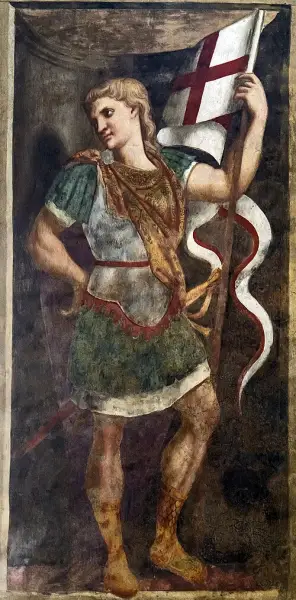
Liberalis' afterlife in the art and devotion of the Venetian mainland is exceptionally rich for a saint of whom so little is historically known. In iconography he appears either vested with a dalmatic, the garb of a clerk, or clad in a soldier's cloak, and is most characteristically depicted as a knight — the noble equestrian of the legend transformed into a military figure of sanctity. Treviso Cathedral preserves a fresco of the saint by Pomponio Amalteo from around 1520 and a sixteenth-century marble statue, while the Civic Museums of Treviso hold a representation from the late fifteenth century. A magnificent reliquary of the saint was made by Leonardo Boldrini in 1475 and is now in the Musée des Beaux-Arts de Dijon. The great painters of the Venetian world placed him in their sacre conversazioni: Lorenzo Lotto included him among the saints flanking the Virgin in a panel with Saint Peter, Saint Christina of Bolsena, and Saint Jerome, and Giovanni Mansueti painted him alongside Saints Sebastian, Francis of Assisi, and Roch in 1494, now in the Gallerie dell'Accademia. As patron of Treviso, of its cathedral, and of Castelfranco Veneto, the fourth-century priest of Altinum remains the civic identity of the Venetian plain.
§ Veneration
Timeline
- 27 Apr 400
Died at Castrazone after falling ill as a hermit, and was buried in the church of Saint Lawrence in a marble sepulcher.
§ Legend
- 452
His relics were carried from Altinum to Treviso, probably to safeguard them from the Hunnish invasions, though some date the transfer later under the Lombard threat.
§ Veneration
- 639
His relics may have been placed with those of the martyrs Theonistus, Tabra, and Tabratha in Torcello's cathedral after this date.
§ Veneration
- 1082
Documentation attesting the strong cultus of Liberalis at Treviso exists from this year onwards.
§ Veneration
- 1199
Citizens of Treviso founded Castelfranco Veneto, and Liberalis became that town's patron saint.
§ Veneration
The Record
- Patron of
- Treviso·Treviso Cathedral·Castelfranco Veneto
- Symbols
- Depicted as a knight·Dalmatic·Soldier's cloak
- Canonization
- Pre-congregation; cultus at Treviso documented from 1082; proclaimed patron saint of Treviso in the twelfth century
Prayer
Bibliography
Show 4 sources
- "Liberalis Apr 27". Latin Saints of the Orthodox Patriarchate of Rome.
- "St. Liberalis". Saints & Angels. Catholic Online.
- Banks Hinds, Allen. "Saint Liberale". A Garner of Saints, 1900. CatholicSaints.Info, 21 April 2017.
- "San Liberale". Santi e Beati.
Profile text adapted from the Wikipedia article, licensed CC BY-SA 4.0.
Pray with this saint every day
Save St. Liberalis of Treviso to your favorites, read the full profile, and get feast-day reminders in the Saints app.
Get the Saints AppFree on the App Store for iPhone and iPad