
died 783·Feast July 14
St. Libert of Saint-Trond
Noble-born Benedictine monk of Sint-Truiden
Overview
Libert, whose name appears in the variant forms Lisbert and Libertus, was a Belgian saint who died in 783. He was born into the nobility at Mechelen, the sources styling him Count Libert of Adone, and as a boy he received baptism and his education at the hands of Saint Rumoldus, the missionary whose name remains inseparable from that city. Drawn to the monastic life, he became a Benedictine at the abbey of Sint-Truiden, the Flemish community that gave him the title by which he is best known. His death came not in the peaceful closure of old age but violently, at the hands of barbarians who killed the monk within reach of his cloister. The Orthodox Church, and in particular the Russian Orthodox Church, preserves his memory; his feast is kept on 14 July. He belongs to the eighth-century generation of Low Countries saints who carried the Christian faith from the mission stations of Rumoldus and his companions into the settled monastic life of the region.
The Complete Life
A Count's Son at Mechelen
The earliest fact recorded of Libert is the most formative one: he was born at Mechelen, on the great bend of the Dyle in what is now Belgium, into a family of rank. The tradition gives him the name and title of Count Libert of Adone, marking him as a member of the noble class from which the Carolingian church so often drew its bishops and abbots. More consequential still was the figure who received him for baptism and schooling. Saint Rumoldus, the Irish or Scottish missionary who preached in the lands of the Scheldt and Dyle and whose cult made Mechelen a center of pilgrimage, personally baptized the boy and oversaw his education. To be formed by the apostle of the region was to be formed for the apostolate; among the fruits of Rumoldus's mission were men who carried his work forward in their own lives. In Libert, the nobleman's son became first a pupil of the saints and then, in time, a saint himself, one of the small company of Mechelen's own born. Rumoldus's teaching planted in the boy a direction he would follow for the rest of his life.
§ Libert of Saint-Trond
Monk of Sint-Truiden
Libert abandoned the prospects of a count for the habit of a Benedictine. The house he entered was the abbey of Sint-Truiden, in the prince-bishopric's territory along the streams of the Hageland, a monastery whose name he bears in nearly every account of his life. The choice joined two eighth-century movements that transformed the Low Countries: the mission of Rumoldus and his fellow workers, which had planted the faith among the noble houses, and the Benedictine settlement, which gave that faith its disciplined, permanent form. At Sint-Truiden the former count took his place in the choir and the fields like any other brother, and it was there that the community came to know his holiness. The sources preserve no writings, no foundations, and no offices from his monastic years; what they record is the shape of the life itself, a nobleman made ordinary for the sake of the kingdom. That life ended abruptly and violently, and the manner of its ending is what the calendar remembers. The sources offer no dates for his profession or his offices, only the settled fact of a life wholly given to the monastery.
§ Libert of Saint-Trond
Death at the Hands of Raiders
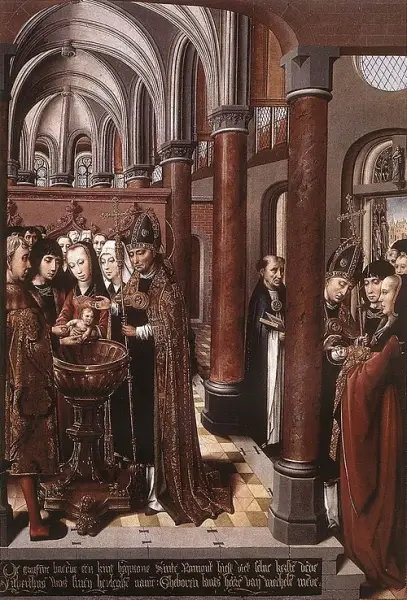
Libert died in 783, killed by barbarians, in the plain language of the tradition. The eighth century was a violent time on the frontiers of the Frankish world, and monasteries with their stores of grain and treasure stood exposed to raiders; many of the martyrs of the region died in circumstances of this kind. Whatever the exact course of the attack, the monk of Sint-Truiden perished at the hands of violent men, and the church of his region counted him among its martyrs from an early date. His feast was fixed on 14 July, and the memory of the saint passed into the calendars of the Low Countries. In later centuries his cult found a home above all in the Orthodox East: he is venerated in the Russian Orthodox Church, which keeps his name among the saints of the West who lived before the separation of the churches. A fifteenth-century painting of his baptism by Rumoldus survives, testimony that the connection between the missionary and his noble pupil remained vivid centuries after both were gone. The violent ending of so quiet a life fixed it in the memory of the church that had received him.
§ Libert of Saint-Trond
The Record
- Canonization
- Pre-congregation; venerated in the Russian Orthodox Church
Prayer
Profile text adapted from the Wikipedia article, licensed CC BY-SA 4.0.
Pray with this saint every day
Save St. Libert of Saint-Trond to your favorites, read the full profile, and get feast-day reminders in the Saints app.
Get the Saints AppFree on the App Store for iPhone and iPad