
died 397·Feast July 23
St. Liborius of Le Mans
Bishop of Le Mans and patron of Paderborn
Overview
Liborius of Le Mans, who died in 397, was the second bishop of that city and became, centuries after his death, the patron of the German cathedral city of Paderborn. A Gaul formed in Latin culture, he led the diocese for a term the tradition fixes at forty-nine years, building churches in the surrounding countryside and ordaining an immense number of clergy for his time, said to number 217 priests and 186 deacons across 96 ordinations. When he lay dying, Martin of Tours came to his side, one of the most celebrated friendships in the record of the Gaulish church. He was buried in the Apostle Basilica of Le Mans beside Julian, the founder of the see. Miracles were reported at his tomb, and in 836 his body was translated to Paderborn at the emperor's instruction, creating a bond of brotherhood between the two dioceses that endures to this day and is counted the oldest agreement of its kind still in force. The faithful ask his help against colic, fever, and gallstones, and they honor him as a patron of a good death and of peace among peoples.
The Complete Life
Forty-Nine Years on the See of Le Mans
Like nearly every saint of the fourth century, Liborius comes down to us with the outlines of his life rather than its detail. He was a Gaul, formed in the Latin culture of the western empire, and at some point in the middle of that century he succeeded Julian, the founder of the bishopric, as head of the church of Le Mans. The tradition credits him with an extraordinarily long episcopate of forty-nine years, a tenure long enough to shape an entire generation of the Gaulish church. Its most concrete monument was clerical: the numbers preserved by the tradition speak of 96 ordinations at which he consecrated 217 priests and 186 deacons for the service of the altars. Whatever allowance one makes for the rounding of pious arithmetic, the picture is of a diocese growing so steadily that its bishop spent his decades supplying it with shepherds. The episcopate of Liborius thus belongs to the great age in which the church of Gaul passed from a persecuted minority to the settled institution that would define medieval France. Half a century of ordinations left the church of his city stocked with clergy and rooted in every district it served.
§ Le Mans and Paderborn
Churches Across the Gaulish Countryside
The record notes that Liborius built churches in the neighborhood of Le Mans, and it draws from this the reasonable conclusion that his missionary energy was spent within the Gaul of his own time rather than on distant fields. In the fourth century such building was itself evangelization: a church of stone in a rural district fixed the Christian community in the landscape, gave it a place of assembly and baptism, and outlasted the missionary who raised it. Under his episcopate the territory around Le Mans, the later diocese of a city that would become the capital of Maine, received this permanent Christian shape. He worked beneath the long shadow of Julian, who had founded the bishopric and whose grave would one day receive his own. The measure of the work is indirect but clear. A church that could ordain hundreds of clergy over half a century was a church whose parishes, villages, and rural chapels multiplied year by year, and the building program of Liborius was the visible sign of that quiet expansion of the Gospel through the lands between the Loire and the Channel.
§ Le Mans and Paderborn
Patron of a Good Death and Healer of the Stone
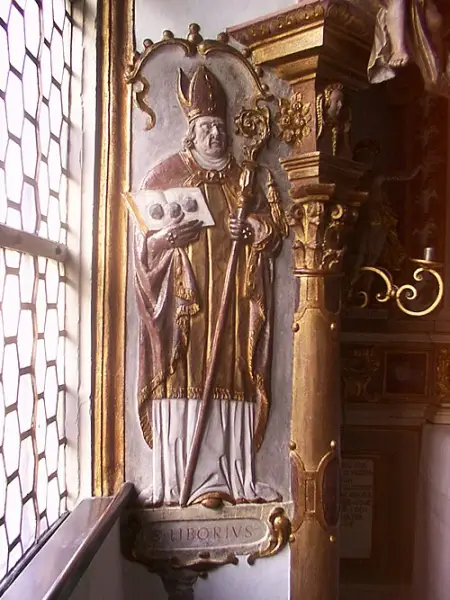
Two devotions grew up around the memory of Liborius. The first concerns his death: because Martin of Tours, the greatest saint of Gaul, held him in his arms at the last, Christians looked to him as a patron of a happy and holy death, the grace every believer hopes for at the last. The second grew from the ground itself. From the thirteenth century onward he has been invoked for deliverance from gallstones, a suffering common in the limestone country where his relics rested; the earliest account of such a healing tells of Archbishop Werner von Eppstein, who made pilgrimage to the shrine at Paderborn in 1267 and went away cured. Out of this devotion came his most distinctive emblem, three small stones laid upon a copy of the Bible, the sign by which artists have depicted him ever since. A gentler legend gave him a second attribute: when his body was carried to Paderborn, a peacock was said to have guided the bearers along the way, and the bird appears beside the bishop in his images to this day.
§ Patronage and symbology
Dying in the Arms of Martin of Tours
The closing scene of the life of Liborius is the most famous thing about it. When he lay at the point of death in 397, Martin of Tours came to assist him, and the image of the great ascetic supporting his brother bishop at the last hour entered the tradition of both churches. The two men were the outstanding figures of the Gaulish episcopate of their generation, and their friendship at the end of a long life has made Liborius a model of holy companionship in dying. He was buried in the Apostle Basilica of Le Mans, laid beside Julian, the founder of the see whose second occupant he had been. There his tomb began to draw the faithful, for miracles were soon reported at it, and the pilgrimage to his grave continued through the centuries that followed. The saint who had spent forty-nine years serving the living church of Le Mans completed his work by becoming, in death, the intercessor whose body the city would one day share with a German diocese it had never met. The friendship of the two men became part of the memory of the Gaulish church and a promise for every Christian facing death.
§ Le Mans and Paderborn
From Local Cultus to the Roman Calendar
Liborius has always been honored as a saint of the Roman Catholic Church by the ancient route of uninterrupted cultus rather than by formal canonization. His liturgical rank, however, has shifted with the centuries. His feast was not among those of the Tridentine calendar as promulgated by Saint Pius V; it was added only in 1702, and then as a secondary observance attached to the 23 July feast of Apollinaris of Ravenna, the day on which the Church keeps his memory. The liturgical reform of 1969, in the constitution Mysterii Paschalis, concluded that his rank was not universal enough for a place in the General Roman Calendar, and handed his feast back to the local calendars of the dioceses that venerate him. This administrative demotion changed nothing in the devotion of his people: in Paderborn his feast remains the center of the year, and the Church keeps him on 23 July as she has for centuries, a saint recognized not by decree but by the long, unbroken prayer of the faithful. His cause never needed one; the cultus of the people was proof enough from the start.
§ Liturgy
The Oldest Bond of Brotherhood in Christendom
The greatest monument of Liborius was built long after his death. In 835 Bishop Aldrich of Le Mans placed relics of the saint within an altar of his cathedral, and in the following year, at the instruction of Emperor Louis the Pious, sent the body itself to Bishop Badurad of Paderborn, a young diocese founded in 799 by Pope Leo III and Charlemagne that possessed no saint of its own. Out of that translation came a covenant: the two churches bound themselves to lasting brotherhood, promising each other prayer and material help, and they have kept the promise through more than a thousand years of war and division. The agreement is considered the oldest contract of its kind still in force. The bond is renewed in the week-long Libori festival that fills Paderborn each year in the last week of July, and in 1977 Archbishop Johannes Joachim Degenhardt founded the Saint Liborius Medal for Unity and Peace, awarded every five years to those who have served the unity of Europe on Christian principles. Parishes under his patronage stretch from Croatia to Australia.
§ Le Mans and Paderborn
Timeline
- 23 Jul 397
Died at Le Mans on the date traditionally given for his death, attended at the last by Martin of Tours, and was buried in the Apostle Basilica beside Bishop Julian.
§ Le Mans and Paderborn
- 835
Bishop Aldrich placed relics of Liborius into an altar of the cathedral of Le Mans.
§ Le Mans and Paderborn
- 836
On the instruction of Emperor Louis the Pious, the body of Liborius was sent from Le Mans to Bishop Badurad of Paderborn.
§ Le Mans and Paderborn
- 1267
Archbishop Werner von Eppstein came on pilgrimage to the shrine at Paderborn and was healed, the first recorded cure of the kind.
§ Patronage and symbology
- 1702
The feast of Saint Liborius entered the Roman calendar in 1702, kept as a secondary observance joined to the 23 July feast of Apollinaris.
§ Liturgy
- 1969
The revision of the Roman calendar in Mysterii Paschalis judged Liborius of insufficient universal rank and left his feast to local calendars.
§ Liturgy
- 1977
Archbishop Johannes Joachim Degenhardt of Paderborn established the Saint Liborius Medal for Unity and Peace, conferred every five years.
§ Le Mans and Paderborn
The Record
- Major works
- Churches built in the countryside around Le Mans·Pact of lasting brotherhood between the churches of Le Mans and Paderborn
- Patron of
- against gallstones·against calculi·against colic·against fever·a good death·Paderborn Cathedral·Paderborn·peace and understanding among peoples
- Symbols
- pebbles on a book·peacock·episcopal attire
- Canonization
- Ancient cultus; feast entered the Roman calendar as a commemoration in 1702
Prayer
Bibliography
Show 6 sources
- Stracke, Richard (2015-10-20). "Saint Liborius". Christian Iconography.
- Hermann-Joseph Rick (1993). "Liborius, zweiter Bischof von Le Mans". In Bautz, Traugott (ed.). Biographisch-Bibliographisches Kirchenlexikon (BBKL) (in German). Vol. 5. Herzberg: Bautz. cols. 17–20. ISBN 3-88309-043-3.
- "Martyrologium Romanum" (Libreria Editrice Vaticana, 2001 ISBN 88-209-7210-7)
- "Calendarium Romanum" (Libreria Editrice Vaticana, 1969), p. 131
- "St Liborius Catholic Parish Eaglehawk". St Liborius Catholic Parish Eaglehawk.
- Matic, Gabrijela; Pekovic, Zeljko (July 2021). "Sacral architecture of Split parish churches built since 1990". ST Open. p. 9.
Profile text adapted from the Wikipedia article, licensed CC BY-SA 4.0.
Pray with this saint every day
Save St. Liborius of Le Mans to your favorites, read the full profile, and get feast-day reminders in the Saints app.
Get the Saints AppFree on the App Store for iPhone and iPad