
1380 – 1433·Feast April 14
St. Lidwina
Paralyzed Dutch mystic and patroness of skaters
Overview
Lidwina of Schiedam was a Dutch mystic whose thirty-eight years of suffering made her one of the most celebrated holy women of the late Middle Ages. Born in Schiedam on 18 April 1380, one of nine children of a laborer, she fell while ice skating at the age of fifteen and broke a rib; she never recovered. Paralysis spread through her body, and for the rest of her life she lay in escalating illness that her modern students have linked to the earliest recorded case of multiple sclerosis. Out of this broken body came a reputation that drew all Holland: she fasted continually, lived on almost nothing, and became known as a healer and holy woman whose food and means multiplied to feed the needy. The officials of Schiedam drew up a surviving document attesting to her complete abstinence from food and sleep. She died on 14 April 1433, aged fifty-two, and her tomb in the parish church became a place of pilgrimage. Pope Leo XIII canonized her in 1890; she is the patroness of Schiedam, of the chronically ill, and of ice skaters.
The Complete Life
A Miller's Daughter on the Ice
Lidwina was born at Schiedam on 18 April 1380, the daughter of a laborer and one of nine children in a household of modest means. Schiedam was then a small walled town on the Schie between Delft and Rotterdam, in the County of Holland, a place of brewers and fishermen where the canals froze hard each winter. Skating on those waterways was an established pastime for both sexes, and at fifteen Lidwina went out on the ice with the rest. There she fell and broke a rib, an accident that in any other life would have healed and been forgotten. For her it was the beginning of everything: the injury never mended, and illness after illness followed it until her body failed completely. Those who wrote her life say that paralysis left her only her left hand, and that her body wasted in ways too grim for the squeamish. Modern physicians studying her case have seen in the age of onset, the course, and the long deterioration the recognizable profile of multiple sclerosis, which would make this girl on the ice one of the earliest identified patients in medical history.
§ Life
The Fast That Amazed a Town
After her fall Lidwina ceased, by degrees, to take food at all, and the abstinence that followed made her famous across Holland. At the beginning she could manage a small piece of apple, afterward a morsel of date with wine thinned by water, and at last only river water carrying the salt of the tides. So extraordinary were the claims that the town officials of Schiedam themselves drew up a document, which still survives, attesting her complete lack of food and sleep; the same record describes skin, bone, and pieces of her intestines that her body let fall; her parents stored them in a vase, from which a sweet smell rose, until their fame grew so great that, at her pleading, her mother buried them. Around this living spectacle of suffering gathered the two roles she would hold for the rest of her life. The sick came to her and were cured, for she acquired a reputation as a healer; and the hungry were fed by her means, for food was said to multiply in her hands or last beyond nature. When the troops of Duke Philip of Burgundy held Schiedam, they posted a watch about her to test whether her fast was real, and its truth was confirmed.
§ Life
Thirty-Eight Years of Deterioration
The course of Lidwina's disease, reconstructed from her biographers, was one of slow and pitiless advance marked by intervals of relief. Soon after the fall on the ice came difficulty in walking, headaches, and violent pain in her teeth. By nineteen both legs were paralyzed and her sight was failing. In the thirty-four years that followed her state went downhill steadily, interrupted here and there by seasons of relief, until death came on 14 April 1433, in her fifty-second year. The modern retrospective diagnosis is multiple sclerosis, whose onset age, duration, and course her record so exactly matches that the medical historian sees in her the disease's earliest documented patient, carrying it back to the fourteenth century. Not everyone accepts the identification; the Canadian neurologist Thomas John Murray objected that the enthusiasm of her devotees clouds any clinical reading. During the Burgundian occupation her suffering was even turned against her, and four soldiers abused her, claiming that her swollen body came from pregnancy by the local priest rather than from sickness. She bore that calumny as she bore the rest, and the holy reputation of her last decades only grew.
§ Multiple sclerosis
From Tomb to Altar
Her body received burial in a marble sepulcher set in the chapel of Schiedam's parish church, and pilgrims soon found their way to it. The writings that carried her fame outward were many: Friar John Brugman, the celebrated preacher and poet, wrote two lives of her, the first in 1433 and a second printed at Schiedam in 1498, while Thomas à Kempis epitomized her story at Cologne, and all the texts were gathered by the Bollandists in the Acta Sanctorum. The devotion à Kempis's work kindled spread her veneration through Europe. Her cultus, centuries old and continuously kept, received the Church's formal recognition on 14 March 1890, when Pope Leo XIII granted her equipollent canonization at Saint Peter's Basilica. The diocesan church of Schiedam was officially dedicated to her in 1931, and in 1990 Pope John Paul II raised it to the rank of minor basilica. Her feast is kept on 14 April, and the Sunday before Ascension Day is kept in her honor by the town that watched her live and die. Her canonization crowned a devotion that had never once faltered in the five centuries since her death.
§ Veneration
Patroness of Skaters and the Chronic Sick
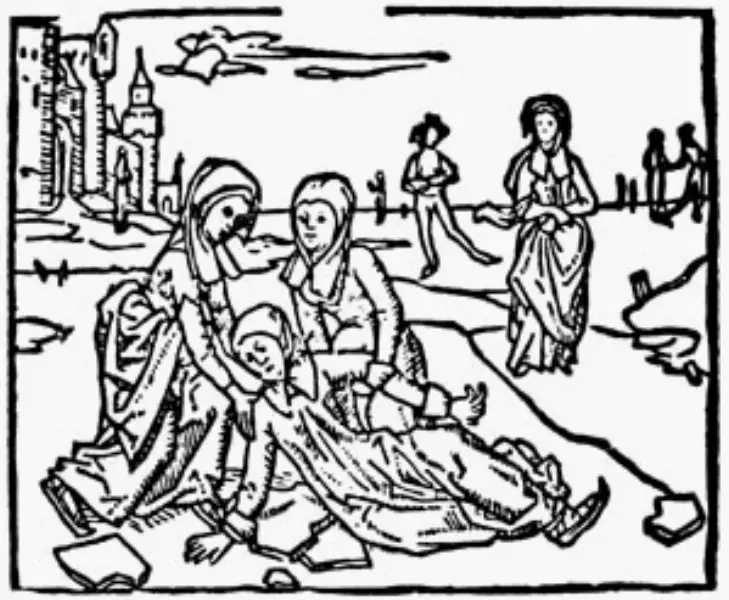
No saint of the Netherlands has left a deeper mark on her own town. The house in which Lidwina died became a monastery of Gray Sisters; the chapel that the Calvinists demolished was succeeded by new foundations, and after every displacement her relics found a home, returning from Brussels to Schiedam in 1871 and resting today in the Basilica of Lidwina. Many institutions in her town carry her name, and since 2002 a biennial musical theatrical work about the town's saint has been staged in one of the Schiedam churches. In art an angel is shown bringing her a rod in flower and a branch of roses, and the 1498 woodcut of her fall on the ice, echoing Rogier van der Weyden's Descent from the Cross, made her image one of the most reproduced of late medieval saints. Historians of sport note that her biography is the earliest good evidence that skating was a common winter pastime for men and women in Holland; the Church has made her the patron of ice skaters, of those in chronic pain, and of her native town.
§ Veneration
Timeline
- 18 Apr 1380
Born at Schiedam in the County of Holland, one of the nine children of a laborer.
§ Life
- 1395
Fell while ice skating at the age of fifteen and broke a rib, beginning the illness from which she never recovered.
§ Life
- 1399
By the age of nineteen both her legs were paralyzed and her sight was disturbed.
§ Multiple sclerosis
- 14 Apr 1433
Died at Schiedam in her fifty-second year and was laid in a marble sepulcher that pilgrims soon made a goal of devotion.
§ Life
- 1433
Friar John Brugman wrote the first of his two lives of Saint Lidwina.
§ Biographies
- 1448
Brugman's first life of Lidwina was reprinted anonymously at Leuven.
§ Biographies
- 1498
Brugman's second life of Lidwina appeared at Schiedam, its text accompanied by the celebrated woodcut of her fall on the ice.
§ Biographies
- 1615
Relics of Lidwina were carried to Brussels for enshrinement in the church of Saint Michael and Saint Gudula, today that city's cathedral.
§ Veneration
- 1859
The Church of Our Lady of Visitation opened on the Nieuwe Haven in Schiedam, known as the Frankelandsekerk.
§ Veneration
- 1871
Lidwina's relics were returned from Brussels to Schiedam.
§ Veneration
- 14 Mar 1890
Pope Leo XIII granted her equipollent canonization at Saint Peter's Basilica in view of her long-standing cultus.
§ Veneration
- 1901
Joris-Karl Huysmans published his biography of Lidwina, translated into English in 1923.
§ Biographies
- 1931
The Schiedam church was officially dedicated to Saint Lidwina and named the Lidwinakerk.
§ Veneration
- 1968
After the demolition of the Frankeland church, veneration of Lidwina moved to the Singelkerk, now the Basilica of Lidwina.
§ Veneration
- 18 Jun 1990
Pope John Paul II elevated the Schiedam church to the rank of minor basilica.
§ Veneration
In Their Own Words
I have made use, in this Life, of the three texts of [Jan] Gerlac, [Jan, as Huysmans calls] Brugman, and à Kempis, completing their anecdotes by collation....
[e]nthusiastic, exaggerated reports and myth building by those who revered her saintliness make interpretation of her condition difficult for the historian.
The Record
- Patron of
- against chronic pain·the chronically ill·ice skaters·Schiedam
- Symbols
- branch of roses from an angel·flowering rod
- Canonization
- Canonized by Pope Leo XIII, 14 March 1890, by equipollent canonization
Prayer
Bibliography
Show 8 sources
- Bynum, Caroline Walker. Holy Feast and Holy Fast: The Religious Significance of Food to Medieval Women. Berkeley: University of California Press, 1987, p. 124.
- Albers, Petrus Henricus (1910). "St. Lidwina". In Herbermann, Charles (ed.). Catholic Encyclopedia. Vol. 9. New York: Robert Appleton Company. pp. 233a–233b.
- Huysman, J. K., Saint Lydwine of Schiedam: 1380-1433, TAN Books, 1979, ISBN 9781505103601
- Kestnbaum, Ellyn (2003). Culture on Ice: Figure Skating and Cultural Meaning. Middletown, Connecticut: Wesleyan University Press. p. 57. ISBN 0-8195-6641-1.
- Medaer R (1979). "Does the history of multiple sclerosis go back as far as the 14th century?". Acta Neurol. Scand. 60 (3): 189–92. doi:10.1111/j.1600-0447.1979.tb08970.x. PMID 390966.
- Murray, T. Jock. Multiple Sclerosis: The History of a Disease, Demos Medical Publishing, 2004. ISBN 9781934559277, p. 25
- Butler, Alban. "Blessed Lidwina, Called Lydwid, Virgin". Lives of the Fathers, Martyrs, and Principal Saints, 1866.
- Hines, James R. (2011). Historical Dictionary of Figure Skating. Lanham, Maryland: Scarecrow Press. pp. xix. ISBN 978-0-8108-6859-5.
Profile text adapted from the Wikipedia article, licensed CC BY-SA 4.0.
Pray with this saint every day
Save St. Lidwina to your favorites, read the full profile, and get feast-day reminders in the Saints app.
Get the Saints AppFree on the App Store for iPhone and iPad