
died c. 534·Feast November 5
St. Lié
Hermit Deacon of the Forest of Orléans
Overview
Lié — also written Lyé, or in Latin Laetus — was a hermit of the Orléanais whose plain, hidden life became one of the treasured memories of the Frankish church. Born of a Gallo-Roman family in Berry during the reign of Chlothar I, he was a small-statured peasant who kept herds as a boy and embraced monastic life at the age of twelve. At the monastery of Micy-Saint-Mesmin near Orléans the abbot Treïcius ordained him a deacon, and there he gave direction to the young monk who would become Leonard of Noblac. Seeking deeper solitude, Lié withdrew to the edge of the Loges forest, the Forest of Orléans, and settled in a dense thicket where he built himself a hut, prayed without ceasing, and lived on wild fruits. He left his solitude only to visit and comfort the sick, and the blind, the lame, and the crippled who came to him more than once were healed. He died in 534, the very year he had predicted would be his entry into eternal beatitude, and was buried where he had lived. His relics, twice displaced and once burned, now rest at Saint-Lyé-la-Forêt, and he is honored as a protector of the sick.
The Complete Life
A Peasant Boy from Berry
Lié was born into a family of Berry, the old province of central France, sometime within the long reign of the Frankish king Chlothar I. The form of his name suggests a Gallo-Roman origin: he belonged to the older population of the land, carrying a Latin name — Laetus, the joyful one — into a century reshaped by Frankish rule. Nothing noble marked his beginnings. He was small of stature and worked as a peasant herd keeper, a boy among the flocks and fields of the rural Loire country. Yet it was precisely in that obscure setting that a remarkable call took shape: according to the tradition, he embraced the monastic life at only twelve years of age. The vocation of a child, in an age when monasteries received the young as oblates and novices, meant the surrender of the ordinary paths of marriage and inheritance that a peasant's son might have expected. From the herds of Berry the boy set out toward the religious houses of the Orléanais, carrying nothing but the faith that had already claimed him, and his humility — the trait for which his biographers singled him out — was rooted in those earliest years of poverty and work.
§ Life
Formation at Micy-Saint-Mesmin
Lié found his way to the monastery of Micy-Saint-Mesmin, the celebrated house on the edge of Orléans where the Loire and the Loing meet, and there the abbot Treïcius welcomed him. In time the abbot ordained him a deacon, binding him formally to the service of the church while he remained a monk of the community. His gifts were not confined to his own observance: while he lived at Micy, Lié provided direction to a fellow monk named Leonard, the man whom tradition remembers as Leonard of Noblac, one of the most widely venerated saints of medieval France. That the quiet herdsman from Berry should have been entrusted with the guidance of so notable a soul testifies to the maturity of his spiritual judgment while still a young monk. Yet even Micy, with its discipline and its holiness, could not satisfy the longing that had grown in him. After some years he made the decisive choice of his life: he would leave the monastery in search of greater solitude, following the eremitical impulse that drew so many sixth-century monks out of the cloister and into the wilderness, where they believed God could be sought without remainder.
§ Life
Solitude and Mercy at the Forest's Edge
Lié headed north from Micy and stopped at the edge of the Loges forest, the great Forest of Orléans, near a clearing where poor loggers were felling oaks and stripping their bark — a working camp that gave the surrounding hamlet the name Les Ecossoires. Deep in the woods he found a thicket so dense that no sound penetrated it, and there he raised himself a hut. His life took on the severe simplicity of the desert fathers transplanted to Gallic soil: he passed his days in prayer and lived on wild fruits gathered from the forest. But the solitude of Lié was never sealed against charity. One thing alone drew him out of his retreat: seeking out those who were ill, speaking a few words of holiness over them, and easing the dread of their dying hours. The mercy drew the suffering to him in turn: the blind, the lame, and the crippled made their way to the hermit's clearing, and more than once, the tradition records, they went away healed. Word of the forest saint spread through the countryside, and the man who had fled human company became, without seeking it, a refuge for every afflicted soul of the region.
§ Life
A Death Foretold
Lié lived in his forest retreat into old age, and the tradition preserves a striking detail about his end: he foretold that 534 was destined to carry him into everlasting blessedness — and so it fell out. He died in the place where he had lived, the hut that had been his cloister and his cell, and he was buried there among the trees. Over his tomb a chapel was erected, the first of the sanctuaries that would keep his name alive in the diocese of Orléans. For a man who had hidden himself from the world, the world proved unwilling to forget him: the clearing in the Loges forest became a place of prayer, the village that grew nearby took the name Saint-Lyé-la-Forêt, and the peasants who had known the living hermit handed on the memory of his humility to their descendants. The herdsman of Berry, the deacon of Micy, the director of Leonard, the healer of the forest — all these lives were gathered into the single title under which the church of Orléans honored him from that day forward.
§ Life
The Long Journey of the Relics
Lié was venerated as a saint by the acclamation of the local church, long before formal processes of canonization existed, and his cult centered first on the chapel at his tomb. Ermentheus, bishop of Orléans, later translated the body to the church of Pithiviers. There disaster struck in 1580, when the relics were burned by the Huguenots in the wars of religion. Yet the devotion of the Christians of Pithiviers had preserved fragments of the saint's legs, and in 1664, after many adventures, these surviving remains were carried back to the village of Saint-Lyé. There they remain today, enshrined in a reliquary at the base of the altar bearing his name; Pentecost Monday drew pilgrims to them year after year, and to ask healing of their infirmities — a fitting pilgrimage to make to the friend of the sick. Farther away, at Mohon in the Ardennes, a brotherhood founded in 1523 to honor his relics obtained an indulgence from Pope Paul V, and in 1611 the local church's dedication was changed from Saint Gilles to Saint Lié; relics of the saint were brought there probably around 1683, and in that church he is celebrated on 2 January.
§ Veneration
Places and Images of the Forest Saint
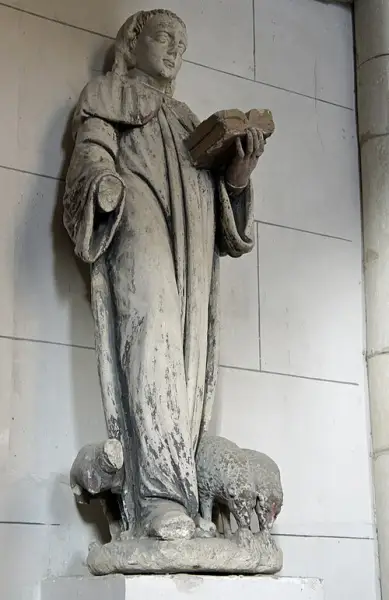
The geography of the Orléanais keeps the hermit's memory in its very names. The village of Saint-Lyé-la-Forêt — Saint Lyé of the Forest — is named for him and guards his principal shrine, and the Parish of Mont Saint Lié in the Archdiocese of Reims bears his name as well. In the town of Saint-Lyé in the department of Aube, the Église Saint-Lyé preserves a sixteenth-century polychrome stone statue of the saint and, on canvas, the saint's vision rendered by one of the two Cossard painters, Pierre or Guillaume the younger. At Ville-Dommange the church dedicated to him dates from the thirteenth century, and around 1442 it held a silver reliquary containing a bone from the saint's arm — the statue of Lié de Micy still stands in the village today. Even the great cathedral of Chartres gave him a place: the south porch of that church carries a carved image of Saint Lyé on one of its pillars. Honored in the bishopric of Orléans with his feast on 5 November, the small herdsman who wanted only silence has remained for fifteen centuries a public figure of the French church, invoked above all as a protector of the sick.
§ Legacy
Timeline
- 534
Dies in his hut at the edge of the Loges forest, in the year he had predicted would be his entry into eternal beatitude, and is buried on the spot
§ Life
- 1523
A brotherhood dedicated to venerating his relics is founded at Mohon in the Ardennes
§ Veneration
- 1580
His relics, brought earlier to the church of Pithiviers by Bishop Ermentheus, are burned by the Huguenots
§ Veneration
- 1611
The Mohon church, whose brotherhood had obtained an indulgence from Pope Paul V, is rededicated from Saint Gilles to Saint Lié
§ Veneration
- 1664
Fragments of his legs preserved by the Christians of Pithiviers are returned after many adventures to the village of Saint-Lyé
§ Veneration
- 1683
Some of his relics are transported to the Église Saint-Lié de Mohon, probably around this date
§ Veneration
The Record
- Patron of
- Protector of the sick
- Canonization
- Pre-congregation; honored in the bishopric of Orléans from the earliest times
Prayer
Bibliography
Show 6 sources
- "Saint Lié", Nominis.
- Les petits Bollandistes: vies des saints, Tome XVII - Appendices et tables générales, 1876.
- Brouard, Eugène. Saint Lyé (Loiret) Légendes - Histoires - Anecdotes. Orléans, 1904.
- Martin, Christine. Pèlerinages d'Ardenne méridionale. 1991, p. 33.
- La vie de Saint Lié confesseur, dédiée a monsieur de Louvat. Charleville: Poncelet & J. Morard, 1675.
- Headlam, Cecil. The Story of Chartres. United Kingdom: Dent, 1902, p. 228.
Profile text adapted from the Wikipedia article, licensed CC BY-SA 4.0.
Pray with this saint every day
Save St. Lié to your favorites, read the full profile, and get feast-day reminders in the Saints app.
Get the Saints AppFree on the App Store for iPhone and iPad