
c. 1000 – 1076·Feast September 28
St. Lietbertus
Bishop of Cambrai and founder of Holy Sepulchre Abbey
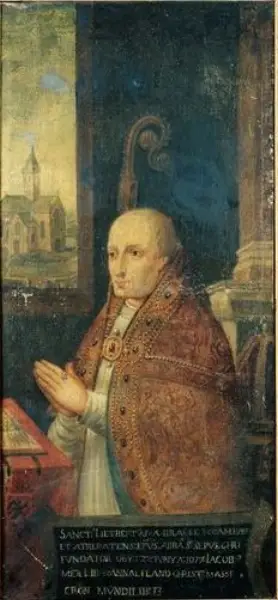
Overview
Lietbertus, known also as Lietbert, Libert, or Liberat of Brakel, governed the diocese of Cambrai for a quarter of a century. Born into the Brabantian nobility at Opbrakel around the year 1000, he had already served the cathedral of Cambrai as archdeacon and provost when he was raised to the episcopal seat, which he occupied from 31 March 1051 until 28 September 1076. The defining adventure of his episcopate was a pilgrimage undertaken in 1054 with a great company of his flock. The party crossed the Danube, was received with promises of protection by King Andrew I of Hungary, and pressed south through the Balkans to Corinth, where the bishop prayed at the tomb of Saint Demetrius. From Cyprus, where he waited weeks for a passage that never came, he was deceitfully carried to Laodicea instead of Jerusalem; there, on the advice of the local bishop, he abandoned the vow he could not fulfill and turned homeward beside Hélinand of Laon. His unfulfilled longing bore fruit at Cambrai: in 1064 he founded the abbey of the Holy Sepulchre. He also proved a resolute defender of his city against Robert, Count of Flanders, and excommunicated the castellan Hugh of Oisy, at the price of a conflict with the German emperor.
The Complete Life
A Brabantian Nobleman on the Cathedral Throne
Opbrakel, the village where Lietbertus was born around the year 1000, lay in the wooded country of Brabant, within the present-day municipality of Brakel. His family belonged to the regional nobility, the class from which eleventh-century bishops were regularly drawn, and his abilities pointed him early toward church service at the highest level. By the time of his elevation he had held both of the senior offices of the cathedral of Cambrai: archdeacon, with oversight of the clergy and the diocese's administration, and provost, the head of the cathedral chapter itself. These were positions of real power in a diocese that sat on the contested frontier between the Kingdom of France and the Empire, and they schooled him in the mixture of pastoral care and political management that his episcopate would demand. His election to the see was confirmed and he entered upon his bishopric on 31 March 1051. For the next twenty-five years he ruled Cambrai, a city whose bishops were temporal lords as much as spiritual fathers, and the sources preserve him as a figure of energy: an organizer of pilgrimage, a builder, and a fighter who would excommunicate a castellan and quarrel with an emperor rather than surrender the rights of his church.
§ Biography
The Pilgrimage of 1054
Three years into his episcopate Lietbertus set out for Jerusalem, and he did not travel alone: his biographer describes a company of people of every age and both sex, a lay pilgrimage on a grand scale led by their own bishop. Crossing the Danube, the party entered the land his biographer calls Pannonia, where King Andrew I of Hungary received the bishop and promised the travelers safe conduct through his realm. The route then bent southward through Bulgaria, Dalmatia, and Isauria, hard country where dangers gathered, until the pilgrims came to Corinth in Greece. There Lietbertus turned aside to venerate the tomb of Saint Demetrius, one of the great soldier-saints of the East. The sea crossing proved the journey's undoing. Driven ashore on Cyprus, the bishop waited from 4 June to 31 July, spending gold he could ill spare, until sailors who feared the ambushes of the pirates took his payment and landed him at Laodicea instead of the Palestinian coast. Delay followed delay until, as his biographer records, no hope of fulfilling the vow remained. On the counsel of the bishop of Laodicea, and in the company of Hélinand of Laon, who had made his own pilgrimage, Lietbertus took the sorrowful road back to Flanders.
§ Pilgrimage
Founder of the Holy Sepulchre
The failure of 1054 did not end Lietbertus's engagement with the Holy Land; it redirected it. In 1064 he founded the abbey of the Holy Sepulchre at Cambrai, planting in his own city a living memorial of the sepulchre he had been denied, and it was from this community that his first biographer would come. As a ruler he showed the same tenacity he had displayed on the road. He organized the defense of Cambrai against Robert I, Count of Flanders, and he excommunicated Hugh I of Oisy, the city's castellan, a sentence that embroiled him in conflict with the German emperor whose vassal the castellan was. He died on 28 September 1076, the date still kept as his feast. Two medieval works transmitted his memory: the Gesta Lietberti episcopi, compiled in two phases, one covering the years 1051 to 1054 and probably from the continuator of the Gesta episcoporum Cameracensium, the other carrying the story to 1076; and the Vita sancti Lietberti, Rodulfus's work — he was a monk of the Cambrai community itself — the source of the vivid Cypriot narrative. Through them the bishop who never reached Jerusalem remains one of the best-documented prelates of eleventh-century Flanders.
§ After his pilgrimage
Timeline
- 1000
Born into the Brabantian nobility at Opbrakel, in the present municipality of Brakel.
§ Biography
- 31 Mar 1051
Consecrated bishop of Cambrai after serving the cathedral as archdeacon and provost.
§ Biography
- 1054
Set out for the Holy Land at the head of a pilgrimage drawn from his own flock.
§ Pilgrimage
- 4 Jun 1054
Stranded on Cyprus, where he sheltered from 4 June until 31 July while seeking a crossing to Jerusalem.
§ Pilgrimage
- 1054
Deceived by his sailors and landed at Laodicea, he gave up the journey and returned home with Hélinand, bishop of Laon.
§ Pilgrimage
- 1064
Founded the abbey of the Holy Sepulchre at Cambrai in fulfillment of his disappointed vow.
§ After his pilgrimage
- 28 Sep 1076
Died at Cambrai after twenty-five years as its bishop.
§ After his pilgrimage
In Their Own Words
The shores of Cyprus received the lord bishop, saved from the sea waves, together with all his men.
The Record
- Major works
- Abbey of the Holy Sepulchre, Cambrai (1064)
- Canonization
- Pre-congregation; venerated from shortly after his death, with a feast kept on 28 September
Prayer
Bibliography
Show 2 sources
- Ott, John S. "Raoul of Saint-Sépulcre, The Life of St. Lietbertus, Bishop of Cambrai"
- Hofmeister, A. (ed.). Vita Lietberti episcopi Cameracensis auctore Rudulfo monacho S. Sepulchri Cameracensis. MGH Scriptores 30-2 (Leipzig 1926, 1934), pp. 838–868.
Profile text adapted from the Wikipedia article, licensed CC BY-SA 4.0.
Pray with this saint every day
Save St. Lietbertus to your favorites, read the full profile, and get feast-day reminders in the Saints app.
Get the Saints AppFree on the App Store for iPhone and iPad