
died 6th century·Feast June 3
St. Liphardus
Lawyer turned hermit and abbot of Meung-sur-Loire
Overview
Liphardus, whose name appears in many forms — Lifard, Lifardus, Liphard, Lyphard — was a man of Orléans who traded a magistrate's career for the hermit's cell and ended as the founding abbot of Meung-sur-Loire. The early modern historian Symphorien Guyon makes him a son of Rigomert, prince of Le Mans, a kinsman of King Clovis I, and the brother of Saint Leonard. Educated in letters and in law, he was appointed a governor and judge at Orléans on account of his talent and birth, but around his fortieth year he grew weary of worldly advancement, resigned his office, and was ordained deacon. With his disciple Urbice he withdrew to Meung-sur-Loire, four leagues from the city, where fortifications ruined in the wars of Attila offered solitude, and there he built himself a cell of twigs and rushes. The bishop of Orléans, hearing of his virtue, ordained him priest so that he might teach others, and later permitted a monastery to rise beside the hermitage. A popular legend tells how a dragon that terrorized the district died before a rod planted at Liphardus's command while the saint prayed. He gathered a numerous community, ruled it as first abbot, and died in the second half of the sixth century; over his tomb eventually rose the collegiate church that bears his name.
The Complete Life
The Judge Who Laid Down His Office
By the account that Symphorien Guyon preserved, Liphardus was born to prominence: his father Rigomert was prince of the city of Le Mans, the family stood close to King Clovis I, and his younger brother Leonard would himself be honored as a saint. The boy was given the education proper to his rank, first in literature and then in the law, and his capacity soon showed itself. Because of his ability and his noble birth he was named a governor and judge at Orléans, one of the great cities of the Loire, and he discharged the office with distinction. Yet the honor sat uneasily on him. Around the age of forty, wearied by the worldly life, he resigned his charge and entered the clerical state, receiving ordination as deacon soon afterward. He joined the monastery of Saint Mesmin for a time, while his brother Leonard departed for Aquitaine; but enclosure was not his destination. Taking with him a disciple named Urbice, he withdrew to Meung-sur-Loire — Meun in the old spelling — some four leagues below Orléans, where the wars of Attila had left an old castle standing in ruins. In that solitude he raised a small cell and began the austere life that would define him.
§ Guyon's Life
The Dragon at the Fountain
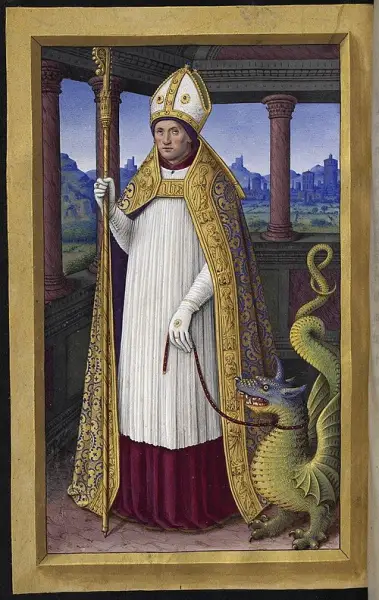
The legend that fixed Liphardus's image in art belongs to his years at Meung. A monstrous serpent, the story runs, had its lair near the saint's cell and terrified the whole neighborhood, crawling and rolling beside the fountain from which the people drew their water. Only Liphardus and his disciple Urbice dared approach the spot. One day, warned in a vision that the beast was coming toward his cell to do harm, the saint sent Urbice ahead along the way he knew the dragon would take. The disciple went unsuspecting, but at the sight of the creature he fled back in panic. Liphardus smiled at his timidity, reproached his lack of faith, and handed him a rod with instructions to plant it in the ground before the animal. Urbice obeyed; the dragon coiled and struck at the rod, trying to break it, and instead hung itself upon it and died. A legion of devils that had ridden the beast came pouring out, howling that they had lost their dwelling. The peasants, alarmed by the din and anxious for the saint, ran to the cell and found him at his ordinary prayers with the dragon lying dead beside him. After this, with Urbice at his side, Liphardus gathered the monastery of Meung-sur-Loire, and when he died his disciple succeeded him as abbot.
§ Guyon's Life
Bread, Water, and the Whole Night in Prayer
Alban Butler, drawing on the older lives, sketching the discipline of the hermitage at Meung, records a regime of almost total renunciation. Bread in small measure and water made up the saint's entire diet, in sickness as in health, and his single garment was woven of sackcloth. Whole nights went by in prayer, and in every occupation his mind, Butler writes, was so possessed by God that he seemed to live without a body. Such austerity might have remained hidden in the wilderness had not virtue announced itself. Mark, the bishop of Orléans, then resided at Cléry, two leagues downstream, beside the celebrated pilgrim church of the Blessed Virgin; his own residence brought him within reach of the hermitage, and he became an eyewitness of Liphardus's manner of life. Convinced of the holiness he had seen, the bishop ordained the hermit priest so that his gifts might serve others, and authorized him to found a monastery on the very ground where his cell stood. Butler notes that this happened before the Fourth Council of Orléans, at which Bishop Mark subscribed in the year 541, and that the community which gathered around the saint quickly became celebrated: a numerous brotherhood, of which Liphardus was at once the founder and the living model of Christian perfection, adorned in the eyes of his contemporaries by an extraordinary gift of miracles.
§ Butler's account
The Tomb at Meung
The year of Liphardus's death went unrecorded; Butler sets it beyond the sixth century's midpoint, and the Monks of Ramsgate likewise leave the date unnamed. His body was buried at Mehun — the Meung-sur-Loire of the present day — and the tomb became the seed of a great church. First a chapel rose over the grave, and then the famous collegiate church enriched with his relics and bearing his name, the Collégiale Saint-Liphard de Meung-sur-Loire, which still holds his tomb. Devotion spread beyond the abbey walls: a church in the city of Orléans and several others across the diocese were dedicated under his invocation, and his name found a place in the Roman Martyrology, where his feast is kept on 3 June. Medieval and Renaissance artists remembered the legend as much as the man; his attribute in iconography is the hermit contending with a dragon by a staff, and in some versions the beast impaled or cut in two by the rod of the saint's command. Jean Bourdichon portrayed him in the hours of Henry VII's prayer book at the opening of the sixteenth century, a sign that his cult had traveled far from the Loire.
§ Butler's account
In Their Own Words
A citizen of Orleans who, having occupied various municipal positions of distinction, at the age of fifty embraced the Ecclesiastical state.
The Record
- Major works
- Monastery of Meung-sur-Loire (Collégiale Saint-Liphard)
- Symbols
- hermit fighting a dragon with a stick·impaled dragon
- Canonization
- Pre-congregation; ancient cult confirmed by his listing in the Roman Martyrology
Prayer
Bibliography
Show 4 sources
- Butler, Alban (1799), The Lives of the Primitive Fathers, Martyrs, and Other Principal Saints, vol. VI, Edinburgh: J. Moir
- Guyon, Symphorien (1647), Histoire de l'Église, diocèse, ville et université d'Orléans, Paris
- St. Augustine's Abbey, Ramsgate (1921). The Book of Saints: a dictionary of servants of God canonized by the Catholic Church. London: A. & C. Black
- Église Saint-Liphard à Hiesse (PDF) (in French), Office de tourisme du Confolentais
Profile text adapted from the Wikipedia article, licensed CC BY-SA 4.0.
Pray with this saint every day
Save St. Liphardus to your favorites, read the full profile, and get feast-day reminders in the Saints app.
Get the Saints AppFree on the App Store for iPhone and iPad