
1246 – 1255·Feast July 27
Little Saint Hugh of Lincoln
Boy whose death fueled a medieval blood libel
Overview
Hugh was an English boy of Lincoln, about nine years old, whose disappearance in the summer of 1255 became the pretext for one of the most damaging blood libels in English history. His body was found in a well at the end of August, and it was alleged that the Jews of the town had imprisoned, tortured, and crucified him. A resident named Copin confessed after interrogation under torture; King Henry III, arriving in the city, ordered Copin executed and had ninety Jews arrested at random and sent to the Tower of London, of whom eighteen were hanged. The affair is remembered less for the child than for its consequences: it was the first occasion on which the English Crown gave official credence to a ritual murder charge, and the chronicler Matthew Paris embroidered the story into the most widely read version. A popular cult formed around the boy — miracles were reported, an unofficial feast was observed, and a shrine rose in Lincoln Cathedral — but he was never canonized, and the Vatican never admitted him to any calendar of saints. Historians judge that churchmen steered the affair to draw pilgrims and their offerings, and the Church of England in 1958 set a penitential plaque at the site of the shrine repudiating the fiction. The 'Sir Hugh' ballads kept the slander in circulation into the twentieth century.
The Complete Life
A Death Turned into a Story
Hugh was born in Lincoln in 1246, a townsman's child of the reign of Henry III, and he would have vanished from history altogether had his death not been conscripted into a legend already generations old. He disappeared on 31 July 1255, a boy of about nine; his body was found in a well on 29 August. The charge that followed held that the Jews of Lincoln had shut him in a secret chamber, tortured him, and finally crucified him in mockery of Christ, casting the corpse into the well when the earth itself, it was said, refused to keep it buried. An ugly coincidence supplied the setting: Jews from many parts of England had come to Lincoln that very summer for a wedding. The most famous telling came from the chronicler Matthew Paris, who described a ritual assembly of Jews summoned from every city of England, a tribunal mocking Pilate, scourging, a crown of thorns, and a death by crucifixion and spear. Paris's account, precisely because of his popularity and storyteller's gifts, became the version that rang through the centuries; yet modern historians regard it as the least trustworthy of all the contemporary sources, a garbled fabrication rather than a record. The plainer annals of Waverley and Burton Abbey preserve what can be known of the affair, and it is little enough.
§ The accusation and myth
A Cult Built Without a Canonization
What raised the boy of Lincoln above the other alleged victims of his era was the intervention of the crown. A Jew named Copin, interrogated under torture by John of Lexington — brother of the new bishop of Lincoln and servant of the king — confessed to the murder, reportedly with a promise of immunity; Henry III arrived about a month after the arrest, ordered Copin put to death, and had ninety Jews of the city seized at random and confined in the Tower. Eighteen went to the gallows for refusing to plead before a Christian jury they deemed a show trial; the remaining seventy-one were condemned at Westminster on 3 February by a jury of forty-eight, and freed by May after the friars and Richard of Cornwall interceded. As Gavin Langmuir observed, it was this royal endorsement, unique among the English cases, that made Hugh's fame eclipse that of William of Norwich and all the rest. Miracles were soon reported, an unofficial feast was fixed on 27 July, and Lincoln Cathedral prospered on pilgrim offerings. But the boy was never canonized — the popes had reserved the making of saints to themselves since the decretals of Alexander III and Innocent III — and he never entered any Catholic martyrology. The shrine itself, built after the expulsion of 1290 with the help of Edward I and adorned with the royal arms and echoes of the Eleanor crosses, was a monument of crown propaganda as much as piety; its offerings dwindled to ten and a half pence by 1420, and the Reformation left it largely destroyed.
§ Veneration
A Libel That Outlived Its Authors
The story of Hugh of Lincoln entered the permanent furniture of English culture, and its afterlife is the true measure of the harm. It stands behind the Prioress's Tale in Chaucer's Canterbury Tales; Marlowe echoes it in The Jew of Malta; Thomas Fuller retold it as fact in his Worthies of England of 1662. Ballads on the death of 'Sir Hugh' circulated in England, Scotland, and France from near the time of the events and were still being sung, in transplanted American versions, in the twentieth century. Nineteenth-century antisemitic polemicists on the continent tried to 'prove' the story true; in Lincoln itself a well at Jews' Court was advertised to tourists as the place where the body was found, though it was in fact dug before 1928 to ornament the property. Langmuir's verdict on John of Lexington is the historians' verdict on the whole affair: his invention became a thread running through English letters and a prop for unreasoning hatred of Jews, from the thirteenth century to the death camps. The reckoning came slowly. In 1958 the Church of England, after exchanging letters with Wilfred Samuel, who had founded the Jewish Museum, set a plaque beside the shrine's remains confessing the stories to be trumped-up fictions on which innocent Jews lost their lives, and asking to be forgiven for the past, amended in the present, and directed for the future.
§ Legacy and significance
Timeline
- 1246
Born in Lincoln, in the reign of Henry III.
§ The accusation and myth
- 31 Jul 1255
Disappeared in Lincoln, aged about nine, at a time when Jews from across England had gathered in the city for a wedding.
§ The accusation and myth
- 29 Aug 1255
His body was discovered in a well, after claims that it had been cast there when the earth refused it burial.
§ The accusation and myth
- 1255
King Henry III, arriving in Lincoln, ordered Copin executed and had ninety Jews arrested and held in the Tower of London on charges of ritual murder.
§ Royal intervention
- 1290
A shrine was built in Lincoln Cathedral in the aftermath of the expulsion of the Jews from England, aided by Edward I and bearing the royal arms.
§ Veneration
- 1420
The cult had so far declined that the shrine drew an offering of only ten and a half pence in the year.
§ Veneration
- 1790
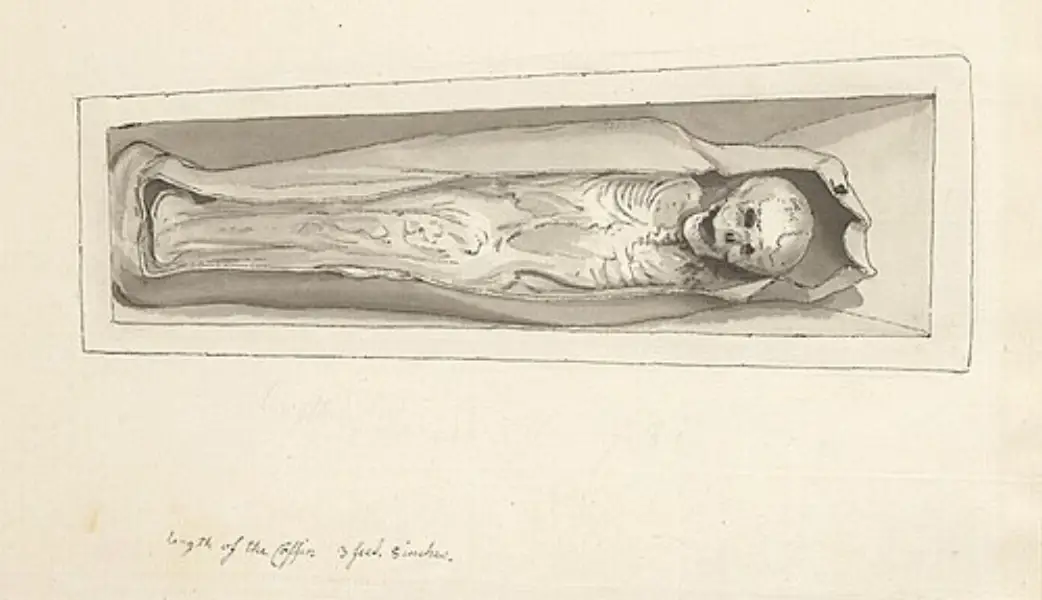
Cathedral restoration work uncovered a boy's skeleton lying in a stone coffin a metre in length.
§ Veneration
- 1958
The Church of England placed a penitential plaque at the site of the former shrine, acknowledging the falsehood of the ritual murder stories.
§ Veneration
In Their Own Words
Trumped up stories of "ritual murders" of Christian boys by Jewish communities were common throughout Europe during the Middle Ages and even much later. These fictions cost many innocent Jews their lives.
The Record
- Canonization
- Never canonized; locally acclaimed as a martyr in the Middle Ages but never recognized by the Vatican
Prayer
Bibliography
Show 6 sources
- Langmuir, Gavin I (July 1972). "The Knight's Tale of Young Hugh of Lincoln". Speculum. 47 (3): 459–482. doi:10.2307/2856155
- Hillaby, Joe (1994). "The ritual-child-murder accusation: its dissemination and Harold of Gloucester". Jewish Historical Studies. 34: 69–109
- Hillaby, Joe; Hillaby, Caroline (2013). The Palgrave Dictionary of Medieval Anglo-Jewish History. Basingstoke: Palgrave Macmillan. ISBN 978-0230278165
- Huscroft, Richard (2006). Expulsion: England's Jewish solution. Stroud, UK: Tempus. ISBN 978-0-752-43729-3
- Jacobs, Joseph (1893). "Little St. Hugh of Lincoln. Researches in history, archæology, and legend". Transactions (Jewish Historical Society of England). 1: 89–135
- Stocker, David (1986). "The Shrine of Little St Hugh". Medieval Art and Architecture at Lincoln Cathedral. British Archaeological Association. pp. 109–117. ISBN 978-0-907307-14-3
Profile text adapted from the Wikipedia article, licensed CC BY-SA 4.0.
Pray with this saint every day
Save Little Saint Hugh of Lincoln to your favorites, read the full profile, and get feast-day reminders in the Saints app.
Get the Saints AppFree on the App Store for iPhone and iPad