
1128 – 1180·Feast November 14
St. Lorcán Ua Tuathail
Archbishop of Dublin and mediator of the invasion age
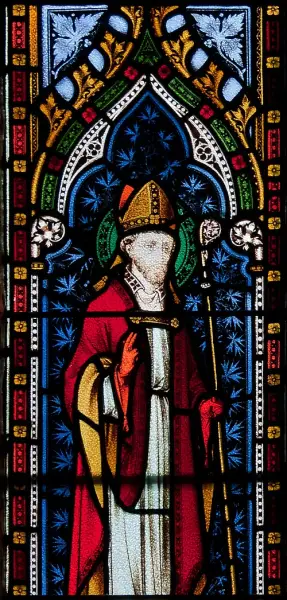
Overview
Lorcán Ua Tuathail — Laurence O'Toole in English, Laurent d'Eu in French — shepherded the see of Dublin through the most convulsive generation in Irish history. Born in 1128 at Kilkea, County Kildare, the son of King Muirchertach Ua Tuathail of the Uí Muiredaig, he passed two harsh years as a hostage of King Diarmait Mac Murchada in boyhood, an ordeal that fixed his desire for the religious life. At twenty-six he became abbot of Glendalough and set that ancient Gaelic monastery in step with the reforming monasticism of the continent, bringing in the Canons of St Augustine. In 1162 he was elected archbishop of Dublin — the first Gael to govern a Hiberno-Norse see — and he spent the decade rebuilding churches, fostering Gregorian chant, feeding the city's poor daily, and founding refuges for abandoned children. When the Normans invaded in 1169–70 he became the one man trusted by Gaels, Norse, and newcomers alike, mediating through the seizure of Dublin, the siege of his cathedral city, and the negotiations that produced the Treaty of Windsor. Attacked by an assailant at the shrine of Thomas Becket in Canterbury, he rose from the floor and finished his mass. He died at Eu in Normandy on 14 November 1180, carrying out one last embassy of peace, and was canonized in 1225 by Pope Honorius III.
The Complete Life
A King's Son in Chains
Lorcán was born in 1128 at Kilkea in County Kildare, the fourth son — and the youngest — of Muirchertach Ua Tuathail, who ruled the Uí Muiredaig, one people among the Uí Dúnlainge kings of Leinster; through his mother, an O'Byrne princess of the Uí Fáelán. The family name descended from Tuathal mac Augaire, a king of Leinster dead since 958, and its seat was at Maistiu, the Mullaghmast of the present maps. The boy's childhood was spent in the shadow of a new power: Diarmait Mac Murchada, king from 1126, had made his father's line subordinate, and at the age of ten Lorcán was handed over to Diarmait as a hostage for his father's good behavior. When Muirchertach's loyalty came under suspicion, the child paid the price — some two years of imprisonment in extreme austerity, given scarcely enough to live on. Release came through the abbot of Glendalough, in whose church Lorcán's kindred had buried their dead for generations, and whose mediation restored peace between the two kings. The confinement worked a lasting change: it hardened the boy's wish to enter religion. When his father came at last to Glendalough to fetch him and declared that he would cast lots for which son should be made a priest, Lorcán laughed — the purpose had long been formed in him. No lots were drawn, and the boy stayed on at Glendalough.
§ Early life
Reformer at Glendalough
The monastery in the Wicklow valley, hallowed by the memory of Saint Kevin, made Lorcán its abbot in 1154, when he was twenty-six. He arrived as the wider movement of twelfth-century church reform was sweeping Ireland, and he set himself to marry the best of the Gaelic monastic inheritance to the liturgical discipline of the Frankish houses of the continent — to bind, in practice, the Irish Church more closely to Rome. His first years tested him severely: a great famine raged through the opening four months of his administration, and brigandage troubled the community, practiced even by noblemen. The early thirteenth-century Life of the saint records that he shielded his people through solemn prayer, fasting, and cures reported as miraculous. He brought in the Canons of St Augustine to help reform the abbey and joined their order himself, aligning the Gaelic monastery of Glendalough with continental observance. Neighbors as well as monks came to esteem him: both the community and its secular surroundings knew him for holiness and for unflagging charity to the poor. It was a reputation that traveled. When the archbishopric of Dublin fell vacant, the remonasticizing abbot of a Wicklow valley was a candidate whom kings, clergy, and the Norse burghers of the port could all endorse.
§ Abbot of Glendalough
Archbishop in a Booming, Broken City
Dublin in 1162 was a Hiberno-Norse city-state in the midst of an economic boom, and Lorcán, elected unanimously at the Synod of Clane at thirty-two, was the first Gael ever placed over its see — a nomination backed not only by the high king and by Glendalough, but by the Norse clergy and laity of the city itself, and by Diarmait Mac Murchada, who had married Lorcán's sister Mór. He threw himself into the reform programme: rebuilding parish churches, advancing the use of Gregorian chant, and seating the Augustinian canons in the cathedral chapter. He laid the foundation stone of the Cathedral of the Holy Trinity — the Christ Church of today — and made its building the emblem of his episcopate. The boom had its casualties, and the archbishop made himself their patron: in a city of appalling poverty he fed the poor daily at his own table and established care centres for children abandoned or orphaned in the streets. Then politics overwhelmed the pastoral agenda. Diarmait's deposition in 1166 and return with Norman allies brought war to Leinster; when the foreign knights breached the walls of Dublin and began slaughtering the unarmed townsfolk, the terrified Norse crowded the archbishop's house begging him to save them, and he went out alone to the invaders' camp. Hearing the tumult of the massacre behind him, he hurried back into the city and stopped the slaughter. Through the fall of Wexford, Waterford, and Dublin, through sieges and counter-sieges, Gaels, Norse, and Normans came alike to regard him as the one mediator all sides could trust.
§ Archbishop of Dublin
Ascetic and Peacemaker
The externals of Lorcán's holiness were those of the Irish ascetic tradition carried into the age of cathedrals. Contemporaries described him as tall and graceful in figure; beneath the archbishop's vestments he wore a hair shirt, he never ate meat, and every Friday he kept the ancient discipline of bread and water. Hospitality he practiced with a courtier's grace and an ascetic's trick: guests at his table lacked for nothing, while he himself drank water colored to look like wine so that the feast should not be spoiled. Each Lent he withdrew from Dublin to Glendalough for a forty days' retreat, and even there he sought out solitude — hiding himself in a cave on the precipice of Lugduff Mountain above the Upper Lake, between rock and water, the same shelter that Saint Kevin had used centuries before. This interior rigor was the engine of his public role. Early devotees, comparing him with Thomas Becket, saw in both men the same double fidelity: to their people against oppression and to the independence of the Church against capture by the state, backed by the same readiness to threaten divine curse and excommunication against violators. The summit of his spiritual authority was, fittingly, a scene of violence — struck down before the shrine of Becket at Canterbury, he rose, stood up, and completed the mass.
§ Last years and death in Normandy
Rome, Windsor, and a Poor Man's Death
The last act of Lorcán's life was diplomacy to the end. After Henry II's arrival in 1171 and the Synod of Cashel, he carried Ua Conchobair's case to London; at Windsor in 1175 he won the king's acknowledgment of the high kingship and lands of Ruaidrí Ua Conchobair, though at the cost of ceding the high king's tribute. Some sources allege that Henry feared this mediator might become another Becket. During those negotiations came the Canterbury assault: as he said mass at the martyr's tomb, a club-blow came down on his head in front of the altar and brought him to the floor; officially a madman who fancied giving the Church another martyr, possibly something less random than madness. In 1179 he went with five bishops to the Third Council of the Lateran, returning with a papal bull confirming the rights of the see of Dublin and the office of papal legate; his reforming zeal ran so hot that as many as 150 clerics were removed from their offices for abuses and sent to Rome. In 1180 he sailed for the last time, taking Ua Conchobair's son as hostage and intending to admonish Henry for breaches of the Windsor treaty. Ports closed, he waited at Abingdon, then landed in Normandy and was carried, mortally ill, to the Abbey of St. Victor at Eu. Asked to make his will, he answered that God knew he owned nothing he could leave; the last words on record were spoken for the poor of Dublin. He died on 14 November 1180 and was buried at Eu, where a cove at nearby Le Tréport still bears his name.
§ Last years and death in Normandy
Canonized Within a Generation
The verdict of the altars came with unusual speed. Miracles were reported in rapid succession at his tomb at Eu and through his intercession, and just forty-five years after his death Pope Honorius III inscribed Lorcán among the saints, canonizing him on 11 December 1225. The comparison with Becket, dead only thirty years before, shaped the cult from the beginning: early devotees honored Lorcán as a man who had suffered physical attack for defending his people from oppression and the Church's liberty from state control, and who had met his assailants, like the martyred archbishop, with the threat of excommunication. Where Becket's cause was served by blood, Lorcán's was served by his reputation as the blameless arbiter of a guilty age — the bishop whom Norman and Gael had trusted alike. The canonization of 1225 made the church at Eu a pilgrimage center: crowds of devotees to his relics there financed a magnificent new collegiate church, Notre-Dame-et-Saint-Laurent, whose crypt still preserves his recumbent effigy, bearded and mitred and robed in his priestly insignia — a tomb figure from the twelfth century's closing decades, one of the earliest of its sort anywhere in France. The man who died claiming to own not a penny had become, within living memory of his death, the possession of two nations.
§ Veneration and relics
The Heart of Dublin
Lorcán's relics divide, like his life, between Normandy and Ireland. At Eu the collegiate church keeps a reliquary containing his skull; a second skull was reported carried to England in 1442 by Sir Rowland Standish, veteran of Agincourt, and buried at Chorley parish church — now St Laurence's — until it vanished amid the convulsions of the English Reformation. The more famous relic came home: his heart, preserved in a reliquary in Christ Church Cathedral, Dublin, the cathedral whose foundation stone he laid, and it survived even the Reformation in the hands of the Church of Ireland. In 2012 the reliquary was stolen; the thieves, media reported, came to believe the heart cursed and the cause of illnesses in their families, and in 2018 a Garda tip-off led to its recovery in the Phoenix Park and received back into the cathedral at a special evensong on 26 April, the archbishop taking it from a senior officer's hands. Devotion endures on both sides of the Irish Sea: he is patron of the Archdiocese of Dublin and invoked against head injury, his feast is kept on 14 November by Catholics and Anglicans alike, and the pipe band that bears his name marches each year behind the memory of Dublin's own archbishop-saint.
§ Veneration and relics
Timeline
- 1128
Born at Kilkea in County Kildare, fourth and youngest son of King Muirchertach Ua Tuathail of the Uí Muiredaig.
§ Early life
- 1154
Became Abbot of Glendalough at the age of twenty-six and began a programme of spiritual renewal among the monks.
§ Abbot of Glendalough
- 1162
Elected Archbishop of Dublin after the death of Archbishop Gregory, and consecrated by Gelasius, Archbishop of Armagh.
§ Archbishop of Dublin
- 1166
His brother-in-law Diarmait Mac Murchada was deposed as King of Leinster, the upheaval that opened the way to the Norman invasion.
§ The Norman invasion
- 11 Nov 1171
Henry II landed at Dublin as Lord of Ireland, took the homage of Ireland's kings and princes, and arranged a synod at Cashel.
§ Synod of Cashel
- Apr 1172
Traveled to London with Catholicus, Abbot of Clonfert, to negotiate a settlement between Ruaidrí Ua Conchobair and Henry after the Synod of Cashel.
§ Synod of Cashel
- 1175
Brokered the Treaty of Windsor, winning Henry's acknowledgment of Ua Conchobair's high kingship and lands.
§ Treaty of Windsor
- 1179
Left Ireland with five other bishops for the Third Council of the Lateran in Rome, receiving a papal bull and appointment as papal legate from Alexander III.
§ Last years and death in Normandy
- 1180
Sailed from Ireland for the last time, bringing a son of Ua Conchobair as hostage to King Henry and landing in Normandy mortally ill.
§ Last years and death in Normandy
- 14 Nov 1180
Died at the Abbey of St. Victor at Eu, Normandy, and was buried there.
§ Last years and death in Normandy
- 11 Dec 1225
Canonized by Pope Honorius III on 11 December, forty-five years after his death, amid a flood of reported miracles at his tomb.
§ Veneration and relics
- 1442
His skull was reportedly carried to England by Sir Rowland Standish, a veteran of Agincourt, and interred at the parish church of Chorley.
§ Veneration and relics
- 2012
The reliquary holding his heart was stolen from Christ Church Cathedral, Dublin.
§ Veneration and relics
- 26 Apr 2018
The stolen heart was recovered in Phoenix Park after a tip-off and returned to Christ Church Cathedral at a special evensong.
§ Veneration and relics
In Their Own Words
God knows, I have not a penny under the sun to leave anyone.
Alas, you poor, foolish people, what will you do now? Who will take care of you in your trouble? Who will help you?
It has no economic value, but it is a priceless treasure that links our present foundation with its founding father.
The Record
- Major works
- Cathedral of the Holy Trinity (Christ Church), Dublin·Reform of Glendalough Abbey on the Augustinian model
- Patron of
- Archdiocese of Dublin·against head injury
- Canonization
- Canonized 11 December 1225 by Pope Honorius III, forty-five years after his death
Prayer
Bibliography
Show 6 sources
- Plummer, Charles (ed.), "Vie et miracles de St Laurent, archevêque de Dublin", Analecta Bollandiana, 33 (1914), 121-86
- Forristal, Desmond (1988). The man in the middle: St Laurence O'Toole, Patron Saint of Dublin. Dublin: Veritas.
- Flanagan, Marie Therese (2004). "Laurence (St Laurence, Lorcán Ua Tuathail, Laurence O'Toole) (c. 1128–1180)", Oxford Dictionary of National Biography, vol. 32, pp. 691–93. Oxford: Oxford University Press.
- MacShamhráin, Ailbhe (2005). "Ua Tuathail (O'Toole), St. Lawrence (d.1180)" in Seán Duffy (ed.), Medieval Ireland: an encyclopedia. New York and London: Routledge, 483-5.
- Mac Shamhráin, Ailbhe. "Ua Tuathail, Lorcán (O'Toole, Laurence)" in James McGuire & James Quinn (ed.), Dictionary of Irish Biography: from the earliest times to the year 2002. Cambridge: Royal Irish Academy and Cambridge University Press, 2009-
- Harrington, Jesse (July/August 2018). "The curse of St. Laurence O'Toole", History Ireland, pp. 18–21.
Profile text adapted from the Wikipedia article, licensed CC BY-SA 4.0.
Pray with this saint every day
Save St. Lorcán Ua Tuathail to your favorites, read the full profile, and get feast-day reminders in the Saints app.
Get the Saints AppFree on the App Store for iPhone and iPad