
1594-1637·Feast September 28
St. Lorenzo Ruiz
Layman and Protomartyr of the Philippines
Overview
Lorenzo Ruiz was born at Binondo, Manila on 28 November 1594, the son of a Chinese father and a Tagalog mother, both Catholic — from one he learned Chinese, from the other Tagalog. He was an altar server at the Binondo Church, was schooled for some years by the Dominican friars, and by his fine handwriting earned the title of escribano, working as a clerk and scrivener for the parish. He joined the Confraternity of the Most Holy Rosary, married a woman named Rosario, and with her had two sons and a daughter; the family's life was quiet, religious, and content. In 1636 that life broke open: falsely accused of murdering a Spaniard, Lorenzo took refuge aboard a ship carrying three Dominican priests, a Japanese priest, and a lay leper of Kyoto, and sailed for Okinawa on 10 June 1636. Japan was then hunting Christians, and the party was arrested, imprisoned for two years, and sent to Nagasaki for trial by torture. At Nishizaka on 27 September 1637 they were hung head-down over a pit in the torture called tsurushi. Two days later, on 29 September, Lorenzo died of blood loss and suffocation, refusing to the end to apostatize.
The Complete Life
Early Life
Lorenzo Ruiz was born at Binondo, across the river from the walled city of Manila, on 28 November 1594, the son of a Chinese father and a Tagalog mother, both of them Catholics — a mixed marriage of exactly the kind the Spanish colony found it hardest to categorize, and the Binondo parish, set up for the Chinese converts and their families, was where his whole early life unfolded. From his father he learned Chinese, from his mother Tagalog, and from the Dominicans who ran the parish both Spanish and Latin enough to serve at the altar, which he did as a boy. He was schooled by the friars for some years, and by his fine hand earned the title of escribano, clerk and scrivener, working for the parish as a document-writer. He joined the Confraternity of the Most Holy Rosary, married a woman named Rosario, and had with her two sons and a daughter. The record of that household is of a quiet, religious, contented life in a parish community of Chinese-Filipino Catholics.
§ Early life
Conversion and Vocation
No conversion was involved, and no vocation in the religious sense: Lorenzo was a married layman with three children, and his road to martyrdom began with a disaster rather than a call. In 1636 he was accused of murdering a Spaniard. The charge was false — biographers agree on this — but the Philippines of the time offered a Filipino scrivener no tribunal in which to disprove it, and Lorenzo did what the accused without protectors did: he fled, taking refuge aboard a ship then loading at Manila. The ship carried three Dominican priests, Antonio González, Guillermo Courtet, and Miguel de Aozaraza; with them travelled Vicente Shiwozuka de la Cruz, a Japanese priest, and Lazaro of Kyoto, a Japanese lay leper. The destination was Japan. Lorenzo, it is said, learned where they were bound only after they had sailed, and accepted it: leaving his family behind was the price of escape, and Japan was then the last place a Catholic should have chosen to go.
§ Early life
Mission and Ministry
There was no ministry. Japan had been closed to Christianity for two decades, its missionaries executed or expelled, and the ports watched. The party landed at Okinawa and was discovered and arrested; the shogunate's officials, wanting the source of the missionary traffic rather than the passengers, held them and eventually shipped them to Nagasaki for interrogation. Lorenzo's own account of the voyage, preserved in the trial records, is a layman's: he knew no Japanese, had baptized no one, was a Catholic because his parents were, and had come aboard to escape a false charge. The court was not interested. Under the torture of the period, the question put to every prisoner was the same — apostatize or die — and the officials were confident that a married layman with children at home would be the first to break. Their two years in Japanese custody were spent in the ordinary conditions of that persecution's prisons, and the interrogations were periodic rather than continuous; the final determination to execute the party came when the officials at Nagasaki were satisfied that no useful information and no recantation was to be had from them.
§ Martyrdom
Trial and Final Years
At Nagasaki the party was imprisoned for some two years, and then, on 27 September 1637, taken to Nishizaka, the hill above the city where the twenty-six martyrs had died forty years before, and hung by the feet into the pits in the torture called tsurushi: the body suspended head-downward, the blood settling until the prisoner suffocated or bled out, the ligature at intervals loosened to prolong the agony and to give time for recantation. The priests and the Japanese laity held; so did Lorenzo. The sources preserve his answer to his interrogators — that he was a Christian, that he would die a Christian, and that if he had a thousand lives he would offer them all — words he is said to have repeated as the blood ran to his head. He died on 29 September 1637, two days into the torture, of blood loss and suffocation, the first Filipino to be killed for the faith.
§ Introduction
Canonization
The cause moved slowly. The group was beatified in Manila — significantly, in the Philippines rather than Rome — by John Paul II at Rizal Park on 18 February 1981, and Lorenzo Ruiz was canonized with his fifteen companions, the martyrs of Japan killed in the great persecution, on 18 October 1987, the first canonization of a Filipino and of an Asian layman from the region. His feast is 28 September, and he is kept in the Philippines with something close to a national cult; the calendar date of his death is also honored in Japan among the martyrs of Nagasaki. The beatification of 1981 was the first major liturgical honor ever conferred by a pope on Philippine soil, and Rizal Park held an enormous crowd for it; the canonization of 1987 followed after the confirmation of the group's martyrdom in odium fidei. His death with the fifteen companions of the Japanese persecution gave the Philippines its protomartyr, and the title has attached to him ever since.
§ Introduction
Legacy
Lorenzo is the patron of the Philippines and of the Filipino people, of overseas and migrant Filipino workers, of youth, of the poor, and of Chinese-Filipinos, and his patronage of migrants has grown steadily in a century that has scattered Filipinos across the world — for the sakada and the seaman and the domestic worker abroad, his story of a man who left home under a cloud and died far away holding his faith has an obvious application. Binondo keeps his memory in the parish of his childhood; the Manila processional image of him is carried through the Chinese quarter each September; and in the historiography of the Japanese persecution he stands for the accidental martyr, the layman who had no intention of witnessing and was found capable of it. Parishes, schools, and shrines under his invocation exist across the Filipino diaspora from California to the Gulf, and his image — a Filipino layman in the dress of Binondo, sometimes holding a rosary — is the most reproduced of any Asian saint of the modern era.
§ Introduction
Timeline
- 28 Nov 1594
Born at Binondo, Manila; his father Chinese, his mother Tagalog, the two of them Catholics
§ Early life
- 1636
While serving as a clerk of Binondo Church, is falsely accused of killing a Spaniard
§ Early life
- 10 Jun 1636
Seeking asylum, sails for Okinawa with three Dominican priests, a Japanese priest and a lay leper
§ Early life
- 27 Sep 1637
Taken to Nishizaka Hill, Nagasaki, where the group is suspended head-down over a pit and bled (tsurushi)
§ Martyrdom
- 29 Sep 1637
Dies aged 42 from blood loss and suffocation, refusing to renounce Christianity
§ Martyrdom
- 18 Feb 1981
Beatified by Pope John Paul II at Rizal Park, Manila, the first beatification held outside the Vatican
§ Veneration
- Oct 1983
A girl cured of brain atrophy after prayers for his intercession provides the miracle supporting canonization
§ Canonization
- 18 Oct 1987
Canonized by Pope John Paul II among the 16 Martyrs of Japan, becoming the first Filipino saint
§ Canonization
- 28 Sep 2017
The 30th anniversary of his canonization is celebrated in the Archdiocese of Manila
§ Canonization
In Their Own Words
I am a Catholic and wholeheartedly do accept death for God; had I a thousand lives, all these to Him shall I offer.
Had I many thousands of lives I would offer them all for him. Never shall I apostatize. You may kill me if that is what you want. To die for God—such is my will.
The Record
- Patron of
- The Philippines·Filipino people·Overseas Filipino workers and migrant workers·Immigrants·The poor·Separated families·Filipino youth·Chinese-Filipinos·Filipino altar servers·Archdiocese of Manila
- Symbols
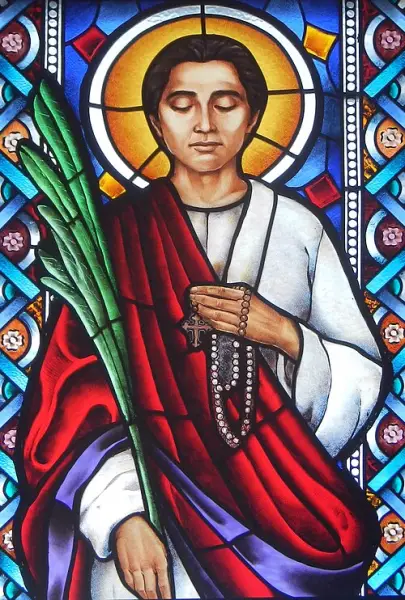
- Rosary in clasped hands·Gallows and pit (tsurushi)·Barong tagalog and black trousers·Palm of martyrdom
- Canonization
- Beatified by Pope John Paul II at Rizal Park, Manila on 18 February 1981; canonized on 18 October 1987 among the 16 Martyrs of Japan
Prayer
Bibliography
Show 12 sources
- 1 2 "Asian Catholic Directory: List of Catholic Dioceses in Asia" . Union of Catholic Asian News . Retrieved August 12, 2024 .
- 1 2 3 Foley O.F.M., Leonard. Saint of the Day, Lives, Lessons and Feast , (revised by Pat McCloskey O.F.M), Franciscan Media
- 1 2 3 "Visit of Her Excellency President Gloria Macapagal Arroyo to Participate in the 2005 World Summit – High Level plenary session of the 60th Session of the United Nations General Assembly , New York, United States of America, 12–15 Sep
- 1 2 3 Religion-Cults.com Dominguez, J, M.D., September 29: Saints of the Day, Saint Lorenzo Ruiz and Companions, 1600–1637, Religion-Cults.com , retrieved on: June 10, 2007
- 1 2 3 Filipino Apostolate/Archdiocese of New York, Chapel of San Lorenzo Ruiz, ChapelofSanLorenzoRuiz.org Archived November 20, 2008, at the Wayback Machine , retrieved on: June 9, 2007
- ↑ Carunungan, Celso Al. (June 26, 1987). "Sainthood at last!" . Manila Standard . Standard Publications, Inc. p. 4 . Retrieved December 12, 2020 .
- ↑ azheepineda (January 2, 2010). "UST Archives director Fidel Villarroel, OP: Master key to UST's past" . Skyrock . Archived from the original on December 3, 2013 . Retrieved April 30, 2012 .
- ↑ "2-volume UST history charts evolution of higher education in the Philippines" . inquirer.net . January 22, 2012.
- ↑ "UST historian named Master of Theology" . The Varsitarian . March 25, 2010.
- ↑ The Pinoy Catholic (June 11, 2009). "The Pinoy Catholic: St. Lorenzo Ruiz" . thepinoycatholic.blogspot.com .
- ↑ "Cathedral of Our Lady of the Angels" . olacathedral.org . Archived from the original on February 20, 2012 . Retrieved January 16, 2009 .
- ↑ Dimalanta, Ophelia Alcantara. Lorenzo Ruiz, Escribano: A Play in Two Acts . Manila: University of Santo Tomas Publishing House, 2002. pp. ii-iii. ISBN 971-506-178-8.
Profile text adapted from the Wikipedia article, licensed CC BY-SA 4.0.
Pray with this saint every day
Save St. Lorenzo Ruiz to your favorites, read the full profile, and get feast-day reminders in the Saints app.
Get the Saints AppFree on the App Store for iPhone and iPad