
1526 – 1581·Feast October 9
St. Louis Bertrand
Dominican Missionary and Apostle of South America
Overview
Louis Bertrand was a Spanish Dominican friar whose preaching carried the Gospel across the northern coast of South America in the sixteenth century. Born in Valencia on 1 January 1526 to Juan Bertrand and Juana Angela Exarch, he was related through his father to St. Vincent Ferrer. Against his father's wishes he entered the Dominicans at Valencia in 1544, was ordained in 1547, and spent long stretches as master of novices. During the plague of 1557 he tended the stricken, laid out the dead for burial, and dug their graves personally. Though his voice was rough and his memory poor, he became a celebrated preacher whose crowds overflowed the churches of Valencia. In 1562 he sailed for the New World, landing at Cartagena, and labored through Panama, Tubará, Cipacoa, Paluato, and Santa Marta, winning tens of thousands of converts while defending native rights against Spanish conquerors, encouraged by Bartolomé de las Casas. He survived an attempted poisoning among the Caribs. Returning to Spain in 1569, he was barred from going back to the mission field and instead served the Church in Valencia and counseled figures such as Teresa of Ávila. His death came at Valencia on 9 October 1581, reportedly just as he had foretold; canonization followed in 1671.
The Complete Life
A Valencian Novice
Louis Bertrand was born in Valencia on the first day of January 1526, born to Juan Bertrand and Juana Angela Exarch, and through his father's line he counted St. Vincent Ferrer, the great Dominican preacher of the previous century, among his kin of the previous century, and the family's connection to the Order of Preachers shaped the boy's imagination early. As a child he resolved to become a Dominican friar himself. His father opposed the plan and tried to turn him from it, but the boy persisted, and on 26 August 1544 he received the Dominican habit at the Convent of St. Dominic in Valencia. Once the usual time of probation had run its course, he made his evangelical vows. Contemporaries described a young man grave in demeanor and seemingly without any sense of humor, yet possessed of a gentle and sweet disposition that endeared him to all who met him. He could not claim exceptional intellectual gifts, but he applied himself assiduously to study and made up in diligence what he lacked in brilliance. In 1547 the archbishop of Valencia, St. Thomas of Villanova, ordained him to the priesthood. He was then appointed master of novices in the Valencia convent, an office he would hold at different intervals over the years for an aggregate of thirty years, forming generations of young Dominicans in the religious life.
§ Early life
Plague, Pulpit, and the Call to the Missions
The first great trial of Bertrand's priesthood came in 1557, when plague swept through Valencia. While others fled the infected city he devoted himself entirely to the sick and dying, preparing the dead for burial and lowering them into the ground with his own hands. When the epidemic subsided, his zeal sought a wider field in the apostolate of preaching. By natural endowment he seemed poorly suited to it: witnesses said his voice was raucous, his memory treacherous, and his carriage without grace. Yet he became a fervent preacher whose effectiveness drew multitudes. The cathedral and the largest churches of Valencia could not hold the crowds that wished to hear him, and eventually he had to preach in the public squares of the city. His fame reached beyond the Dominican order; it was probably as a preacher that St. Teresa of Ávila came to seek his counsel in the difficult work of reforming her order. Through it all Bertrand cherished a longing he had held for years: to labor in the mission fields of the New World. When leave was finally granted, he crossed the Atlantic in 1562, disembarked at Cartagena, and at once threw himself into the missionary labor that would define his life.
§ Early life
Apostle of South America
Bertrand's years in the Americas unfolded along the northern coast of South America and among the islands of the Caribbean. From Cartagena, the scene of his first labors, he was sent to Panama, where in a short time he brought some 6,000 people to the faith. His next mission was at Tubará on the coast between Cartagena and the Magdalena River; the baptismal registers there, written in his own hand, record that the entire population entered the Church, and the historian Touron reckons the converts at 10,000. From Tubará he moved on to Cipacoa and Paluato, meeting striking success at the former and disheartening results at the latter. In the province of Santa Marta his former successes returned, yielding some 15,000 souls, and while he labored there a tribe of 1,500 natives came from Paluato seeking the baptism they had once refused. He then turned to the warlike Caribs, possibly of the Leeward Islands, with less fruit, but among them, by legend, a native priest gave him a deadly draught that failed to harm him through divine interposition. The bull of his canonization records the gift of miracles and reports that while he preached in Spanish, listeners understood him in various languages. He also worked at Tenerife in the Canaries, at Mompox, where many thousands were converted, and on the islands of St. Vincent and St. Thomas. Encouraged by Bartolomé de las Casas, he consistently defended the rights of the natives against their Spanish conquerors.
§ Missionary work in South America
Return to Valencia
In 1569, after seven years of missionary labor, Bertrand returned to Spain with the intention of pleading the cause of the oppressed Indians. He was never permitted to go back to the mission fields. Instead he turned his growing reputation for sanctity, together with his family connections, into advocacy for the native peoples he had come to know during his years overseas, while resuming pastoral service in his native diocese of Valencia. He again took up the office of master of novices and became a sought-after spiritual counselor; St. Teresa of Ávila numbered among those who turned to him for direction in the reforms of her order. His health, worn by years of hardship overseas, steadily declined. In 1580, while preaching, he was taken ill in the pulpit of Valencia cathedral and had to be carried down. He lingered for another year, and died on 9 October 1581 at the age of fifty-five, a death he is said to have foretold. Valencia, which had already revered him as a preacher, nurse of plague victims, and advocate of the native peoples, now honored him as a saint, and his memory spread from Spain to the lands in South America where he had preached.
§ Return to Spain
Honors of the Church
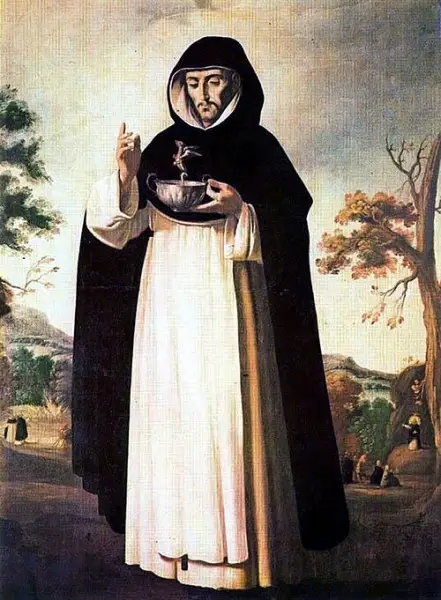
The Church moved quickly to recognize Bertrand's sanctity. He was beatified on 19 July 1608 by Pope Paul V in a ceremony at Saint Peter's Basilica in the Papal States, barely twenty-seven years after his death. Six decades later Pope Clement X canonized him on 12 April 1671, likewise at Saint Peter's Basilica, enrolling him among the saints of the universal Church. The bull of canonization attested the gifts that tradition had long attributed to him: miracles worked through his intercession and the wonder of preaching understood in many languages. His feast day, fixed on 9 October, the anniversary of his death, is observed as reported in the 2004 edition of the Martyrologium Romanum. His principal shrine is in Saint Peter's Basilica in Vatican City, and a statue of the saint stands on the north colonnade of the basilica in Rome. In art he is depicted with a chalice containing a snake, recalling the legend of the poisoned draught that could not harm him. In Buñol, a town in Valencia province of which he is patron, his feast is kept with celebration alongside that of the Mare de Déu dels Desemparats; the famous festival of La Tomatina is held in the town in honor of its patron saints.
§ Veneration
Patron of Colombia and Buñol
Bertrand's legacy endures on two continents. In South America he is remembered as the Apostle of South America, and the nations that grew from the territories where he preached claim him as their own: he is a patron of New Granada and of Colombia, and he numbers among the Colombian saints honored by the Church. The baptismal registers he filled in his own hand at Tubará remain a concrete witness to the scale of his evangelization, preserving the names of thousands who entered the Church through his ministry. His championing of native rights, encouraged by Bartolomé de las Casas, places him among the missionaries who opposed the exploitation of indigenous peoples during the conquest era, and this aspect of his career has made him a figure of enduring significance in the history of the Spanish missions. In his native Valencia he remains a beloved local saint, patron of Buñol, where the town festival honors him each year. Within the Dominican Order he stands among its great saints, his life offered as a model of the friar who unites contemplative discipline with apostolic daring. Devotion to him continues wherever the Order of Preachers serves, and his story is retold as an example of sanctity achieved through plain obedience and tireless labor.
§ Veneration
Timeline
- 1 Jan 1526
Born in Valencia, Spain, to Juan Bertrand and Juana Angela Exarch.
§ Early life
- 26 Aug 1544
Clothed with the Dominican habit at the Convent of St. Dominic, Valencia, despite his father's efforts to dissuade him.
§ Early life
- 1547
Ordained to the priesthood by St. Thomas of Villanova, archbishop of Valencia.
§ Early life
- 1557
Devoted himself to the sick and dying during the plague in Valencia, burying the dead with his own hands.
§ Early life
- 1562
Sailed for America and landed at Cartagena, beginning his missionary career.
§ Early life
- 1569
Returned to Spain after seven years in South America to plead the cause of the oppressed native peoples.
§ Return to Spain
- 1580
Collapsed while preaching in Valencia cathedral and was carried from the pulpit.
§ Return to Spain
- 9 Oct 1581
Died in Valencia at the age of fifty-five, as he is said to have foretold.
§ Return to Spain
- 19 Jul 1608
Beatified by Pope Paul V at Saint Peter's Basilica.
§ Veneration
- 12 Apr 1671
Canonized by Pope Clement X at Saint Peter's Basilica.
§ Veneration
The Record
- Major works
- Baptismal registers at Tubará recording ten thousand converts in his own handwriting
- Patron of
- Buñol·New Granada·Colombia
- Symbols
- A chalice containing a snake
- Canonization
- Canonized 12 April 1671 by Pope Clement X at Saint Peter's Basilica (beatified 19 July 1608 by Pope Paul V)
Prayer
Bibliography
Show 9 sources
- Stracke, Richard (2015-10-20). "Saint Louis Bertrand". Christian Iconography.
- O'Connor, John Bonaventure. "St. Louis Bertrand." The Catholic Encyclopedia. Vol. 9. New York: Robert Appleton Company, 1910.
- Butler, Alban. Lives of the Saints, Benziger Bros. ed. (1894)
- "St. Louis Bertrand", Dominican Friars, Province of St. Joseph
- Dorcy, Marie Jean. "St. Louis Bertrand", St. Dominic's Family, Tan Books and Publishers, 1983
- Wilberforce, The Life of St. Louis Bertrand (London, 1882)
- Touron, Histoire des Hommes Illustres de l'Ordre de Saint Dominique (Paris, 1747), IV 485-526
- Roze, Les Dominicains en Amérique (Paris, 1878), 290-310
- Byrne, Sketches of illustrious Dominicans (Boston, 1884), 1-95.
Profile text adapted from the Wikipedia article, licensed CC BY-SA 4.0.
Pray with this saint every day
Save St. Louis Bertrand to your favorites, read the full profile, and get feast-day reminders in the Saints app.
Get the Saints AppFree on the App Store for iPhone and iPad