
1673 – 1716·Feast April 28
St. Louis de Montfort
Apostle of Marian Devotion and Mission Preacher
Overview
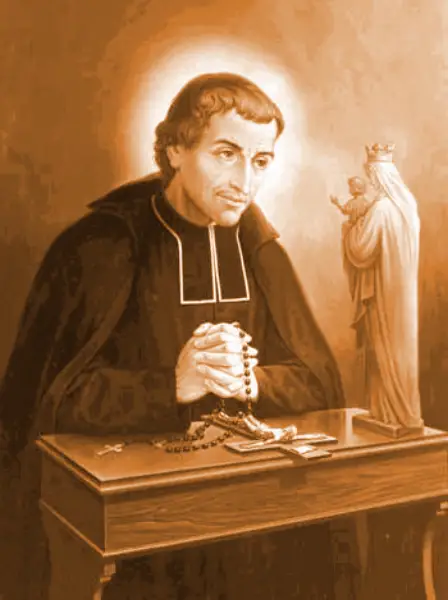
Louis-Marie Grignion de Montfort was a French Catholic priest whose preaching and writings made him one of the most influential figures in the history of Catholic devotion to the Virgin Mary. Born on 31 January 1673 at Montfort-sur-Meu in Brittany, the eldest surviving of eighteen children of a notary, he studied under the Jesuits at Rennes and prepared for priesthood at Saint-Sulpice in Paris, where hardship and illness marked his student years. Ordained in June 1700, he longed for the foreign missions but was directed instead to preach parish missions among the poor of western France. He walked from mission to mission across Brittany, Nantes, Poitou, and the Vendée, attracting crowds, founding free schools, building calvaries, and eventually winning from Pope Clement XI the title of Apostolic Missionary. He joined the Third Order of Saint Dominic, promoted the rosary, and gathered followers around him, among them Marie Louise Trichet, with whom he founded the Daughters of Wisdom. He also established the Company of Mary for missionary priests. His writings, including True Devotion to Mary, The Secret of the Rosary, and The Secret of Mary, taught total consecration to Jesus through Mary and later shaped the spirituality of several popes. Worn out by labor and sickness, he died at Saint-Laurent-sur-Sèvre on 28 April 1716, aged forty-three.
The Complete Life
A Breton Boy of Eighteen Siblings
Louis-Marie Grignion was born on 31 January 1673 in the small town of Montfort-sur-Meu in Brittany, the second of eighteen children born to Jean-Baptiste Grignion, a notary, and his wife Jeanne Robert; Louis-Marie was the eldest to survive. Much of his infancy and early boyhood passed at Iffendic, a few kilometers away, where his father had purchased a farm. At the age of twelve he was sent to the Jesuit College of St. Thomas Becket at Rennes, where an uncle served as a parish priest, and there he completed his ordinary schooling before beginning studies in philosophy and theology at the same institution. The decisive influence of these years was the Abbé Julien Bellier, a local priest whose stories of life as an itinerant missionary fired the boy's imagination. Bellier encouraged his students in a consecration and entrustment of themselves to Mary, and under his guidance, together with that of other priests, Louis-Marie developed the deep devotion to the Blessed Virgin that would define his entire life. A benefactor eventually opened the way to Paris and the celebrated Seminary of Saint-Sulpice toward the end of 1693. On arriving he discovered the money promised was insufficient, and he lodged in a series of boarding houses among the very poor while attending theology lectures at the Sorbonne, until illness and hospitalization interrupted his studies.
§ Early years
Formation at Saint-Sulpice
When Montfort left the hospital, he found that his place had been reserved at the Little Saint-Sulpice, which he joined in July 1695. This seminary owed its foundation by Jean-Jacques Olier, one of the principal figures of the French school of spirituality, and its atmosphere shaped Montfort's priestly soul. Appointed librarian, he gained access to most of the available literature on spirituality and devoted himself especially to works on the place of the Virgin Mary in the Christian life, study that bore fruit decades later in his classic books on the rosary. Even as a seminarian he was noted for his veneration of the angels, urging his confreres to treat their guardian angels with respect and tenderness and closing his letters with a salutation to the angel of the correspondent; when he later came to a new town, he was accustomed to salute all its angels first. This devotion flowed naturally from his formation, for his Jesuit teachers had championed the angels and the Sulpician masters Olier and Cardinal de Bérulle both held them in deep honor. He was ordained a priest in June 1700 and assigned to Nantes. His great dream remained the foreign missions, preferably in Canada, but his spiritual director steered him away, and letters from the period show a young priest chafing because no opening offered for the preaching to which he believed God summoned him.
§ Early years
The Good Father from Montfort
Seeking clarity about his vocation, Montfort walked as a pilgrim to Rome to consult Pope Clement XI. The pope recognized his true calling, told him that France offered abundant scope for it, and sent him home with the title of Apostolic Missionary. On the return journey he made a retreat at Mont Saint-Michel, praying to the archangel for the grace to win souls for God, confirm the faithful, and battle sin. For the remaining decade of his life he preached missions almost without pause, walking from town to town from Brittany to Nantes, and became known simply as the good Father from Montfort. At Pontchateau he drew hundreds of volunteers to build an enormous calvary, only to have the bishop forbid its blessing on the very eve of the ceremony, the King of France having ordered its destruction under Jansenist influence; Montfort received the news with the words, Blessed be God. In November 1710 he joined the Third Order of Saint Dominic and obtained leave to preach the rosary and establish rosary confraternities. As chaplain of the hospital in Nantes he met Marie Louise Trichet, whose thirty-four years of service to the poor began with that encounter, in an era when France's growing population was outstripping its food supply. His preaching style was heated and, to some, strange; he was even poisoned once, and though the attempt failed, it weakened his health permanently. He continued undeterred, founding free schools for poor boys and girls wherever he went.
§ From priest to preacher
La Rochelle and the Daughters of Wisdom
The bishop of La Rochelle had long admired Montfort and invited him to open a school in his city. Montfort called on Marie Louise Trichet, then directing the General Hospital at Poitiers, and in 1715 she and Catherine Brunet left Poitiers for La Rochelle; within a short time their school counted four hundred students. On 22 August 1715 Trichet, Brunet, Marie Valleau, and Marie Régnier received the approbation of Bishop de Champflour to make their religious vows under Montfort's direction, and at the ceremony he bestowed the community's name, directing the sisters to style themselves Daughters of Wisdom, since their work would be teaching children and caring for the poor. The community would grow into an international religious congregation. In those same years Montfort composed his most enduring works: True Devotion to Mary, The Secret of Mary, and The Secret of the Rosary, together with the rules drawn up for the Company of Mary and for the Daughters of Wisdom, and a great many hymns. His missions made a particular impact in the Vendée. He balanced ceaseless activity with seasons of solitude, perhaps four years in all, at the hermitage of Saint Lazarus close to his native village, in the Mervent cave deep in the forest, and at the hermitage of Saint Eloi in La Rochelle. In April 1716, exhausted by labor and sickness, he began a mission at Saint-Laurent-sur-Sèvre, fell ill during it, and died there on 28 April at forty-three. Thousands gathered for his burial, and miracles were soon reported at his tomb.
§ Daughters of Wisdom
Total Consecration to Jesus through Mary
The heart of Montfort's teaching is total consecration to Jesus through Mary, founded on his conviction that Jesus and Mary are inseparable. In his view, since Mary of all creatures is the most conformed to Christ, the devotion that most consecrates a soul to the Lord is devotion to Christ's own Mother; and the deeper a soul's consecration to her, the deeper its consecration to Jesus. He called her the surest, gentlest, briefest, and most perfect of all the roads that lead to Jesus, and famously compared her to the sea that gathers all the waters as Mary gathers all God's graces. His consecration unfolds in seven movements and fruits: recognizing one's own unworthiness, taking one's place in Mary's faith, receiving the gift of pure love, reposing boundless trust in God and in Mary, receiving a communication of Mary's own spirit, being remade in the likeness of Jesus, and giving Christ ever greater glory. The practice has internal and external dimensions: inwardly, the soul surrenders itself to Mary and to Jesus through her, performing every action with her, in her, through her, and for her; outwardly, it embraces enrollment in Marian societies, the spread of Marian devotion, and almsgiving in Mary's honor. His motto, God Alone, appears more than 150 times in his writings. His spirituality centers on the Incarnation as the absolute central reality, joined to love of the Blessed Virgin, fidelity to the cross, and unquenchable missionary zeal.
§ Total consecration to Jesus through Mary
Honored by the Church
Montfort's reputation for holiness grew steadily after his death, nourished by the miracles reported at his tomb in the parish church of Saint-Laurent-sur-Sèvre, where Marie Louise Trichet was buried beside him exactly forty-three years later, on 28 April 1759. Pope Leo XIII beatified him in 1888, deliberately choosing as the date of the ceremony his own golden jubilee of priesthood. On 20 July 1947 Pope Pius XII canonized him, hailing him as the guide who brings souls to Mary and through Mary to Jesus, and a statue of the founder carved by Giacomo Parisini occupies an upper niche in the south nave of Saint Peter's Basilica, a distinction reflecting the international growth of the congregations he founded. His feast is kept on 28 April. The popes of the modern era testified again and again to his influence: Pius IX judged his form of Marian devotion the best and most acceptable; Leo XIII granted indulgences for practicing his method of consecration; Pius X acknowledged Montfort's writings in composing his encyclical Ad diem illum; and Pius XI said he had practiced Montfort's methods since his youth. In 1996 Pope John Paul II, who had read Montfort's works repeatedly as a young seminarian and taken the motto Totus Tuus, came to Saint-Laurent-sur-Sèvre to pray at the adjacent tombs of the saint and the woman he himself had beatified.
§ Death and burial
A Teacher of Popes and of the Faithful
Few spiritual writers have shaped Catholic life beyond their own century as Montfort has. His books became classics of Catholic devotion: True Devotion to Mary and The Secret of the Rosary continue to be printed, translated, and prayed across the world, and his complete works were gathered in 1987 under the title God Alone: The Collected Writings of St. Louis Marie de Montfort. His influence reached the highest levels of the Church. Pope John Paul II credited Montfort's teaching with convincing him that he could not exclude the Lord's Mother from his life without neglecting the will of God, adopted Totus Tuus, drawn from Montfort's consecration, as his papal motto, and held up Montfort's teaching in Redemptoris Mater as an outstanding witness to Marian devotion within Catholic tradition. The congregations he founded carry his work forward: the Company of Mary continues his missionary preaching, and the Daughters of Wisdom, grown from the four women who first vowed at La Rochelle, became an international organization devoted to teaching children and serving the poor. His missions left a lasting mark on the Vendée, and his promotion of the rosary and Marian consecration entered the mainstream of Catholic practice, guiding countless laypeople who follow his thirty-three-day program of preparation for total consecration to Jesus through Mary.
§ Total consecration to Jesus through Mary
Timeline
- 31 Jan 1673
Born at Montfort-sur-Meu in Brittany, eldest surviving child of Jean-Baptiste and Jeanne Robert Grignion.
§ Early years
- 1685
Entered the Jesuit College of St. Thomas Becket in Rennes at the age of twelve.
§ Early years
- 1693
Traveled to Paris to study at the Seminary of Saint-Sulpice, living among the very poor while attending lectures at the Sorbonne.
§ Early years
- Jul 1695
Entered the Little Saint-Sulpice seminary, where he served as librarian and studied works on Marian spirituality.
§ Early years
- Jun 1700
Ordained a priest and assigned to Nantes.
§ From priest to preacher
- 1706
Made a pilgrimage to Rome, where Pope Clement XI confirmed his vocation and sent him back to France as Apostolic Missionary.
§ From priest to preacher
- Nov 1710
Joined the Third Order of Saint Dominic and sought permission to preach the rosary and form rosary confraternities.
§ From priest to preacher
- 22 Aug 1715
Marie Louise Trichet, Catherine Brunet, Marie Valleau, and Marie Régnier made religious vows under his direction, founding the Daughters of Wisdom at La Rochelle.
§ Daughters of Wisdom
- 28 Apr 1716
Died at Saint-Laurent-sur-Sèvre at the age of forty-three while preaching his last mission.
§ Death and burial
- 1888
Beatified by Pope Leo XIII, who chose the day of his own priestly Golden jubilee for the ceremony.
§ Total consecration to Jesus through Mary
- 20 Jul 1947
Canonized by Pope Pius XII.
§ Louis-Marie Grignion de Montfort
In Their Own Words
Blessed be God.
Call yourselves the Daughters of Wisdom, for the teaching of children and the care of the poor.
God the Father made an assemblage of all the waters, and He named it the sea (mare). He has made an assemblage of all His graces, and He has called it Mary (Maria).
Mary is the safest, easiest, shortest, and most perfect way of approaching Jesus.
The Record
- Major works
- True Devotion to Mary·The Secret of the Rosary·The Secret of Mary·The Love of Eternal Wisdom·Letter to the Friends of the Cross·Methods for Saying the Rosary·Prayer for Missionaries·Rules for the Company of Mary and the Daughters of Wisdom·many hymns
- Patron of
- preachers·those devoted to the Virgin Mary and the rosary
- Symbols
- rosary·founder's statue in Saint Peter's Basilica
- Canonization
- Canonized 20 July 1947 by Pope Pius XII (beatified 1888 by Pope Leo XIII)
Prayer
Bibliography
Show 10 sources
- "St. Louis-Marie Grignion de Montfort | Patron Saint, Marian Devotion, & France | Britannica". www.britannica.com.
- Augustin Poulain, St. Louis-Marie Grignion de Montfort in The Catholic Encyclopedia Vol. 9. New York: Robert Appleton Company, 1910.
- McDermott, Ferdi (August 2015). "The Life and Legacy of St Louis Marie Grignion de Montfort". Conference: The Virgin Mary in Liturgy, Literature and Life at Chavagnes International College.
- Leonard Foley OFM, Saint of the Day: Lives, Lessons and Feast, revised by Pat McCloskey OFM, Franciscan Media
- Jesus Living in Mary: Handbook of the Spirituality of St. Louis de Montfort, Montfort Publications, Litchfield, CT, 1994
- Raymond Burke, 2008, Mariology: A Guide for Priests, Deacons, seminarians, and Consecrated Persons, Queenship Publishing
- Grignon De Montfort, Louis Marie. A treatise on the true devotion to the blessed virgin, (F.W. Faber, trans.), 1863
- Pope John Paul II (21 June 1997). "Letter of Pope John Paul II to Mark the 50th Anniversary Of The Canonization of Saint Louis-Marie Grignion de Montfort". vatican.va.
- Antoine Nachef, 2000, Mary's Pope, Rowman & Littlefield Press
- Pope John Paul II, Redemptoris Mater, March 25, 1987, Libreria Editrice Vaticana
Profile text adapted from the Wikipedia article, licensed CC BY-SA 4.0.
Pray with this saint every day
Save St. Louis de Montfort to your favorites, read the full profile, and get feast-day reminders in the Saints app.
Get the Saints AppFree on the App Store for iPhone and iPad