
1214 – 1270·Feast August 25
St. Louis IX of France
King of France and Crusader Saint
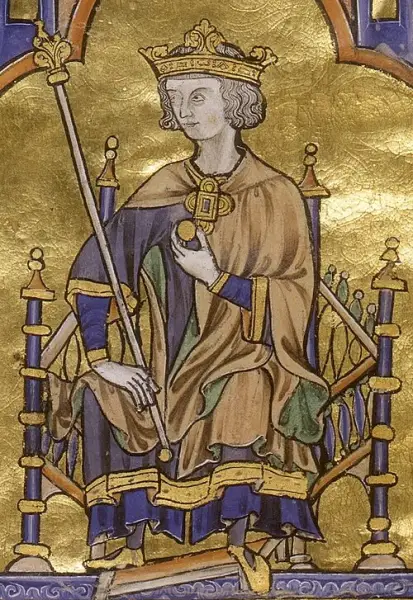
Overview
Louis IX, known to history as Saint Louis, ruled the kingdom of France from 1226 to 1270 and remains the only French king raised to the altars. Born at Poissy on 25 April 1214, son of Louis VIII and Blanche of Castile, he was crowned at Reims at the age of twelve, with his formidable mother governing as regent and later advising him until her death in 1252. His reign is regarded as a political and economic zenith of medieval France. He reformed royal justice so that subjects could appeal directly to the crown, abolished trial by ordeal, introduced the presumption of innocence, and deployed enquêteurs to investigate official abuses. A profoundly devout ruler, he built the Sainte-Chapelle to house the crown of thorns, founded hospitals, and personally served the poor at his table. He settled long-running disputes by treaty with Aragon and England, and his reputation for fairness made him the arbiter of Europe. Keeping a vow made during a grave illness, he led the Seventh Crusade, was defeated and captured in Egypt in 1250, and spent four years fortifying the Holy Land. Returning to France in 1254, he later took the cross again, landing at Tunis in 1270, where he died of dysentery on 25 August. Canonized in 1297, he became the model of the Christian monarch.
The Complete Life
A Crowned Child
Louis came into the world on 25 April 1214 at Poissy outside Paris, the son of Prince Louis the Lion and Blanche of Castile, grandson of Philip II Augustus. He was baptized in the collegiate church of Notre-Dame at Poissy, and his maternal grandfather was Alfonso VIII of Castile. Blanche chose his tutors herself, and the boy was trained in Latin, public speaking, writing, the military arts, and the business of government. His father became king in 1223 upon Philip Augustus's death, when Louis was nine. In November 1226 Louis VIII died suddenly, and the twelve-year-old was crowned at Reims on 29 November, the ceremony performed by the bishop of Soissons. France at that moment was far from secure: rebellious vassals tested the boy-king's minority, and the Albigensian Crusade against the Cathars of the south had been running for two decades. Queen Blanche met these dangers with iron resolve, breaking the rebellion and steering the crusade to a negotiated close in 1229 through an agreement with Raymond VII of Toulouse. She also instilled in her son her own intense Christianity, and her famous words to him—that she loved him dearly but would rather see him dead than guilty of a mortal sin—became the moral key to his whole reign. His younger brother Charles was created count of Anjou, founding the Capetian Angevin line.
§ Minority (1226–1234)
Marriage and Personal Rule
On 27 May 1234 Louis married Margaret of Provence, who was crowned queen at Sens Cathedral the following day. Margaret was the sister of Eleanor of Provence, future queen of England, and her religious zeal made her a fitting partner for so devout a king. The couple genuinely enjoyed one another's company, riding, reading, and listening to music together, and their closeness stirred a jealousy in Blanche that moved the dowager queen to keep the young couple apart as often as she could. Contemporaries regarded the early reign as a co-rule between mother and son, but historians generally date Louis's personal rule from 1234, with Blanche moving into an advisory role she retained until her death in 1252. As king, Louis governed a realm then rising toward its medieval height. France commanded the largest army and the wealthiest state in Europe, Paris was becoming the intellectual capital of Christendom, and the foundations of what would become the Sorbonne were laid in the city about 1257. Yet the king's deepest formation remained religious: he heard Mass daily, practiced severe personal penance, and held the firm belief that France, being the Church's eldest daughter, owed God the service of a protector. It was this sense of sacred duty, joined to a promise made while praying for recovery from grave illness, that drew him toward the crusade.
§ Minority (1226–1234)
The King's Crusades
Louis's crusading career began when Pope Innocent IV called a renewed effort to recover Jerusalem by striking at Egypt, the linchpin of Ayyubid power, through the bull Terra Sancta Christi of 1245. The king sailed in 1248, landing in Egypt in June 1249 and taking the port of Damietta. The advance up the Nile stalled against the flood season and summer heat, and with the death of the Ayyubid sultan the Egyptian command passed through a succession struggle to the rising Mamluks. At the Battle of Fariskur on 8 February 1250 his army was cut to pieces and the king fell into Egyptian hands. In captivity he recited the Divine Office every day. His release was bought at the cost of a ransom of 400,000 bezants, close to a year's royal income, and the surrender of Damietta. Rather than sail home, Louis spent four years fortifying the Christian positions in the Holy Land, working at Acre, Caesarea, and Jaffa, strengthening defenses and negotiating with the Ayyubids, before returning to France in the spring of 1254. Even at home he kept contact with the Mongol courts, sending the Dominican André de Longjumeau to the great khan and later the Franciscan William of Rubruck, hoping always for an alliance against the Mamluks. In 1267 he took the cross a second time, resolved to strike at Tunis; the crusaders landed at Carthage in July 1270, but dysentery swept the camp, and the king died there on 25 August 1270, his heart eventually buried at Monreale and his bones at Saint-Denis.
§ Seventh Crusade
The Monk King
Contemporaries called Louis a monk king, and the description captured the unusual fusion of royal majesty and monastic discipline in his person. He built the Sainte-Chapelle within his palace on the Île de la Cité, a shrine of Rayonnant Gothic architecture built expressly to enshrine the crown of thorns and a piece of the True Cross, relics he had obtained from the bankrupt Latin Emperor Baldwin II at the enormous cost of 135,000 livres. His charity was personal as well as princely: more than a hundred poor people were fed daily in his house even in ordinary times, and the king frequently waited on them himself. He established the Filles-Dieu as a refuge for reformed prostitutes, plus the Quinze-Vingt for three hundred blind men, and hospitals at Pontoise, Vernon, and Compiègne, and he installed Trinitarian friars as his chaplains, taking them with him on crusade. His spirituality was strict to the point of rigor: he forbade usury, enacted savage penalties for blasphemy, and pursued policies against the Jewish population of his kingdom, including compulsory badges and the burning of the Talmud after the Disputation of Paris of 1240, measures that modern readers rightly judge grave injustices even as they display his unbending conception of Christian kingship. For his son Philip he wrote the Enseignements, urging him to model his rule on Christ, and in his testament he charged the young king to accept every martyrdom rather than commit a mortal sin.
§ Religion
Reformer and Arbiter
The last sixteen years of the reign, following the disaster in Egypt, produced Louis's most enduring work as a lawgiver. Before departing on crusade in 1248 he had sent enquêteurs across the kingdom to hear complaints against royal officials and provide restitution; the reports of corruption they compiled, together with the crusade's failure, drove a sweeping reform program. The Great Reform Ordinance promulgated in December 1254 set ethical and practical standards for the conduct of baillis and enquêteurs, enforced through supervision and accountability procedures, including a restored system of enquêtes; the 1261 inquest into the bailli of Vermandois, which collected testimony from 247 witnesses, shows the seriousness of the system. Louis permitted subjects to appeal judgments directly to the crown, abolished trial by ordeal as obsolete, introduced the presumption of innocence into criminal proceedings, and worked to suppress private war, establishing the offices of provosts and bailiffs to carry his justice into the localities. He was famed for sitting under an oak in the forest of Vincennes to hear cases personally. His prestige made him the arbiter of Europe: he judged the case of Enguerrand of Coucy, who had hanged three squires without trial; concluded the Treaty of Corbeil with Aragon in 1258; settled the long war with England by the Treaty of Paris of 1259; and in 1264 issued the Mise of Amiens in the dispute between Henry III and his barons.
§ Legal reforms
Proclaimed a Saint
Louis died as he had lived, on crusade, in his tent near Tunis amid an epidemic that was destroying his army. The testimony gathered about his life was extraordinary: Jean de Joinville, his friend and counselor, wrote a celebrated Life of Saint Louis from personal knowledge; his confessor Geoffrey of Beaulieu and his chaplain William of Chartres composed biographies; and all three gave evidence in the papal inquest into his sanctity. On 11 July 1297 Pope Boniface VIII proclaimed his canonization in Rome, making him the sole king of France ever declared a saint. The Church fixed his feast on 25 August, the day of his death, and honors him among confessors; the Catholic Church and the Anglican Communion both keep his memory. In sacred art he appears with the crown of thorns, sceptre, globus cruciger, sword, and fleur-de-lis, the regalia of the kingdom he sanctified. His cult shaped the French monarchy's self-understanding for centuries: the royal Order of Saint Louis was founded in his honor in 1693, and his name was given to churches, cities, and missions across the French world, from San Luigi dei Francesi in Rome to the cathedral of St. Louis in New Orleans and the American city that bears his name. Religious orders founded at Vannes in 1803 and Juilly in 1842 took his name as well.
§ Veneration as a saint
The Ideal Christian King
No medieval king left a deeper imprint on the ideal of Christian rulership. Through the centuries his devotees have hailed him as the quintessential Christian monarch: a knight of genuine skill who walked among his people with an engaging manner, a judge whose fairness drew petitions from across Europe, and a penitent whose piety outstripped many cloistered religious. Even his severest modern critics, who condemn his persecution of Jewish communities and the ruinous crusades, acknowledge in him an ethical consistency rare among the powerful. He was the direct ancestor of every subsequent French king, and the prestige of his reign marked a zenith of medieval France, both politically and economically. Places across the world still carry his name—San Luis Province in Argentina, San Luis Potosí in Mexico, Saint-Louis in Senegal, São Luís in Brazil, and St. Louis, Missouri—testimony to the reach of French colonization conducted under his patronage. In the United States his image adorns the chamber of the House of Representatives among the great lawgivers of history, and friezes in the Supreme Court include his figure. The Sisters of Charity of St. Louis and the Sisters of St Louis continue charitable work under his patronage, and he is honored as co-patron of the Third Order of St Francis, which claims him as a member on the strength of his charity, though he probably never formally joined. He remains the standard against which Christian sovereigns are measured.
§ Veneration as a saint
Timeline
- 25 Apr 1214
Born at Poissy near Paris, son of Louis VIII and Blanche of Castile.
§ Early life
- 8 Nov 1226
Succeeded his father as king at the age of twelve.
§ Minority (1226–1234)
- 29 Nov 1226
Crowned at Reims Cathedral, officiated by the bishop of Soissons, with his mother as regent.
§ Minority (1226–1234)
- 1229
His mother ended the Albigensian Crusade by agreement with Raymond VII of Toulouse.
§ Minority (1226–1234)
- 27 May 1234
Married Margaret of Provence at Sens, beginning his personal rule.
§ Minority (1226–1234)
- 1239
Began acquiring the crown of thorns and a relic of the True Cross from Emperor Baldwin II of Constantinople.
§ Religion
- 1241
Foundation of the Sainte-Chapelle laid to enshrine the Passion relics.
§ Construction of the Sainte-Chapelle
- 1242
Ordered 12,000 copies of the Talmud burned following the Paris disputation.
§ Religion
- 1245
Pope Innocent IV inaugurated the Seventh Crusade with the bull Terra Sancta Christi.
§ Seventh Crusade
- 26 Apr 1248
The Sainte-Chapelle was consecrated as the royal private chapel.
§ Construction of the Sainte-Chapelle
- 5 Jun 1249
Landed in Egypt and captured the port of Damietta at the start of the Seventh Crusade.
§ Seventh Crusade
- 8 Feb 1250
Defeated and captured by the Egyptians at the Battle of Fariskur; later ransomed for 400,000 bezants and Damietta.
§ Seventh Crusade
- Nov 1252
Death of his mother Blanche of Castile, who had governed during his crusade.
§ Return to France
- 24 Apr 1254
Set out from Acre after four years strengthening the Kingdom of Jerusalem, arriving in France in July.
§ Return to France
- Dec 1254
Promulgated the Great Reform Ordinance on the conduct of royal officers.
§ Legal reforms
- 1258
Concluded the Treaty of Corbeil with James I of Aragon, settling claims in Catalonia and southern France.
§ Diplomatic relations and treaties
- 1259
Signed the Treaty of Paris with Henry III of England, receiving Normandy, Anjou, Maine, Touraine, and Poitou.
§ Diplomatic relations and treaties
- Jan 1264
Issued the Mise of Amiens, arbitrating the dispute between Henry III of England and his barons.
§ Diplomatic relations and treaties
- 24 Mar 1267
Took the cross with his three sons at a parliament in Paris, launching the Eighth Crusade.
§ Eighth Crusade and death
- 17 Jul 1270
Landed at Carthage near Tunis with the crusading army, where disease broke out in camp.
§ Eighth Crusade and death
- 25 Aug 1270
Died of dysentery outside Tunis; succeeded by his son Philip III.
§ Eighth Crusade and death
- May 1271
His remains reached the royal necropolis of Saint-Denis, carried in procession across Sicily, Italy, the Alps, and France.
§ Eighth Crusade and death
- 11 Jul 1297
Canonized at Rome by Pope Boniface VIII; no other French king has ever been declared a saint.
§ Veneration as a saint
In Their Own Words
I love you, my dear son, as much as a mother can love her child; but I would rather see you dead at my feet than that you should ever commit a mortal sin.
My dearest son, you should permit yourself to be tormented by every kind of martyrdom before you would allow yourself to commit a mortal sin.
The Record
- Major works
- Sainte-Chapelle in Paris·Enseignements (teachings) to his son Philip III·Spiritual testament·House of the Filles-Dieu·Quinze-Vingt hospice for 300 blind men·Hospitals at Pontoise, Vernon, and Compiègne·Great Reform Ordinance of December 1254
- Patron of
- France·Third Order of Saint Francis·The French Monarchy·Archdiocese of New Orleans·Diocese of Port-Louis·barbers·grooms
- Symbols
- crown of thorns·crown·sceptre·globus cruciger·sword·fleur-de-lis·mantle
- Canonization
- Canonized 11 July 1297 by Pope Boniface VIII in Rome, following a papal inquest into his life
Prayer
Bibliography
Show 10 sources
- Goyau, Georges. "St. Louis IX." The Catholic Encyclopedia. Vol. 9. New York: Robert Appleton Company, 1910.
- "Louis IX, king of France". Encyclopædia Britannica.
- Collings, Andrew Jeffrey (2018). "The King Cannot be Everywhere: Royal Governance and Local Society in the Reign of Louis IX".
- Jean de Joinville, Life of Saint Louis
- Gaposchkin, M. Cecilia (2008). The Making of Saint Louis: Kingship, Sanctity, and Crusade in the Later Middle Ages. Cornell University Press.
- Jordan, William Chester (1979). Louis IX and the Challenge of the Crusade: A Study in Rulership. Princeton University Press.
- Le Goff, Jacques (2009). Saint Louis. University of Notre Dame Press.
- Richard, Jean (1983). Saint Louis: Crusader King of France. Cambridge University Press.
- Tyerman, Christopher (2006). God's War: A New History of the Crusades. The Belknap Press of Harvard University Press.
- Sumption, Jonathan (1978). The Albigensian Crusade. Faber and Faber.
Profile text adapted from the Wikipedia article, licensed CC BY-SA 4.0.
Pray with this saint every day
Save St. Louis IX of France to your favorites, read the full profile, and get feast-day reminders in the Saints app.
Get the Saints AppFree on the App Store for iPhone and iPad