
1274 – 1297·Feast August 19
St. Louis of Toulouse
Renounced Prince and Franciscan Bishop
Overview
Louis of Toulouse, also called Louis of Anjou, was a prince of the Capetian House of Anjou who traded a throne for the Franciscan habit and died a bishop at twenty-three. Born on 9 February 1274, the second son of Charles II of Naples and Mary of Hungary, he spent much of his childhood as a political hostage. His father, imprisoned after the war with Peter III of Aragon that followed the Sicilian Vespers, bought his own freedom by surrendering his three sons, and Louis and his brothers were held in Catalonia for seven years under the care of Franciscan friars. There, impressed by the friar Arnauld de Villeneuve, he took up philosophy and theology. Though still a hostage he was made archbishop of Lyon upon reaching his majority. When his elder brother died of plague in 1295, Louis became heir to the Neapolitan crown, but once free he surrendered his rights to the throne of Naples to his brother Robert and bound himself by the vows of poverty, chastity, and obedience in the Franciscan manner. On 5 February 1297 Pope Boniface VIII consecrated him Bishop of Toulouse, a strategically important see for Angevin interests. He won immediate fame for feeding the hungry and serving the poor, neglecting his own health, and after only six months he withdrew from the office, exhausted. He died of fever, probably typhoid, at Brignoles on 19 August 1297, and was canonized just twenty years later.
The Complete Life
A Prince in Captivity
Louis was born on 9 February 1274, either at Brignoles in Provence or at Nocera in Italy, where he passed part of his early childhood. He was the second son of Charles II of Naples and Mary of Hungary, born into the Capetian House of Anjou at the moment of its greatest ambitions and its gravest reverses. In 1285 his father became king of Naples and was almost at once taken prisoner during the war with Peter III of Aragon that had followed the Sicilian Vespers. To obtain his own release, Charles surrendered his three sons as hostages, and Louis was carried off with his brothers to Catalonia. For seven years they lived among the Franciscan friars entrusted with their education. The captivity, intended as humiliation, became for Louis a school of holiness. One friar in particular, the celebrated Arnauld de Villeneuve, made a deep impression on the young prince, who responded by taking up the study of philosophy and theology with genuine application. In the unusual circumstances of his captivity, ecclesiastical preferment could still follow his birth: though still a hostage, he received the archbishopric of Lyon the moment he attained his majority, holding that dignity from 1290 to 1295 without ever being freed to exercise it fully.
§ Life
Renouncing the Kingdom
The death of Louis's older brother of plague in 1295 transformed him overnight from a younger son into heir apparent to the kingdom of Naples. That same year his captivity ended and he regained his freedom. He then made the decision that defines his memory: instead of returning to claim his inheritance, he traveled to Rome and formally surrendered every claim to the Angevin succession in favor of his brother Robert, declaring at the same time that he meant to profess the vows of poverty, chastity, and obedience after the Franciscan manner. It was a choice almost without parallel among European princes. The second son of a king, raised among Franciscans in a foreign land, preferred the mendicant habit to a crown. The papacy, however, was not prepared to let so valuable a churchman remain a simple friar. On 5 February 1297 Pope Boniface VIII consecrated him Bishop of Toulouse, a city his granduncle Alphonse had ruled as count until his death without heir in 1271, and which now occupied an essential place in the belt of territory between Provence and Aquitaine so dear to Angevin ambitions. Louis therefore occupied an ambivalent dynastic and ecclesiastical position, a Franciscan at heart deployed as an Angevin asset, wearing his grey habit beneath the episcopal vestments that were his office and his family's policy in one garment.
§ Life
Bishop for Six Months
Louis was about twenty-two when he took possession of the important see of Toulouse, an appointment won by his princely standing rather than his age. Whatever his family had intended, the young bishop confounded expectations by giving himself entirely to the office's pastoral demands rather than its political uses. He quickly became famous for his care of the destitute, his feeding of the hungry, and his disregard of his own needs, pouring out the energy of a zealous young friar on a diocese that had waited years for a resident bishop. The pace proved fatal. Barely six months into the office he resigned the episcopal position, worn down, it seems, by his labors and unable to go on. He withdrew toward his native Provence, and soon afterward died at Brignoles of a fever, perhaps typhoid, on 19 August 1297, at just twenty-three years of age. His episcopate was among the shortest of any canonized bishop, yet its brevity became part of his testimony: he had held nothing back, and his body gave out where a more calculating man would have conserved his strength. Later ages credited him with two treatises on music, but scholars now assign the works De musicae commendacione and, separately, the Sentencia in musica sonora subiecti instead to Lodewijk Heyligen, who lived a generation later.
§ Life
Sol Oriens
Procedures for Louis's canonization were urged almost immediately after his death, and the cause moved with unusual speed by medieval standards. Pope Clement V took up the promotion of the case in 1307, and on 7 April 1317 Pope John XXII canonized him with the bull Sol oriens, barely twenty years after the young bishop's death. The Angevin court at Naples had every reason to celebrate: Louis's brother Robert, who owed his crown directly to Louis's renunciation, commissioned from Simone Martini a grand altarpiece in which angels crown the saint even as he places the crown upon Robert's head, an image that tied the legitimacy of the Neapolitan throne to the sanctity of the man who had given it up. Composers honored him as well: the polyphonic motet Flos / Celsa / Quam magnus pontifex marked his canonization in 1317, preserved anonymously in the Ivrea Codex and attributed by modern scholars to Philippe de Vitry. His cult spread with the family's fortunes and the Franciscan order's devotion. In Hungary his nephew Charles I promoted his cult and image, consecrating churches and a monastery at Lippa in his honor and giving his name to his own heir, the future Louis I of Hungary. The Franciscans embraced him throughout Europe, keeping his feast of 19 August in their calendar.
§ Veneration
Patron of Valencia and San Luis Obispo
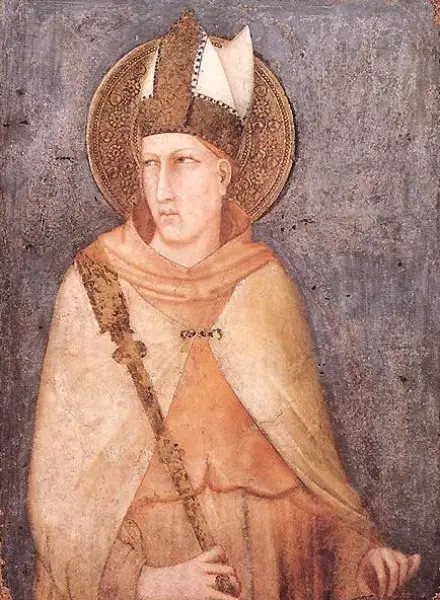
Louis's relics became, like his renunciation, instruments of dynastic politics and seeds of devotion. In 1423 Alfonso V of Aragon sacked Marseille and carried the relics off to Valencia, where the saint was proclaimed patron. He remains the patron of Valencia and of Málaga in Spain, of Limosano in Italy, and of Baler and Lucban in the Philippines. His fame crossed the Atlantic with the Franciscans: Mission San Luis Obispo de Tolosa, founded in California in 1772, bears his name, as do the surrounding city and county of San Luis Obispo. In the Netherlands, Kolleg St Ludwig at Vlodrop was dedicated to him, and a Vlodrop hotel still carries the name of Saint Ludwig. In art he is instantly recognizable: a young bishop vested in pontifical garments over the brown or grey Franciscan habit, his cope patterned with the French fleur-de-lys, a crosier in his hand and a discarded crown lying at his feet, the symbol of a prince who renounced the kingdom of Naples for Holy Orders. The silver reliquary of the saint now in the Musée de Cluny and his crosier preserved at the Basilica of Saint-Sernin in Toulouse survive as witnesses to the splendor his cult once commanded. In the Chronicon Pictum of 1358 he raises his right hand in blessing, the Hungarian Angevin arms on his breast, the crown forever at his feet.
§ Veneration
Timeline
- 9 Feb 1274
Born at Brignoles in Provence, second son of Charles II of Naples and Mary of Hungary.
§ Life
- 1285
His father became king of Naples and was taken prisoner in the war with Peter III of Aragon.
§ Life
- 1290
Made archbishop of Lyon upon reaching his majority, while still held in captivity.
§ Life
- 1295
His older brother died of plague, making Louis heir apparent; freed that year, he renounced the Angevin inheritance in favor of Robert and took Franciscan vows.
§ Life
- 1296
Appointed Bishop of Toulouse, succeeding Hugues Mascaron.
§ Life
- 5 Feb 1297
Consecrated Bishop of Toulouse by Pope Boniface VIII.
§ Life
- 19 Aug 1297
Died of fever, possibly typhoid, at Brignoles at the age of twenty-three, about six months after withdrawing from his bishopric.
§ Life
- 1307
Pope Clement V promoted the case for his canonization.
§ Veneration
- 7 Apr 1317
Canonized by Pope John XXII with the bull Sol oriens.
§ Veneration
- 1423
Alfonso V of Aragon sacked Marseille and transferred Louis's relics to Valencia, where he was made patron saint.
§ Veneration
The Record
- Patron of
- Valencia (Spain)·Málaga·Mission San Luis Obispo de Tolosa·Limosano (Italy)·Baler (Philippines)·Lucban (Philippines)
- Symbols
- boy bishop·discarded crown at his feet·pontifical vestments over the Franciscan habit·book·crosier·fleur-de-lys
- Canonization
- Canonized 7 April 1317 by Pope John XXII with the bull Sol oriens (case promoted by Clement V from 1307)
Prayer
Bibliography
Show 10 sources
- Arnold, John H. (2014). The Oxford Handbook of Medieval Christianity. OUP Oxford.
- Brunner, Melanie (2011). "Poverty and Charity: Pope John XXII and the canonization of Louis of Anjou". Franciscan Studies. 69.
- Cusato, Michael F.; Geltner, Guy (2009). Defenders and Critics of Franciscan Life: Essays in Honor of John V. Fleming. BRILL.
- Grieco, Holli J. (2013). "In Some Way Even More than Before: Approaches to Understanding St. Louis of Anjou, Franciscan Bishop of Toulouse". Brill.
- Johnson, Timothy (2007). Franciscans at Prayer. BRILL.
- Klaniczay, Gábor (2002). Holy Rulers and Blessed Princesses: Dynastic Cults in Medieval Central Europe. Cambridge University Press.
- Musto, Ronald G. (2003). Apocalypse in Rome: Cola di Rienzo and the Politics of the New Age. University of California Press.
- Pryds, Darleen N. (2000). The King embodies the world: Robert d'Anjou and the politics of preaching. BRILL.
- Tolan, John V. (2009). Saint Francis and the Sultan: The Curious History of a Christian-Muslim Encounter. OUP Oxford.
- Toynbee, Margaret (1929). S. Louis of Toulouse and the Process of Canonisation in the Fourteenth Century. Manchester University Press.
Profile text adapted from the Wikipedia article, licensed CC BY-SA 4.0.
Pray with this saint every day
Save St. Louis of Toulouse to your favorites, read the full profile, and get feast-day reminders in the Saints app.
Get the Saints AppFree on the App Store for iPhone and iPad