
1591 – 1660·Feast May 9
St. Louise de Marillac
Co-foundress of the Daughters of Charity
Overview
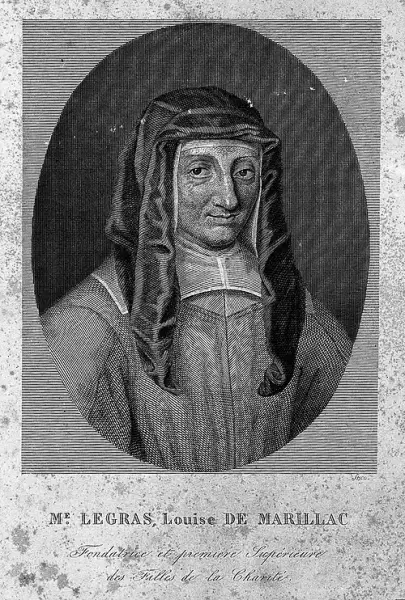
Louise de Marillac, called Louise Le Gras in her married life, founded the Daughters of Charity together with Vincent de Paul and the pioneer of organized social service in the Catholic Church. Born out of wedlock on 12 August 1591 at Ferrières-en-Brie in Picardy, she never knew her mother and was raised amid Parisian affluence but without a stable home, educated at the royal monastery of Poissy where her aunt was a Dominican nun. Refused admission to the Capuchin nuns, she married Antoine Le Gras, secretary to Queen Marie de' Medici, in 1613, and bore a son, Michel. She nursed her husband through chronic illness while battling depression and guilt over her unfulfilled religious calling, until a Pentecost experience in 1623 freed her from doubt. Widowed in 1625, she came under the direction of Vincent de Paul, whom she recognized as the priest shown to her in prayer. From 1629 she organized his Confraternities of Charity, and in 1633 she gathered four country girls into her home to train them for direct service to the poor, the nucleus of the Daughters of Charity, a community of uncloistered women free to serve the sick in their homes, hospitals, orphanages, prisons, and battlefields. She led the community until her death in Paris on 15 March 1660, leaving more than forty houses. Canonized in 1934, she is patroness of Christian social workers.
The Complete Life
An Illegitimate Daughter of Nobility
Louise de Marillac was born out of wedlock, most likely on 12 August 1591, at Ferrières-en-Brie near Le Meux, in what is now the department of Oise in Picardy. She never knew her mother. Her father, Louis de Marillac, Lord of Ferrières, a widower and a member of one of France's prominent families, acknowledged her as his natural daughter but not as his legal heir. Her uncle Michel de Marillac stood among the leading figures of Queen Marie de' Medici's court, and although Louise was never presented at court, she grew up living and working among the French aristocracy. Her position remained precarious: when her father married Antoinette Le Camus, the new wife refused to accept Louise into the household, and the girl grew up amid the affluence of Paris without a stable home life. She was nonetheless well looked after and given a splendid education in the royal convent of Poissy outside Paris, where one of her aunts lived as a Dominican religious. Louise stayed on at Poissy until her father died, when she was about twelve. Afterwards she boarded with a pious unmarried woman from whom she learned household management and the secrets of herbal medicine. Around the age of fifteen she felt the cloister calling and in due course petitioned the Capuchin nuns in Paris, but was turned away, whether because of her continual poor health or other reasons; her spiritual director assured her only that God had other plans for her.
§ Early life
Wife, Mother, Widow
Devastated by the refusal of the Capuchins and at a loss for her next step, Louise yielded at twenty-two to her family's judgment that marriage was the best course open to her. Her uncle arranged her marriage to Antoine Le Gras, secretary to Queen Marie, an ambitious young man apparently destined for great things. They were wed in the fashionable Church of St. Gervaise on 5 February 1613, and that October their only child, Michel, was born. Louise grew to love her husband and proved an attentive mother, while also remaining active in her parish and stood at the head of the Ladies of Charity, an association of wealthy women devoted to helping those stricken by poverty and disease. Troubles then closed in from every side. During civil unrest her two uncles, both senior officials of the realm, were jailed; one went to a public execution and the other perished in his cell. Around 1621 Antoine contracted a chronic illness that gradually confined him to bed, and Louise nursed him and their child while sliding into depression. She carried for years an internal doubt and guilt over the religious calling she had not pursued. In 1623, with her husband wasting and her spirits failing, she experienced on the feast of Pentecost a complete liberation from doubt, together with the conviction that she should remain with her husband and that a day would come when she would make vows in a small community. Antoine died in 1625, and the widow vowed never to remarry.
§ Family and personal troubles
Meeting Vincent de Paul
Louise believed she had also been shown the face of the spiritual director who would guide her next, and when she met Vincent de Paul she recognized him at once as the priest of her prayer. Widowed and lacking financial means, she had moved to a dwelling near his. Vincent at first was reluctant to take on her direction, being fully occupied with his Confraternities of Charity, associations of aristocratic women who raised money and attended to the poor and to neglected children. He recognized in Louise precisely what his work lacked: someone able to teach and organize helpers who would be close to the poor themselves. Over the next four years the two met frequently and corresponded by letter, Vincent drawing her toward moderation, peace, and calm. In 1629 he invited her to become involved in the Confraternities, where she found great success. In 1632 a spiritual retreat confirmed her intuition that the time had come to intensify her ministry among the needy, and she said so to Vincent. The charitable care of the poor in seventeenth-century France was completely unorganized; noble ladies in beautiful dresses found it socially impossible to nurse peasants in the slums, and most sent servants, whose work was widely considered unimportant. Louise found her answer in young, humble country women with the energy and attitude to face destitution. She invited four of them to live in her home on the Rue des Fosses-Saint-Victor and began to train them, the seed of the Daughters of Charity.
§ Decision on life
Contemplation in the Streets
Louise's spiritual life joined two great currents of seventeenth-century French piety. Under her directors' guidance she had been drawn into deep prayer in the manner of the Rhenish-Flemish spiritualists and been introduced to the French School of Cardinal Pierre de Bérulle. Like Duns Scotus, she regarded the Incarnation as the very moment of humanity's salvation, and this Christ-centered vision flowed into her insistence that the poor be served as Christ himself. The poor, she taught her Daughters, must be loved and honored as though each one were Christ in person, and that conviction became the foundation of the community. Her great innovation was mobility: unlike the established religious orders, whose women lived behind cloister walls in monasteries of contemplative prayer, the Daughters of Charity would keep their vows but go out daily into the streets, homes, and hospitals of the world. Vincent had taught her the integration of contemplation and activity, and it was this very balance that made her labor so fruitful; near the end of her life she confided that the secret of the spiritual life lies in surrendering to God everything we love by yielding ourselves to whatever He wills. After her death, in the climate of suspicion surrounding Quietism, her first biographer Nicholas Gobillon stripped her writings of their mystical content and rewrote her meditations, obscuring for a time the depth of the interior life that had powered her outward labor.
§ Spirituality
Building the Company
From her house on the Rue des Fosses-Saint-Victor, Louise built the Daughters of Charity into the Church's first uncloistered community of women devoted to active service. The young sisters first served the sick and poor in their homes, and Louise's work with them grew into a full scheme of pastoral care within the Hôtel-Dieu, Paris's oldest and largest hospital. When the community was invited to Angers to take over the nursing services of the hospital there, its first foundation outside Paris, Louise made the arduous journey in the company of three Daughters. Having negotiated with city officials and hospital managers, she instituted a collaboration among doctors, nurses, and others that formed a comprehensive care team, a model so successful it remains in use by the Daughters of Charity today. Under her guidance the Company expanded into orphanages, institutions for the elderly and the mentally ill, prisons, and the battlefield. The Vatican granted the community official approbation in 1655. Louise insisted that her sisters live balanced lives, and she led them until her death. Her last letter pressed upon them faithful care of the service of the poor, to live in union and cordiality, and to pray to the Blessed Virgin as their only Mother. After long illness she died in Paris on 15 March 1660, aged sixty-eight, six months before Vincent de Paul, leaving the Daughters more than forty houses in France and a reputation for philanthropy that already reached around the world.
§ Daughters of Charity of St. Vincent de Paul
Raised to the Altars
The Church's recognition of Louise came in the twentieth century. Pope Benedict XV beatified her on 9 May 1920 at the Vatican, and Pope Pius XI canonized her on 11 March 1934. Her feast, kept on 15 March until 2015, was moved to 9 May. Her bones lie today in the chapel of Our Lady of the Miraculous Medal the motherhouse chapel of the Daughters of Charity; the figure enshrined there, often mistaken for an incorrupt body, is in fact a wax effigy containing her bones. In 1960 Pope John XXIII declared her patroness of Christian social workers, a tribute to the organized, professional charity she invented. She is honored as well by the Episcopal Church in the United States, which keeps a Lesser Feast in her memory on 15 March. Her patronages gather the sorrows of her own life into intercession for others: she is invoked for social workers and sick people, for widows, for children who disappoint, for those who have lost parents, and for people rejected by religious orders, as she herself once was. Her attributes in art are simply the widow's clothing she wore for the last thirty-five years of her life.
§ Veneration
Mother of Modern Social Service
The Daughters of Charity grew from four country girls in a widow's house into one of the largest religious communities in the history of the Church, serving in hospitals, schools, orphanages, and missions across the world. The community's distinctive habit, the grey wool tunic with the white linen cornette, was until 1964 the instantly recognizable emblem of Catholic nursing, drawn from the ordinary dress of Breton peasant women. Louise's organizational genius, her collaboration of doctors, nurses, and caregivers into comprehensive teams, anticipated modern health care management by centuries, and her declaration that the poor must be loved and honored as Christ himself reshaped Catholic social teaching in practice long before it was formulated in theory. Her memory is preserved on several continents: parishes and schools named for her stand in Pittsburgh, Bellevue, LaGrange Park, Covina, and Montreal, with St Louise's Comprehensive College in Belfast and St. Louise de Marillac Primary School in Dublin; De Marillac Academy serves poor children in San Francisco, and the Marillac Medical Clinic for the Poor operates in Grand Junction, Colorado; a parish bears her name in Santo Domingo. The Vincentian Service Corps carries her spirit to a new generation of lay volunteers who give a year of their lives to the service of the poor.
§ Veneration
Timeline
- 12 Aug 1591
Born out of wedlock at Ferrières-en-Brie in Picardy, daughter of Louis de Marillac, Lord of Ferrières.
§ Early life
- 5 Feb 1613
Married Antoine Le Gras, secretary to Queen Marie de' Medici, at the Church of St. Gervaise in Paris.
§ Early life
- Oct 1613
Gave birth to her only child, a son named Michel.
§ Early life
- 1621
Her husband Antoine contracted a chronic illness that eventually left him bedridden; she nursed him and their child.
§ Family and personal troubles
- 1623
On the feast of Pentecost she was freed of all doubt, receiving the conviction that she would one day make vows in a small community.
§ Decision on life
- 1625
Antoine died; widowed and short of means, she moved to a dwelling near Vincent de Paul.
§ Decision on life
- 1629
Vincent de Paul drew her into his own work with the Confraternities of Charity.
§ Decision on life
- 1632
Following a spiritual retreat she sensed the moment had come to give herself more intensely to the poor, and told Vincent so.
§ Decision on life
- 1655
The Daughters of Charity received official approbation from the Vatican.
§ Daughters of Charity of St. Vincent de Paul
- 15 Mar 1660
Died in Paris at age sixty-eight, six months before Vincent de Paul; the Daughters then numbered more than forty houses in France.
§ Daughters of Charity of St. Vincent de Paul
- 9 May 1920
Beatified by Pope Benedict XV at the Vatican.
§ Veneration
- 11 Mar 1934
Canonized by Pope Pius XI at the Vatican.
§ Veneration
- 1960
Named by Pope John XXIII as patroness of Christian social workers.
§ Veneration
In Their Own Words
On the feast of Pentecost during Holy Mass or while I was praying in the church, my mind was completely freed of all doubt. I was advised that I should remain with my husband and that the time would come when I would be in the position to make vows of poverty, chastity and obedience and that I would be in a small community where others would do the same...I felt that it was God who was teaching me these things and that, believing there is a God, I should not doubt the rest.
Certainly it is the great secret of the spiritual life to abandon to God all that we love by abandoning ourselves to all that He wills.
Take good care of the service of the poor. Above all, live together in great union and cordiality, loving one another in imitation of the union and life of our Lord. Pray earnestly to the Blessed Virgin, that she might be your only Mother.
The Record
- Major works
- Daughters of Charity of St. Vincent de Paul·Rule of Life in the World·System of pastoral care at the Hôtel-Dieu, Paris·Nursing services model at the hospital of Angers·Spiritual writings and meditations
- Patron of
- Christian Social Workers·Disappointing children·Loss of parents·People rejected by religious orders·Sick people·Social workers·Vincentian Service Corps·Widows
- Symbols
- Widow's clothing
- Canonization
- Canonized 11 March 1934 by Pope Pius XI at the Vatican (beatified 9 May 1920 by Pope Benedict XV)
Prayer
Bibliography
Show 10 sources
- Glass, Joseph. "Ven. Louise de Marillac Le Gras." The Catholic Encyclopedia. Vol. 9. New York: Robert Appleton Company, 1910.
- "Saint Louise de Marillac", Franciscan Media
- "Louise de Marillac", Vincentian Online Library
- Foley O.F.M., Leonard, Saint of the Day, American Catholic
- Spiritual Writings of Louise de Marillac, A.2, p. 1
- "Daughters of Charity of St. Vincent de Paul international website"
- "Life and Works of Louise de Marillac". Via Sapientiae, DePaul University
- "Louise de Marillac", Oxford Dictionary of Saints
- Randolph, Bartholomew. "Sisters of Charity of St. Vincent de Paul." The Catholic Encyclopedia. Vol. 3. New York: Robert Appleton Company, 1908.
- Betanzos, CM, Benito Martinez, "Saint Louise de Marillac, a mystic", Santa Luisa de Marillac, ayer y hoy, XXXIV Semana de Estudios Vicencianos, Editorial CEME, Salamanca, 2010
Profile text adapted from the Wikipedia article, licensed CC BY-SA 4.0.
Pray with this saint every day
Save St. Louise de Marillac to your favorites, read the full profile, and get feast-day reminders in the Saints app.
Get the Saints AppFree on the App Store for iPhone and iPad