
died c. 535 or 540·Feast October 22
St. Loup of Soissons
Frankish bishop and nephew of St. Remigius
Overview
Loup of Soissons was a Frankish bishop of the early sixth century, remembered as the thirteenth holder of the see of Soissons. He belonged to the circle of St. Remigius, the apostle of the Franks, being described by most sources as a son of Remigius' sister, the saintly Prince, though other traditions give different parentage. Upon Prince's death, Remigius ordained him bishop of Soissons, and he governed the church there with the same wisdom that marked his uncle's ministry. His episcopate coincided with the conversion of the Frankish kingdom, and he took part in the First Council of Orléans, convened by Clovis I in 511, where the bishops of the new Christian realm settled the norms of church life. On his return he applied the conciliar canons in his own diocese, rebuilding a basilica at Bazoches and gathering a chapter of seventy-two priests to celebrate the divine office, a foundation that endured for more than four centuries. He also served as executor of Remigius' will, securing endowments for the church of Soissons. He died while still in office and was buried beside his mother; his relics later rested in Soissons Cathedral until their destruction by Calvinists in the sixteenth century.
The Complete Life
Kinship with the Apostle of the Franks
Loup belonged to that remarkable family which gave the Frankish Church its first generation of shepherds. He was the nephew of St. Remigius, the bishop of Reims who baptized Clovis I, and the sources preserve with unusual care the details of his parentage. Most writers state that he was the son of Saint Prince, Remigius' sister, while others claim that his father was Prince's foster brother, Saint Celsin, whose wife was Saint Balsamie, the wet nurse of Remigius himself. Hincmar of Reims offers yet a third account, making Loup the son of Aemilius, the elder brother of Remigius and Prince. Whatever the truth of his lineage, all traditions agree in placing Loup at the heart of a household in which episcopal office and sanctity were family inheritances. When his mother Prince died, it was Remigius who took charge of the young man's future, ordaining him and setting him over the see of Soissons as its thirteenth bishop. In an age when the Church in Gaul was passing from a Roman to a Frankish future, Loup embodied the continuity between the apostle of the Franks and the new generation of bishops who would consolidate his work.
§ Life
Shepherd of Soissons and Councillor of the Realm
Loup governed the church of Soissons with great wisdom, following in the footsteps of the uncle who had formed him. His episcopate gave him a place in the first great act of the Frankish Church as a national body: in 511, on the advice of Remigius and Bishop Melaine, King Clovis I summoned the First Council of Orléans. Loup met there with five metropolitans and twenty-five bishops, an assembly that issued twenty-one canons regulating the right of asylum, the extent of episcopal power, the submission of abbots to their ordinaries, and the administration of church lands. Rather than let these decisions remain words on parchment, Loup carried them back to his diocese and applied their rules throughout the churches under his care. At Bazoches he rebuilt and enlarged the raised basilica that stood over the tomb of Saints Rufinus and Valerius, and around this new church he gathered seventy-two priests under his own leadership, in deliberate memory of Jesus' seventy-two disciples, so that the divine office might be celebrated without cease. The chapter he founded survived more than four centuries after his death, a testimony to the durability of his institutions.
§ Life
Executor of a Saint and Keeper of Endowments
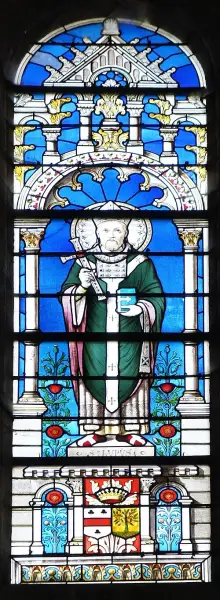
Among the final labors of Loup's episcopate was a duty of family piety: when Remigius died, Loup acted as the executor of his will. In that capacity he secured for the church of Soissons an annual rent of ten gold sous drawn from estates at Sablonnières in Seine-et-Marne, close to Coulommiers, securing a lasting income for the see he served. He continued to govern his diocese until his own death, which came while he was still in office, around the year 535 or 540 according to the sources. He was buried beside his mother Prince in the small chapel of Saint Thecla, a fitting resting place within the family that had given so much to the Church of the Franks, and a shrine that drew the devotion of later generations. In the ninth century his remains were translated into Soissons Cathedral, where the faithful venerated them for centuries. There they remained until the religious violence of the sixteenth century, when Calvinists burned them, so that his memory today survives chiefly in the records of the Church he served and in the stained glass of Saint-Pierre-Saint-Paul in Épernay.
§ Life
Timeline
- 511
Attended the First Council of Orléans, convened by Clovis I on the advice of Remigius and Melaine, with five metropolitans and twenty-five bishops.
§ Life
- 535
Died in office and was laid to rest next to Prince in the little chapel of Saint Thecla.
§ Life
The Record
- Major works
- Rebuilding and expansion of the basilica at Bazoches over the tomb of Saints Rufinus and Valerius
- Patron of
- Diocese of Soissons
- Symbols
- Bishop's mitre and crozier·Stained glass depiction in the church of Saint-Pierre-Saint-Paul in Épernay
- Canonization
- Pre-congregation canonization, venerated as a saint from the early Frankish Church.
Prayer
Bibliography
Show 3 sources
- Guérin, Paul (1876). "Saint Loup, treizième évêque de Soissons" [Saint Loup, thirteenth bishop of Soissons]. Les petits Bollandistes : vies des saints. Vol. 12. p. 539.
- Flodoard, Gallia Christiana, l'abbé Pécheur.
- Annales P. Richard. Actes de la province de Reims.
Profile text adapted from the Wikipedia article, licensed CC BY-SA 4.0.
Pray with this saint every day
Save St. Loup of Soissons to your favorites, read the full profile, and get feast-day reminders in the Saints app.
Get the Saints AppFree on the App Store for iPhone and iPad