
1592 – 1622·Feast July 1
St. Luarsab II
Martyred king of Kartli who refused conversion
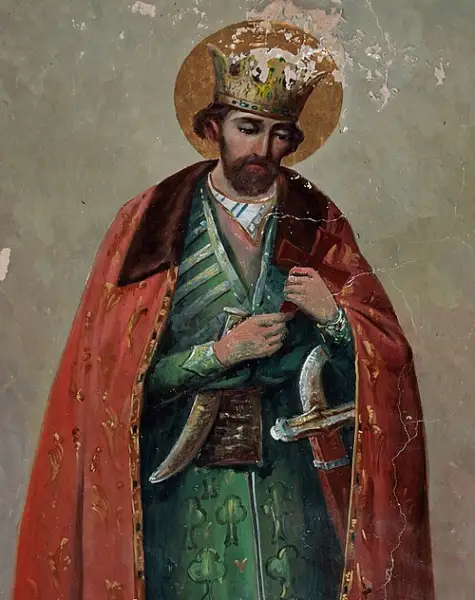
Overview
Luarsab II the Holy Martyr was a Georgian monarch of the Bagrationi dynasty who reigned as king of Kartli, in eastern Georgia, from 1606 to 1615. Born in 1592, he ascended the throne at the age of fourteen after the sudden death of his father, George X, with royal affairs directed during his minority by his tutor Shadiman Baratashvili. His reign unfolded under the shadow of the Ottoman and Persian empires, whose rival ambitions repeatedly swept across the Caucasus. After Persian forces expelled the Ottomans from eastern Georgia, Shah Abbas I confirmed the young king, and a Georgian victory at the Battle of Tashiskari in 1609 secured his position. Political intrigue, including a disastrous marriage alliance with the Saakadze family, weakened his court, and by 1614 a large Persian invasion forced Luarsab and his ally Teimuraz I of Kakheti into exile in the western kingdom of Imereti. When Abbas threatened to annihilate Kartli, Luarsab surrendered in October 1615 on the promise of peace, hoping to save his people from destruction. Held first at Astarabad and then near Shiraz, he refused all pressure to convert to Islam. Georgian efforts to free him, mediated by Tsar Michael of Russia, came to nothing, and in 1622 he was strangled on the shah's orders. The Georgian Orthodox Church venerates him as a martyr, celebrating his memory on July 1.
The Complete Life
A Boy on the Throne of Kartli
Luarsab was born in 1592 into the Bagrationi dynasty, the royal house that had ruled the Georgian lands for centuries. His father was King George X of Kartli and his mother was Princess Tamar Lipartiani, of a collateral line of the House of Dadiani. The realm into which he was born was a small Christian realm pressed between two enormous and rival empires, the Ottoman and the Persian, each of which sought at various points to dominate the Caucasus. George X died suddenly in 1606, and Luarsab ascended the Kartlian throne at only fourteen years of age. Because the king was a minor, the government was in practice conducted by his royal tutor, Shadiman Baratashvili, one of the great nobles of the realm. The boy king's position was soon complicated by the wider war between the empires: when Shah Abbas I expelled the Ottoman armies from eastern Georgia and posted a Persian garrison in Tbilisi, the shah confirmed Luarsab as king of Kartli, retaining him as a client ruler of the Safavid crown. From the first, then, his reign was a delicate balancing act between two powers that regarded his kingdom as a prize.
§ Life
Kingship Between Empires
The young king's early reign was tested almost immediately. The Ottomans, unwilling to accept Persian dominance in Kartli, sent a large army to Georgia with the aim of removing Luarsab from the throne. The invasion ended in disaster for the attackers: at the Battle of Tashiskari in 1609 the Georgian general Giorgi Saakadze destroyed the Ottoman force, and following this triumph Luarsab recovered authority over the Tbilisi citadel. Diplomacy ran alongside war. In 1610 the shah married the king's sister Tinatin, binding the two courts. In late 1611 Luarsab himself married Makrine Saakadze, sister of the victorious general, a woman of the lower nobility. The union alarmed the realm's senior nobles, with Shadiman Baratashvili at their head, who convinced the king that Giorgi Saakadze was a Persian agent scheming after a royal crown. Under their influence Luarsab dissolved the marriage and forced Saakadze into exile in Persia, an estrangement that would prove consequential for the kingdom's defense. In 1612 Luarsab had the khan of Kazakh, Mohammad, whom Abbas encouraged to trouble the Kartlian lands, assassinated, and allied himself with Teimuraz I of Kakheti to meet the Persian aggression everyone anticipated.
§ Life
Surrender for the Sake of a Kingdom
The anticipated blow fell at the start of 1614, when Kakheti was overrun by a massive Persian force that razed several settlements along its route before pushing on into Kartli itself. Unable to withstand the invasion, Luarsab and Teimuraz fled west to the Georgian Kingdom of Imereti, where King George III refused to hand over the refugees despite Persian demands. Shah Abbas then menaced Kartli with total devastation, offering peace on condition that Luarsab gave himself up. Confronted with the annihilation of his realm, the king made the decision that defined his life: in October 1615 he surrendered himself, hoping to save his people from being wiped out. The promise of peace was honored only in the breach. Luarsab was incarcerated, first at Astarabad and then at a location near Shiraz, while his people sought his release. Georgian efforts to ransom their king, carried out through the good offices of Tsar Mikhail I of Russia, produced nothing. The captive king remained a hostage of the Safavid court, his fate hanging on a single question that his jailers would ultimately put to him with lethal insistence.
§ Life
The Faith That Would Not Be Traded
For Luarsab, kingship was inseparable from the Orthodox faith of the Georgian people, the religion of the Georgian Orthodox Church into which the Bagrationi kings were born and for which the dynasty had fought across centuries of Muslim pressure from Persia and the Ottoman world. When his surrender delivered him into Persian captivity, the defining trial of his life became precisely the question of that faith. The shah's court offered him, in effect, survival and perhaps restoration in exchange for conversion to Islam, the customary terms extended to defeated Christian rulers of the Caucasus. Luarsab refused. This refusal separated him from other Georgian royals of his era who accepted Islam to keep or regain their thrones, and it transformed a political hostage into a confessor. Held first at Astarabad and then near Shiraz, far from Georgia and from every hope of rescue, he maintained his refusal to the end. The Georgian negotiators and their Russian mediator could free his body from no dungeon; the faith he kept freed no one could take from him. When in 1622 the order came for his death, he went to execution at the fortress of Qal'eh-ye Golab in southwest Iran as a witness, dying by strangling rather than deny Christ.
§ Life
Captive and Martyr
The last years of Luarsab's life were spent in Persian confinement, first in Astarabad in the northeast and then at a prison near Shiraz, while negotiations for his release dragged on without result between the Georgians and the Russian court of Tsar Mikhail I. The shah had promised peace in return for the king's submission, but submission of the body was not enough: what Abbas ultimately demanded was the submission of the soul, and this Luarsab would not give. His refusal to convert to Islam settled his fate. In 1622, on the orders of Shah Abbas I, he was executed by strangling at the fortress of Qal'eh-ye Golab in southwest Iran. He died at about thirty years of age, six years after leaving his throne and seven after surrendering his liberty for his kingdom. The Georgian Orthodox Church received his death as martyrdom, declaring the martyred king a saint and setting his commemoration on July 1, the anniversary of his execution, which corresponds to June 21 in the Old Style. His memory is kept in Eastern Orthodoxy, and his image survives in the fresco of the Shio-Mghvime Monastery and in icons of Luarsab the Martyr.
§ Life
The Holy Martyr of the Georgian Church
Luarsab's death in Persian captivity was immediately understood by his people in the terms the Church reserves for those who die rather than deny their Lord. The Georgian Orthodox Church declared the martyred king a saint, and his cult took its place among the company of Georgian royal saints, a dynasty that had already given the Church confessors and martyrs across a thousand years of struggle for the faith in the Caucasus. He is venerated in the Eastern Orthodox Church under the title of the Holy Martyr, and his feast is celebrated on July 1, the date of his execution in 1622, which corresponds to June 21 in the Old Style calendar. Devotion to him is expressed above all in liturgical commemoration and in sacred art: the Shio-Mghvime Monastery preserves a fresco of the king, and icons depict him as Luarsab the Martyr. An essay on the saint by the great nineteenth-century Georgian writer Ilia Chavchavadze, published in 1886, testifies to his enduring place in Georgian national memory, where the king who chose the faith over the throne remains a model of steadfastness under coercion.
§ Life
A King Remembered as a Witness
The legacy of Luarsab II unites the political and the spiritual history of Georgia. As king of Kartli from 1606 to 1615 he presided over one of the last periods in which a Bagrationi monarch ruled in Tbilisi while resisting both of the region's imperial powers, and the Georgian victory at Tashiskari in 1609 remained a celebrated feat of arms. His surrender in 1615, whatever its military motives, entered Georgian memory as a sacrifice offered for the survival of his people: he gave himself so that Kartli would not be wiped out. His refusal of Islam in captivity, sealed by his execution in 1622, gave that sacrifice its religious meaning and made him a saint of the national Church. Later generations preserved his memory in many forms: the fresco at Shio-Mghvime, icons of the Holy Martyr, the liturgical feast of July 1, and the 1886 essay by Ilia Chavchavadze, one of the architects of modern Georgian identity, who wrote about Luarsab the Martyr as an exemplary figure. In the long series of Kartlian kings, his name stands where the chronicle of the kingdom's rulers and the calendar of its saints meet.
§ Life
Timeline
- 1592
Born into the Bagrationi dynasty, son of King George X of Kartli and Princess Tamar Lipartiani.
§ Life
- 1606
Ascended the Kartlian throne at the age of fourteen upon the sudden death of his father George X.
§ Life
- 1609
Georgian general Giorgi Saakadze destroyed a large Ottoman army sent to remove Luarsab at the Battle of Tashiskari.
§ Life
- 1610
Shah Abbas I married Luarsab's sister Tinatin.
§ Life
- Nov 1611
Married Makrine Saakadze, sister of the general Giorgi Saakadze; under noble pressure the marriage was dissolved the same year.
§ Life
- 1612
Had the khan of Kazakh, Mohammad, assassinated and allied with Teimuraz I of Kakheti against anticipated Persian aggression.
§ Life
- 1614
Fled with Teimuraz I to the Kingdom of Imereti as a large Persian army invaded Kakheti and moved into Kartli.
§ Life
- Oct 1615
Surrendered himself to Shah Abbas I to save his kingdom from ruin and was imprisoned, first at Astarabad.
§ Life
- 1 Jul 1622
Executed by strangling on the shah's orders at the fortress of Qal'eh-ye Golab in southwest Iran after refusing to convert to Islam.
§ Life
The Record
- Major works
- Defense of Kartli against Ottoman invasion, crowned by the victory at Tashiskari
- Patron of
- Martyrs who die for their faith under coercion·Georgia
- Symbols
- King's crown·Martyr's palm·Icon of Luarsab the Martyr
- Canonization
- Canonized by the Georgian Orthodox Church, which declared the martyred king a saint.
Prayer
Bibliography
Show 3 sources
- Givi Jamburia, "Georgian Soviet Encyclopedia", vol. 6, Tbilisi: Georgian SSR Academy of Sciences, 1983, p. 301.
- Maeda, Hirotake (2006). "The forced migrations and reorganisation of the regional order in the Caucasus by Safavid Iran: Preconditions and developments described by Fazli Khuzani". In Ieda, Osamu; Uyama, Tomohiko (eds.). Reconstruction and interaction of Slavic Eurasia and its neighbouring worlds. Slavic Eurasian Studies, No. 10. Sapporo: Slavic Research Centre, Hokkaido University. p. 244. ISBN 4938637391.
- Beradze, Grigol (19–20 December 2014). On the Iranian prison-fortress where King Luarsab II of Kartli was martyred in 1622. International Conference "The Middle East and Caucasus: History, Culture, Politics" dedicated to the 110th Anniversary of Acad. George Tsereteli. Tbilisi. pp. 45–46.
Profile text adapted from the Wikipedia article, licensed CC BY-SA 4.0.
Pray with this saint every day
Save St. Luarsab II to your favorites, read the full profile, and get feast-day reminders in the Saints app.
Get the Saints AppFree on the App Store for iPhone and iPad