
c. 300 – c. 370·Feast October 13
St. Lubentius
Patron saint of the boatmen of the Lahn
Overview
Lubentius (c. 300 – c. 370) is a saint of the Catholic Church whose memory flourishes above all in the valley of the River Lahn in western Germany. As a small child he was given by his parents to Martin of Tours, who baptized him and raised him as a son. Martin sent the boy to Bishop Maximin of Trier for education, and when Lubentius reached canonical age, Maximin ordained him a priest. He served as a parish priest at Kobern, on the Moselle. When Maximin died in Aquitaine in 349 while visiting relatives, the new bishop of Trier, Paulinus, sent Lubentius to bring the body home; after a diligent search the priest found the church where the bishop lay, and one night he and his companions carried the body away and returned it to Trier. Later tradition, recorded in the twelfth-century Gesta Treverorum, makes him a missionary along the Lahn and the founder of a church at Dietkirchen. He died at Kobern. His remains were probably translated to Dietkirchen before 841, and a romantic legend tells how his body, set afloat in a boat, chose its own burial place by floating up the Lahn against the current. His feast day is 13 October, and he is a patron of the boatmen of the Lahn.
The Complete Life
A Son Given to St. Martin
Lubentius was born around the year 300, at a time when the Christian faith was still spreading through the towns and villas of the Roman Rhineland. While he was a small child, his parents made an act of remarkable trust: they gave their son to Martin of Tours, the soldier-turned-bishop whose name would become one of the most beloved in the whole of Western Christendom. Martin baptized the boy and treated him thereafter as a son, so that Lubentius grew up within the household and orbit of one of the great missionary figures of the age. When the child was ready for serious formation, Martin sent him to Bishop Maximin of Trier, the honored metropolitan of the Gallic church, to be educated for the priesthood. Under Maximin's care at Trier, one of the principal cities of the Roman West, Lubentius received the learning and discipline of an ecclesiastical education. Once he reached the canonical age, Maximin raised him to the priesthood. The story of his childhood, handed down in the saint's early lives, presents a chain of holy sponsorship — from parents to Martin to Maximin — through which the young Lubentius was formed for the service of the Church on the Moselle and the Lahn.
§ Life
Parish Priest at Kobern
Ordained for the church of Trier, Lubentius worked as a parish priest at Kobern, a settlement on the Moselle in the region between that river and the Lahn. His ministry there placed him among the ordinary Christian communities of the Rhineland rather than in the metropolitan circle in which he had been raised. It was from this parish life that he was called to a task of unusual delicacy. In 349, Bishop Maximin, the man who had ordained him, died while visiting relatives in Aquitaine, far from his see. Paulinus of Trier, Maximin's successor — the same bishop who would later suffer exile for his defense of Athanasius — sent Lubentius to retrieve the body. The priest traveled south to Aquitaine and, after a diligent search through the region, discovered the church in which Maximin's body lay. What followed became one of the memorable episodes of his life: one night his party obtained the keys from the custodian as he slept and made away with the body, conveying it back to Trier so that the bishop might be buried in his own city. The story reflects the intense devotion of fourth-century Christians to the remains of their holy bishops.
§ Life
Missionary of the Lahn
According to the Gesta Treverorum, a chronicle of the church of Trier compiled in the twelfth century, Lubentius labored as a missionary beside the waters of the Lahn, a tributary of the Rhine whose valley cuts eastward through the hills of what is now Hesse. There he founded a church at Dietkirchen, the settlement on a bluff above the river that would remain the center of his cult for the rest of the Middle Ages and beyond. The designation of Dietkirchen — in essence, 'the people's church' — preserves the memory of this foundation, which stood at the heart of a region evangelized from Trier. Whether the mission dates to Lubentius' own lifetime or to the generations after his death is a question scholars treat with caution, since the account rests on a chronicle written many centuries later. What is certain is the devotion that gathered around his name along the Lahn: the church he was remembered for founding grew into the great collegiate church of St. Lubentius at Dietkirchen, and the boatmen who worked the river took him as their patron, praying to the priest who had first carried the Gospel, as they believed, into their valley.
§ Life
Death at Kobern and the Boat on the Waters
Lubentius died at Kobern, the parish on the Moselle where he had served as priest, around the year 370. When the people wished to place his body in the local church, they found, according to the legend, that the corpse could not be moved no matter how they tried. A reverend individual then suggested a solution in keeping with the river country: the corpse should be laid in a boat and left to drift up or down the Moselle until it found its own grave. But on reaching the Rhine it refused to go with the current; instead it drifted up the Lahn, against the flow, all the way to Dietkirchen, where the saint's body came to rest. Baring-Gould, the Victorian hagiographer, judged the tale a romantic legend substituting for what was probably a very ordinary removal of relics: the remains had probably been carried from Kobern to Dietkirchen at some point before 841. Emmeram of Regensburg is the subject of a closely comparable story. In either form, history or poetry, the translation made Dietkirchen the home of the saint, where his relics rest today in the church that bears his name.
§ Veneration
Patron of the Boatmen of the Lahn
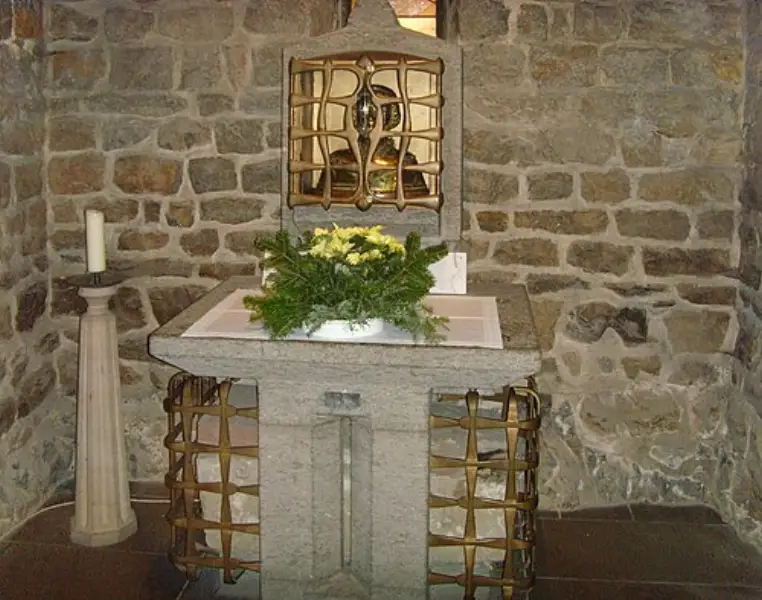
The veneration of Lubentius took root along the rivers of the Rhineland and has endured for more than sixteen centuries. His principal shrine is the collegiate church of St. Lubentius at Dietkirchen, now part of Limburg an der Lahn, where a relic bust of the saint is kept; his remains were likely brought there from Kobern before 841, and the church that grew around them became one of the landmark buildings of the Lahn valley. More relics are venerated at Kell, at St. Lubentius in Kobern, and at Lahnstein, Limburg, and Trier, tracing the geography of his life and cult. The Catholic Church keeps his feast on 13 October. Above all, he stands as patron of the Lahn's boatmen, the men who poled and sailed the river he was said to have evangelized, and whose trade the legend of the floating body made peculiarly his own. In his life the valley found a preacher from the household of St. Martin; in his legend it found a story in which even the waters of the river obeyed the will of the saint; and in his patronage it keeps both memories alive.
§ Patronage
Timeline
- 349
Traveled to Aquitaine after Bishop Maximin's death and brought his body back to Trier on behalf of Bishop Paulinus.
§ Life
- 370
Died at Kobern, where he had served as a parish priest.
§ Life
- 841
His remains had likely been translated from Kobern to Dietkirchen some time before this year.
§ Veneration
The Record
- Major works
- Founding of the church at Dietkirchen on the Lahn·Missionary work along the Lahn river
- Patron of
- Boatmen on the River Lahn
- Symbols
- Boat·Bishop's or priest's vestments·Relic bust at the collegiate church of St. Lubentius, Dietkirchen
- Canonization
- Pre-congregation canonization, venerated by the Catholic Church from the early medieval period.
Prayer
Bibliography
Show 7 sources
- Baring-Gould, Sabine. "S. Lubentius", The Lives of the Saints, vol. 11, John C. Nimmo, 1898, p. 322.
- Lins, Joseph. "Hesse." The Catholic Encyclopedia Vol. 7. New York: Robert Appleton Company, 1910. 14 April 2019.
- Fuchß, Verena. Landesamt für Denkmalpflege Hessen (ed.): Kulturdenkmäler in Hessen. Stadt Limburg. Konrad Theiss Verlag, Stuttgart 2007, ISBN 978-3-8062-2096-4, S. 455–459.
- Martin Persch 1993.
- Delehaye, Hippolyte. "The Development of the Legend", The Legends of the Saints: An Introduction to Hagiography, (V. M. Crawford, trans.), 1907.
- Lorenz Müller: St. Lubentius und Dietkirchen an der Lahn. Eine Untersuchung. 1969.
- Martin Persch (1993). "Lubentius". In Bautz, Traugott (ed.). Biographisch-Bibliographisches Kirchenlexikon (BBKL) (in German). Vol. 5. Herzberg: Bautz. cols. 290–292. ISBN 3-88309-043-3.
Profile text adapted from the Wikipedia article, licensed CC BY-SA 4.0.
Pray with this saint every day
Save St. Lubentius to your favorites, read the full profile, and get feast-day reminders in the Saints app.
Get the Saints AppFree on the App Store for iPhone and iPad