
1669 – 1739·Feast October 30
St. Luca Antonio Falcone
Capuchin preacher known as the Apostle of the South
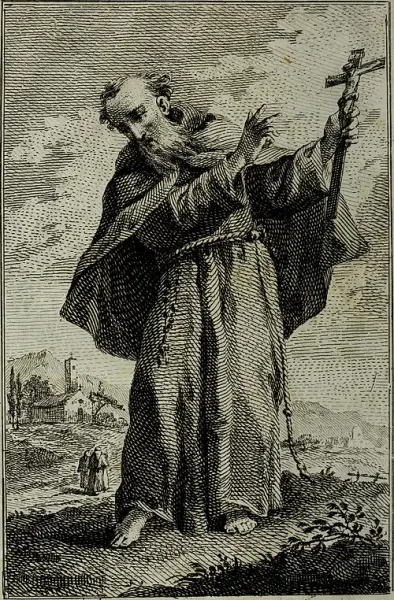
Overview
Luca Antonio Falcone (19 October 1669 – 30 October 1739), known in religious life as Angelo, was an Italian Catholic priest and professed friar of the Order of Friars Minor Capuchin in Cosenza. Born at Acri in Calabria to poor and pious parents, he struggled to find his way into religious life: admitted to the Capuchins in 1687, he twice fled home frightened by the rigors of the habit before his final and permanent entry in November 1690. Ordained a priest in 1700 at Cassano all'Jonio, he consecrated each hour to some aspect of the Passion of Christ. His first efforts in the pulpit were so disastrous that his early sermons attracted ridicule, but after a faltering start in Naples under Cardinal Francesco Pignatelli in 1711 he rose to become one of the most sought-after preachers of southern Italy, credited with converting the hearts of thousands in cities such as Catanzaro, Salerno, and Taranto. He earned the titles 'Angel of Peace' and 'Apostle of the South'. Known for ecstasies during Mass, visions, prophetic gifts, and bilocation, he served as provincial from 1717 to 1720 and built the convent of Cappuccinelle. He died at Cosenza in 1739, was beatified in 1825 by Leo XII, and was declared a saint by Pope Francis on 15 October 2017.
The Complete Life
A Poor House in Calabria
Luca Antonio Falcone was born on 19 October 1669 at Acri in the province of Cosenza, Calabria, the son of Francesco Falcone and Diana Enrico, a poor couple of modest and devout origins. A priest uncle stood among his earliest influences in the faith, and on 24 June 1674 the boy was confirmed. The turning point of his youth came in 1684, when he met a charismatic Capuchin friar, Antonio da Olivadi; the encounter proved decisive in helping him recognize and pursue a call to religious life. Even so, the path was anything but smooth. The Capuchins received him into the Order of Friars Minor in 1687, and the habit was placed on him the following year, but after only a few months the rigor of the life frightened him and he returned home. In that period he persuaded himself — an uncle-priest encouraged the belief — that God was calling him instead to marriage and a settled life. He decided otherwise. On 8 November 1689 he re-entered the order, and once more fear drove him back to his family's house. Only on his third attempt, begging on his knees before a Crucifix for grace, did he find the perseverance that would carry him through a lifetime of ministry.
§ Life
Perseverance and Priesthood
The third entry proved final. On 12 November 1690 Falcone requested readmission for the last time and began his novitiate, completing it on 12 November 1691 at six in the evening, when he made his profession into the hands of the novice master Giovanni d'Orsomarso. His theological studies ran from 1695 to 1700, and he was elevated to the diaconate on 18 December 1694. Priestly ordination followed on 10 April 1700 in the cathedral of Cassano all'Jonio. From that day he marked his priesthood with a distinctive devotion: he consecrated each hour to some aspect of the Passion of Jesus Christ, binding his whole day to the sufferings of the Savior. Yet his beginnings as a preacher gave little sign of what was to come. In 1702, leading a Lenten sermon at San Giorgio Morgeto at the request of his provincial, he lost his thread before the people, could not recall what he was to say next, and was forced to leave the pulpit in confusion. The friar who had run from the novitiate twice now stumbled in his first public ministry, and the trials that formed him were only beginning.
§ Life
From Failure in the Pulpit to the Apostle of the South
In 1711 the Cardinal Archbishop of Naples, Francesco Pignatelli, learned of Falcone's gifts and summoned him to preach in Naples and across the archdiocese. The mission opened in humiliation: his first three sermons were miserable, the first drawing laughter from the crowd and the next two almost no one at all. The worried parish priest begged the cardinal to send another preacher, but Pignatelli refused and kept his trust in the friar. At the fourth sermon the audience grew, and Falcone urged his hearers to give their hearts to the one soon to die in their midst; as they dispersed, a prominent opponent collapsed dead of a stroke. From that point the crowds multiplied. Invitations poured in from across southern Italy — Catanzaro, Salerno, Taranto, Montecassino — and thousands were said to have been converted by his preaching. Two titles fastened themselves to him: Angel of Peace and Apostle of the South. Alongside the missions he carried the responsibilities of office in his order, serving as provincial father from 1717 to 1720, as novice master on several occasions, and as general visitor from 1735.
§ Life
Ecstasies, Visions, and the Passion of Christ
The interior life of Falcone was marked by extraordinary phenomena that accompanied his ordinary fidelity. During the celebration of Mass he was known to fall into ecstasies, absorbed in the mystery he held in his hands. He was credited with visions and prophetic gifts, with the grace of bilocation, and with the ability, in the confessional, to see into the souls of those who knelt before him. These charisms were reported of him by contemporaries and passed into the records of his cause, but they grew from a discipline anyone could imitate: the priest who had vowed to consecrate each hour of his day to an aspect of the Passion of Christ lived with the cross continually before his eyes. His preaching bore the same imprint, since he summoned his hearers to turn their minds to the one who would soon die among them. His love for the Crucifix reached back to the crisis of his youth, when he fled the friary twice and returned only after begging Christ, on his knees before a crucifix, for the grace to persevere. In 1724 he undertook the construction of the convent of Cappuccinelle, its doors opening on 17 June 1726, giving his contemplative and missionary spirit a lasting home.
§ Life
Blindness and Death at Cosenza
Falcone's long ministry closed at the convent in Cosenza where he was stationed. Six months before his death he lost his sight — a severe affliction for a preacher and confessor — but he recovered enough vision to continue reciting the Divine Office and celebrating Mass, refusing to let blindness silence the two duties that framed his day. He died on 30 October 1739, at the age of seventy, on the feast-eve that would become his own memorial. Almost at once the Church of the region began the work that would lead to his elevation: the cause opened at diocesan level on 10 October 1744, scarcely five years after his death. In the 1890s his remains were moved to the Basilica del Beato Angelo d'Acri, raised in his honor in his home town, where the citizens of Acri keep their patron. The friar who had twice run home from the novitiate had ended his life as one of the most celebrated religious of southern Italy, mourned across the cities where he had preached and remembered already as a man of heroic virtue.
§ Life
From Servant of God to the Altar
Falcone's cause followed the full course of the Roman process across nearly three centuries. Titled a Servant of God in 1778 under Pope Pius VI, with the formal introduction of the cause on 22 May of that year, he was declared Venerable by Pope Pius VII on 17 June 1821, once his life of heroic virtue had been confirmed. Three cures were recognized on 20 November 1825 — the cures of Marianna Bernaudo and Pietro Sacco, both of Bisignano, and of Francesco Sirimarco of Sant'Agata d'Esaro — opened the way to beatification, which Pope Leo XII presided over on 18 December 1825 in Saint Peter's Basilica. The drive toward full sainthood began formally on 22 September 1853, but the definitive fourth miracle took long to mature: a diocesan inquiry into it opened in March 2014 and closed that December, validated by the Congregation for the Causes of Saints, and approved by the congregation's medical experts on 15 December 2016 after extensive review. Theologians and the congregation followed, and on 23 March 2017 Pope Francis approved the miracle. After the cardinals formalized the date on 20 April, Falcone was proclaimed a saint in Saint Peter's Square on 15 October 2017.
§ Canonization
Angel of Peace for Acri and the Missions
The memory of Luca Antonio Falcone endures in the land that produced him and in the worldwide work he is asked to protect. He is a patron of Acri, his native town, where the Basilica del Beato Angelo d'Acri received his remains in the 1890s and where his feast is kept with particular devotion; his memorial falls on 30 October, the day of his death. He is also patron of missionaries, an apt commission for the tireless preacher whose missions crossed the breadth of the Italian South. His images show him in the Franciscan habit with the rosary and the crucifix, the two instruments of the spirituality he lived: the prayer of the Rosary and the meditation on the Passion that structured every hour of his priesthood. The titles he earned in life — Angel of Peace and Apostle of the South — remain attached to his name, and his story has a particular word for those who falter: a friar who fled twice, preached badly at first, and was laughed out of the pulpit became one of the great evangelists of his century, canonized by Pope Francis in 2017 before crowds gathered in the same Square where he had been raised to the altars in 1825.
§ Life
Timeline
- 19 Oct 1669
Born at Acri in Cosenza, Calabria, to Francesco Falcone and Diana Enrico.
§ Life
- 24 Jun 1674
Received the sacrament of Confirmation.
§ Life
- 1684
Met the charismatic Capuchin friar Antonio da Olivadi, whose influence proved decisive for his religious vocation.
§ Life
- 1687
Admitted into the Order of Friars Minor Capuchin in Cosenza.
§ Life
- 1688
Clothed in the Capuchin habit, but fled home a few months later, frightened by the rigors of the life.
§ Life
- 8 Nov 1689
Re-entered the order for the second time, but was scared once more and fled back home.
§ Life
- 12 Nov 1690
Requested readmission for the third and final time and began his novitiate.
§ Life
- 12 Nov 1691
Completed his novitiate and made his profession before the novice master Giovanni d'Orsomarso.
§ Life
- 18 Dec 1694
Elevated into the diaconate.
§ Life
- 1695
Began his theological studies, which would span until 1700.
§ Life
- 10 Apr 1700
Ordained to the priesthood at Cassano all'Jonio Cathedral.
§ Life
- 1702
Preached a Lenten sermon at San Giorgio Morgeto at his provincial's behest, faltering and leaving the pulpit in confusion.
§ Life
- 1711
Cardinal Francesco Pignatelli, Archbishop of Naples, called him to preach in Naples and throughout the archdiocese.
§ Life
- 1717
Began service as provincial father of his order, holding the office until 1720.
§ Life
- 1724
Began construction of the convent of Cappuccinelle.
§ Life
- 17 Jun 1726
The convent of Cappuccinelle opened.
§ Life
- 1735
Made general visitor of the order; he had also served as novice master several times.
§ Life
- 30 Oct 1739
Died at the convent where he was stationed in Cosenza, six months after losing his sight.
§ Life
- 10 Oct 1744
The beatification process commenced in the local diocese.
§ Canonization
- 22 May 1778
The formal introduction of his cause came under Pope Pius VI, who titled him a Servant of God.
§ Canonization
- 17 Jun 1821
Pope Pius VII named him Venerable after confirming his life of heroic virtue.
§ Canonization
- 20 Nov 1825
Three miracles attributed to his intercession were recognized, clearing the way for beatification.
§ Canonization
- 18 Dec 1825
Beatified by Pope Leo XII at Saint Peter's Basilica.
§ Canonization
- 22 Sep 1853
The process toward sainthood was formally opened.
§ Canonization
- 14 Mar 2014
The diocesan investigation of the fourth and decisive miracle began, concluding that December.
§ Canonization
- 15 Dec 2016
Medical experts advising the Congregation for the Causes of Saints approved the healing as miraculous.
§ Canonization
- 23 Mar 2017
Pope Francis approved the miracle, confirming that Falcone would be canonized in 2017.
§ Canonization
- 20 Apr 2017
A gathering of cardinals formalized the date of his canonization.
§ Canonization
- 15 Oct 2017
Proclaimed a saint by Pope Francis in Saint Peter's Square.
§ Canonization
In Their Own Words
Assist me with Your grace!
The Record
- Major works
- Convent of Cappuccinelle, begun in 1724 and opened in 1726·Lenten missions and sermons across southern Italy
- Patron of
- Acri·Missionaries
- Symbols
- Franciscan habit·Rosary·Crucifix
- Canonization
- Canonized by Pope Francis on 15 October 2017 in Saint Peter's Square; beatified by Pope Leo XII on 18 December 1825.
Prayer
Bibliography
Show 8 sources
- "Blessed Angelus of Acri". Saints SQPN. 9 April 2015. Retrieved 5 August 2016.
- "Blessed Angelo d'Acri". Santi e Beati. Retrieved 5 August 2016.
- "Angelo d'Acri". Find a Grave. 21 October 2010. Retrieved 5 August 2016.
- "Blessed Angelo of Acri". Roman Catholic Saints. Retrieved 5 August 2016.
- "Blessed Angelo of Acri – October 30". Tradition in Action. Archived from the original on 14 September 2016. Retrieved 5 August 2016.
- "Bl. Angelus of Acri". Catholic Online. Retrieved 5 August 2016.
- Index ac status causarum beatificationis servorum dei et canonizationis beatorum (in Latin). Typis polyglottis vaticanis. January 1953. p. 15.
- "Acri – La Commissione Medica Vaticana conferma il miracolo, il Beato Angelo verso la santificazione". Radio AKR. 16 December 2016. Retrieved 17 December 2016.
Profile text adapted from the Wikipedia article, licensed CC BY-SA 4.0.
Pray with this saint every day
Save St. Luca Antonio Falcone to your favorites, read the full profile, and get feast-day reminders in the Saints app.
Get the Saints AppFree on the App Store for iPhone and iPad