
fl. 5th century·Feast July 20
St. Lucanus of Sabiona
Legendary Tyrolean bishop who rode a bear to Rome
Overview
Lucanus of Sabiona, also called Lucanus of Säben (fl. 5th century; died 20 July), is a fifth-century Catholic saint bound to the memory of the Dolomites and the Tyrol. Tradition commonly makes him bishop of Säben, earlier Sabiona, above Klausen, and was later — mistakenly — called bishop of Brixen. Little of his life is historically certain, and much that is told of him is legend. The most famous story relates to a famine during which he permitted the consumption of milk, butter, and cheese during the Lenten fast when they could be obtained; denounced to Pope Celestine I in 424, the aged bishop traveled to Rome with a single servant, riding a bear that had killed and eaten his horse after Lucanus commanded it to take the animal's place. Along the way he healed a bedridden innkeeper's wife at Spoleto and, on arrival, hung his rain-soaked cloak on a ray of sunshine; the Pope, seeing him in grace, declared him innocent. On his return he was expelled from Säben and found shelter in the Agordo valley, in today's province of Belluno, where he died renowned for many miracles. His head is kept at Agordo and his body in a marble coffin in Belluno Cathedral, with relics also venerated at Brixen since 1658. His feasts are 20 and 27 July, and he is invoked against dropsy.
The Complete Life
A Saint Half-Lost in Legend
Almost nothing can be stated with confidence about the origins of Lucanus. Outside the district where he worked his name hardly travels, and a large share of what is told of him belongs to legend, transmitted through late compilations rather than early documents. Even at Brixen, in the heart of the region he was said to have governed, the old lists of bishops and the liturgical books made little or no mention of him until well into the seventeenth century. What tradition consistently preserves is his association with Säben, earlier called Sabiona, the ancient hill-top seat above Klausen in the Tyrol; there he is said to have exercised episcopal ministry in the first half of the fifth century, long before the bishops of the region moved to Brixen, which they did in the tenth century. Later writers erroneously described him as bishop of Brixen, a title belonging to a later age. The first substantial written account of his life was compiled only at the beginning of the sixteenth century by Peter Paul von Diolaitis, the public notary of Belluno, who did not record his sources. The historical Lucanus, then, stands behind a veil: a fifth-century churchman of the Dolomites whose real service was remembered in stories rather than chronicles.
§ Legend
A Bishop's Mercy in a Famine
The one act of Lucanus that carries the strongest note of history and the clearest pastoral meaning is his decision during a famine to allow the people of his bishopric to consume milk, butter, and cheese during the forty days' fast of Lent whenever these could be obtained. In the austere tradition of the early Church, the Lenten fast excluded not only meat but all animal products, and a bishop's relaxation of that discipline in a time of want was a courageous act of mercy: he weighed the hunger of his flock against the letter of the rule and chose the people. For this decision his enemies denounced him before Pope Celestine I in the year 424, and the Pope ordered him to appear in Rome. The episode places Lucanus among the confessors who suffered for leniency rather than for laxity of doctrine, accused of loosening a fast precisely because his people had nothing else to eat. The whole subsequent legend — the journey, the bear, the sunbeam — grew around this single documented quarrel, as though the memory of his people insisted on adorning with marvels the bishop who had fed them when the law would have let them starve.
§ Legend
The Journey to Rome on a Bear
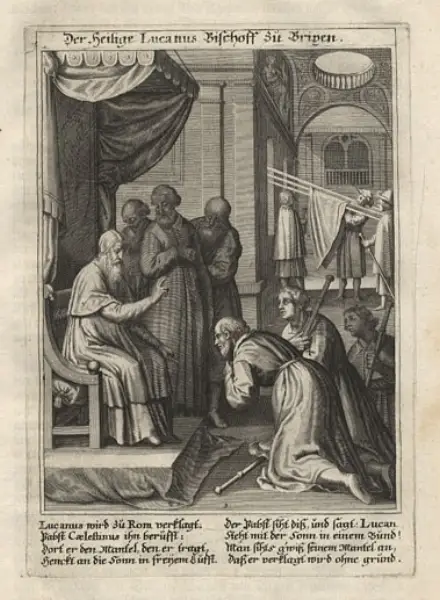
Summoned to Rome despite his advanced age, Lucanus set out accompanied by a single servant. The road south became the stage for the miracles that made his name. When a bear killed and devoured his horse, the bishop ordered the beast, in God's name, to serve in its stead — and, saddling and bridling it, made the rest of the journey to Rome upon it, an image that passes through his iconography and echoes the legends of Saints Romedius and Corbinian, whose cults flourished in the neighboring regions. Stopping overnight at an inn in Spoleto, he discovered that the landlord's wife lay bedridden with dropsy, and he cured her by praying at her bedside, the deed behind his later invocation as a protector against that disease. Nearing the Pope, who as a poor man he could offer nothing worthy of, he sent a covey of partridges flying before him to serve as his gift. At his audience, finding nowhere to hang his rain-soaked cloak, he hung it upon a shaft of sunlight, which bore its weight. The Pope, seeing that Lucanus was manifestly in grace, declared him innocent of the charges, gave him his blessing, and sent him home with rich presents.
§ Legend
Exile in the Valley of Agordo
Vindication in Rome did not restore peace at home. On his return, Säben's enemies — the same party that had carried the accusation south — drove Lucanus out, and he found shelter in the Agordo valley, in today's province of Belluno. There he was received and given food by a woman called Avatia, herself honored as a saint by the church of the valley, so that the exiled bishop found in the kindness of one household the welcome his own see had denied him. In Agordo his fame grew on account of his many miracles, and it was there that he died, on a 20 July, the date that fixed his principal feast. His remains were divided between the places that claimed him: his head was kept at Agordo, while his body rested in a marble coffin in Belluno Cathedral. The valley that sheltered him in his last years kept his memory in its geography — the San Lugano Pass and a valley near Agordo bear his name, because tradition holds that he passed that way both before and after his flight from Säben.
§ Legend
The Slow Return of His Name to Brixen
The formal veneration of Lucanus at Brixen came remarkably late. Up to the early seventeenth century, little or nothing of him was known in the city that had inherited the see of Säben: the old lists of bishops and the liturgical books of the region passed over him in silence, even though the church of Belluno had long venerated him as bishop of Säben. Only after 1621, and after Bishop Hieronymus Otto Agricola had repeatedly republished the breviary of Brixen first issued in 1604, did Lucanus join the patron saints of Brixen Cathedral and receive official veneration there. The decisive impulse came after 1658, when Bishop Anton von Crosini sent Canon Johann Andreas von Rossi to Belluno to obtain relics from the saint's grave. Having secured the consent of the Doge and the High Council of Venice as well as of Belluno's magistrates, von Rossi carried off a shoulder-blade and a rib and reached Brixen on 3 October 1658. After a night in the Capuchin church, the relics were solemnly translated to Brixen Cathedral on Sunday, 6 October. The feast was established on 20 July for the town of Brixen alone, and in 1814 the relics received new containers like those of the diocesan patrons Ingenuin, Albuin, and Hartmann.
§ Cult
Passes, Churches, and a Cloak on a Sunbeam
Lucanus left his name written across the mountains between the Etschtal and the Dolomites. The village of San Lugano at Truden in the South Tyrol preserves his name, and its parish church of St. Lycanus is his, while the diocese of Belluno-Feltre counts at least two churches under his invocation as San Lucano or San Lugano. The pass called San Lugano, which climbs from the Etschtal to the Fleimstal, and a valley near Agordo both recall the journeys tradition assigns to him. The faithful invoke him as a protector against dropsy, in memory of the healing at Spoleto. His iconography is among the most distinctive in the Tyrol: he is represented with a mitre and with his cloak hanging to dry on a sunbeam, and he is shown riding the bear that carried him to Rome, a motif shared with Saints Romedius and Corbinian of the neighboring regions. His feast days are 20 July and 27 July. The bones of the saint remain today in Belluno Cathedral and at Brixen, and a copper engraving of 1714 shows him kneeling before Pope Celestine I with the sunbeam cloak behind him — an image of the accused bishop whom heaven itself defended.
§ Patronage
Timeline
- 424
Denounced by his enemies to Pope Celestine I over the Lenten dispensation and summoned to Rome, which he reached after a legendary journey on a bear.
§ Legend
- 1604
The breviary of Brixen, later repeatedly republished by Bishop Hieronymus Otto Agricola, was issued.
§ Cult
- 1621
From this time Lucanus ranked with the patron saints of Brixen Cathedral, enjoying official veneration there.
§ Cult
- 3 Oct 1658
Canon Johann Andreas von Rossi returned to Brixen with a shoulder-blade and a rib taken from Lucanus's grave at Belluno.
§ Cult
- 6 Oct 1658
The relics were solemnly translated from the Capuchin church to their resting-place in Brixen Cathedral.
§ Cult
- 1814
New reliquaries, modeled on those of the diocesan patrons Ingenuin, Albuin, and Hartmann, were made for the relics of Lucanus.
§ Cult
The Record
- Major works
- Lenten dispensation permitting milk, butter, and cheese during a famine·Early account of his life compiled by Peter Paul von Diolaitis, public notary of Belluno, at the beginning of the 16th century
- Patron of
- Against dropsy
- Symbols
- Bishop's mitre·Cloak hanging to dry on a sunbeam·Riding a bear
- Canonization
- Pre-congregation canonization, venerated as a saint since the early medieval period and officially venerated at Brixen after 1621.
Prayer
Bibliography
Show 7 sources
- Holweck, Frederick George. "Lucanus, Bishop of Sabiona", A Biographical Dictionary of the Saints, vol. 1, B. Herder Book Company, 1924, p. 618.
- Martin Bitschnau; Hannes Obermair (2009). Tiroler Urkundenbuch, II. Abteilung: Die Urkunden zur Geschichte des Inn-, Eisack- und Pustertals. Vol. 1. Innsbruck: Universitätsverlag Wagner. pp. 3–4 no. 3. ISBN 978-3-7030-0469-8.
- Helene Raff (1924), "St. Lucanus", Tiroler Legenden (in German), Innsbruck, pp. 76 ff.
- Carl Pfaundler (1843), Heiliger Tyroler-Ehrenglanz oder Lebensgeschichten — heiliger, seliger, gottseliger, frommer und ausgezeichneter Tyroler (etc.) (in German), vol. 1, Innsbruck: Carl Pfaundler.
- Der Schlern: Monatszeitschrift für südtiroler Landeskunde (in German), vol. Bd. 62, Vogelweider, 1988, p. 89.
- "San Lucano (Lugano) su santiebeati.it". Santiebeati.it. Retrieved 2016-05-13.
- Philipp Ferrarius, Verzeichnis der Heiligen von Italien (Resch, Annal. Sab. I. Pag. 269) (in German).
Profile text adapted from the Wikipedia article, licensed CC BY-SA 4.0.
Pray with this saint every day
Save St. Lucanus of Sabiona to your favorites, read the full profile, and get feast-day reminders in the Saints app.
Get the Saints AppFree on the App Store for iPhone and iPad