
c. 240 – 312·Feast January 7
St. Lucian of Antioch
Martyr, presbyter, and biblical scholar of Antioch
Overview
Lucian of Antioch, called Lucian the Martyr, was a Christian presbyter and theologian remembered for both learning and ascetic discipline. Tradition, preserved by Suidas, places his birth at Samosata in Kommagene to Christian parents and his education at Edessa in the school of Macarius, though some scholars suspect confusion with his famous namesake, the second-century pagan satirist Lucian of Samosata. Ordained presbyter at Antioch, he was praised by Eusebius of Caesarea for his theological learning, and a life composed after 327 credits him with founding a Didaskaleion, a school that some scholars, following Adolf von Harnack, identify as the origin of the School of Antioch. After the deposition of Bishop Paul of Samosata he fell under suspicion of heresy and remained out of communion through three episcopates, until his reconciliation with the Church, most probably about 285. During the persecution of Maximinus Daia he was arrested at Antioch, taken to Nicomedia, tortured, imprisoned for nine months, and executed, most likely by beheading, on January 7, 312. He is also credited with a critical recension of the Septuagint and the Greek New Testament.
The Complete Life
A Christian Childhood in the Syrian East
Tradition, preserved in the Byzantine lexicon of Suidas, holds that Lucian was born at Samosata in Kommagene, then counted among the lands of Roman Syria, to Christian parents. His education took place in the neighboring city of Edessa in Mesopotamia, at the school of a teacher named Macarius, a detail that presents him as formed in the intellectual world of the Syriac East rather than in the great Greek centers of the Mediterranean. Even in antiquity, however, this account was not secure. Modern scholars have noted that the link to Samosata may rest on a conflation with his celebrated namesake, the pagan satirist Lucian of Samosata who wrote in the second century, whose fame could easily have attached itself to the martyr's story. What remains beyond dispute is humbler: a Christian childhood among believing parents and a schooling that equipped him for a life of letters and of Scripture. The uncertainty surrounding his origins has never fully lifted, and historians read the notice in Suidas with appropriate caution. Yet the picture of a gifted provincial youth, raised in the faith and sent to a neighboring city for study, accords with everything known of the scholar and confessor he became at Antioch.
§ History
Presbyter and Founder at Antioch
Lucian's clerical life unfolded at Antioch, where he was ordained presbyter. His reputation for learning was considerable: Eusebius of Caesarea explicitly notes his theological attainments, an acknowledgment from a historian not generous with praise. A vita composed after 327 further reports that Lucian founded a Didaskaleion, a school for the teaching of the faith, at Antioch. Scholars following Adolf von Harnack have seen in this foundation the origin of the distinctively exegetical School of Antioch, whose later luminaries included Diodorus of Tarsus and Theodore of Mopsuestia, and have regarded Lucian as its first head. That contention, however, is unrecorded in the extant sources, and it remains a scholarly reconstruction rather than a documented fact. Whatever the precise institutional continuity, the outline is clear enough: a priest who joined the pastoral office to teaching, gathering students around the study of the Bible in one of the great cities of the Christian East. His ordination placed him among the clergy of a turbulent church, one soon to be shaken by the deposition of its bishop, and his own gifts ensured that his name would be remembered wherever Antiochene theology was discussed.
§ History
Recensing the Greek Scriptures
Lucian's most tangible monument is a critical recension of the Greek Bible. He is credited with a careful revision of the text of the Septuagint and of the Greek New Testament, undertaken because he believed errors had crept into the manuscripts over time; he also undertook to revise the Septuagint against the original Hebrew. The resulting copies enjoyed wide circulation, proving especially popular in Syria, Asia Minor, and Constantinople. They were later used by John Chrysostom and the later Greek fathers, and the tradition underlies the later textus receptus of the New Testament. His editorial boldness drew criticism in his own tradition and after: Jerome mentions that copies of his Greek Old Testament circulated as exemplaria Lucianea, yet elsewhere speaks disparagingly of his texts, and the sixth-century Gelasian Decree lists among forbidden books the Gospels which Lucianus forged. In the absence of definite information, the merits of his critical labors remain impossible to decide with certainty; modern scholars still mark Lucianic rescensions with an L to flag possible readings from his adjustments. He also drew several significant minuscule witnesses of 3 Maccabees into his labors on the Greek Scriptures.
§ Biblical text
A Theology Hard to Pin Down
Lucian's theological position has proved one of the most contested puzzles of early church history, and attempts to reconstruct it from the surviving sources have produced contradictory results. Because Arius, in a letter, addressed Eusebius of Nicomedia as a Fellow-Lucianist, Lucian's name became entangled with the Arian controversy; Adolf von Harnack and many after him read that word as denoting a whole theological school and counted Arius, Eusebius, Maris, Theognis of Nicaea, and Asterius among his pupils. Yet the first writer to attest such discipleship, the Anomoean historian Philostorgius, names Arian sympathisers but not Arius himself. Others hear in the word not a theological program but the special veneration Eusebius paid to Lucian in the city of his martyrdom. Opponents of Arianism countered his cult by recalling his schismatic decades, while Epiphanius associates him with heretical views on Christ's human soul. The Creed of the Dedication of 341 was later claimed by the Homoiousian party as his legacy. A proposal to resolve the contradictions by positing two different Lucians has largely been abandoned, leaving a figure whose convictions remain genuinely difficult to recover.
§ Theology
Confessor and Martyr at Nicomedia
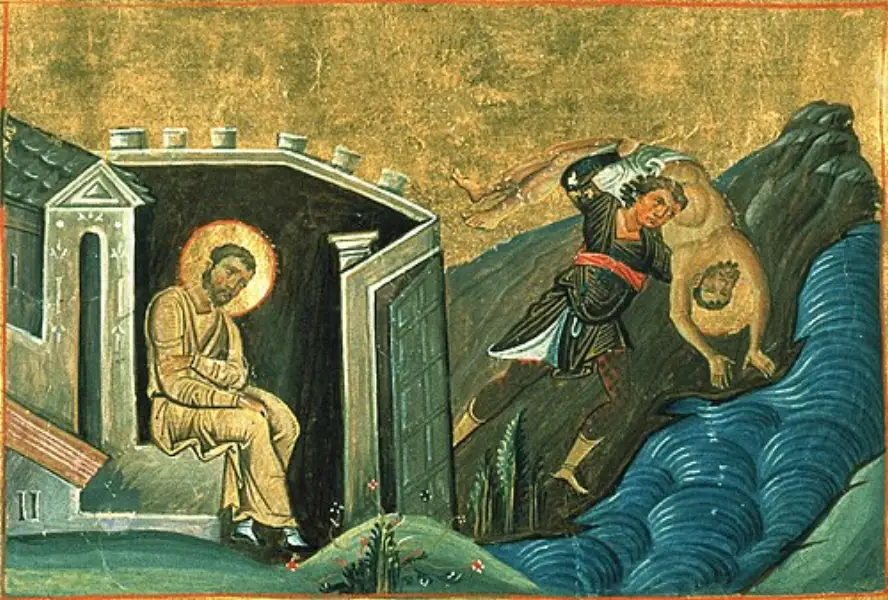
Lucian's long career ended in the persecution of Maximinus Daia. Arrested at Antioch, he was sent to Nicomedia, the imperial residence and a chief theater of the coercion of Christians. There he endured many tortures across nine months of imprisonment. Twice he was brought up for examination, and on both occasions he gave a able account of himself and would not abandon his Christian profession. The manner of his death is uncertain: one account holds that he was starved to death; a second, judged more probable, gives beheading as the manner of his end. Tradition sets the day of his execution on January 7, 312, at Nicomedia. A late tradition of uncertain origin preserves a stranger tale, that he met death by drowning, his body carried back to shore by a dolphin, an image that ancient Christians cherished in several martyr stories. His remains were laid to rest at Drepanum, on the Gulf of Nicomedia, a town later renamed Helenopolis in honor of Helena, the mother of Constantine the Great, whose patronage would soon also attach itself to Lucian's memory. Whatever questions his theology raised, the confession he sealed in death stood beyond dispute.
§ History
A Martyr's Memory Across the Churches
Lucian's standing as a saint never depended on the outcome of the quarrels that gathered around his name. January 7 was the day Antioch kept for his memorial, and it remains his feast in the Roman Catholic Church; Byzantine Christianity keeps him on October 15, and the Armenian Apostolic Church commemorates him on the Monday after the fifth Sunday after Pentecost. His veneration grew notably during the latter half of Constantine's reign, aided by the patronage of the Empress Helena and honored by Eusebius at the church of Nicomedia where he had died. Opponents of Arianism, such as Alexander of Alexandria, sought to blunt this devotion by pointing to his schismatic past, and Marius Victorinus went so far as to identify the Eusebian party with Lucian himself, but none of it dislodged him from the calendars of the churches. Philip Schaff voiced the traditional resolution: a critical scholar whose peculiar views on the Trinity and Christology fell short of later Nicene orthodoxy, yet who wiped out every stain by his heroic confession and martyrdom. His burial church at Helenopolis, and his recension of Scripture in constant ecclesiastical use, kept his name alive in East and West alike.
§ Theology
Timeline
- 240
Born at Samosata, according to the tradition recorded by Suidas, to Christian parents.
§ History
- 268
Fell under suspicion of heresy after the deposition of Bishop Paul of Samosata and was excommunicated.
§ History
- 285
Reconciled with the Church, most probably early in the episcopate of Bishop Cyril.
§ History
- 7 Jan 312
Died a martyr at Nicomedia after nine months of imprisonment, probably by beheading.
§ History
- 341
The Creed of the Dedication, passed at the Council of Antioch, became associated with his name.
§ Theology
In Their Own Words
The contradictory reports are easily reconciled by the assumption that Lucian was a critical scholar with some peculiar views on the Trinity and Christology which were not in harmony with the later Nicene orthodoxy, but that he wiped out all stains by his heroic confession and martyrdom.
The Record
- Major works
- Critical recension of the text of the Septuagint·Critical recension of the Greek New Testament·Didaskaleion, a school founded at Antioch
- Canonization
- Pre-congregation martyr; venerated since antiquity in the Eastern and Western churches
Prayer
Bibliography
Show 6 sources
- "CATHOLIC ENCYCLOPEDIA: Lucian of Antioch". Newadvent.org. 1910-10-01. Retrieved 2014-02-20.
- Attwater, Donald and Catherine Rachel John. The Penguin Dictionary of Saints. 3rd edition. New York: Penguin Books, 1993. ISBN 0-14-051312-4.
- Philipp Schaff, History of the Christian Church.
- Duchesne, Louis; Jenkins, Claude (1912). Early History of the Christian Church. Vol. 1. New York: Longmans, Green & Co. p. 362.
- Gustave Bardy. Recherches sur saint Lucien d'Antioche et son école (Paris: Beauchesne, 1936).
- Jerome, Letter to Pope Damasus: Beginning of the Preface to the Gospels. www.tertullian.org. Retrieved 2019-08-22.
Profile text adapted from the Wikipedia article, licensed CC BY-SA 4.0.
Pray with this saint every day
Save St. Lucian of Antioch to your favorites, read the full profile, and get feast-day reminders in the Saints app.
Get the Saints AppFree on the App Store for iPhone and iPad