
c. 1921 – 1942·Feast Commemorated with the Martyrs of New Guinea on memorial days kept by many churches
St. Lucian Tapiedi
Papuan teacher and martyr of New Guinea
Overview
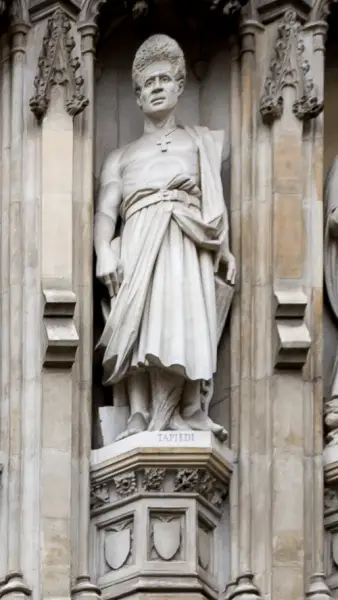
Lucian Tapiedi (c. 1921 – 1942) was a Papuan Anglican teacher and evangelist, counted among the Martyrs of New Guinea, the eight Anglican clergy, teachers, and medical missionaries put to death in the Japanese invasion of 1942, in which some 333 church workers of all denominations lost their lives. Born near Taupota village in the Milne Bay district on the north coast of Papua, the nephew of a suspected sorcerer, he was educated at mission schools under the influence of the teacher Nita Inman and the Papuan priest Edwin Nuagoro. In 1939 he entered St Aidan's Teacher Training College at Dogura, and in 1941 became a teacher and evangelist on the staff at Sangara. When Japan invaded in January 1942, Bishop Philip Strong directed most Anglican missionaries to hold their posts; Tapiedi stayed. Fleeing with a group of ten others, he was intercepted near Kurumbo village and killed with an axe by a man named Hivijapa; one version says he had gone back for the mission's records box and its money. Six of his companions were later beheaded by the Japanese on Buna beach. His killer took the name Hivijapa Lucian, converted, and built a church in his victim's memory. In 1998 a statue of Tapiedi was placed among the ten 20th-century martyrs above the west door of Westminster Abbey.
The Complete Life
A Nephew of the Sorcerer's House
Lucian Tapiedi was born around 1921 on the north coast of Papua, described in the sources as coming from the household of a suspected sorcerer at Taupota in the Milne Bay district — a detail that measures the distance he traveled in barely twenty years. He belonged to the first generation of Papuans formed entirely within the mission world of the Anglican Church of New Guinea. Educated at mission schools, he came under two decisive influences: Nita Inman, the schoolteacher, and the Reverend Edwin Nuagoro, a Papuan priest whose own ministry showed the young man what an indigenous clergy could be. In 1939, at about eighteen, he entered St Aidan's Teacher Training College at Dogura, the Anglican mission's institution for forming local teachers, the backbone of the Church's expansion across Papua. Two years later, in 1941, he finished his training and took up a teaching and evangelist post at Sangara, going to the north of the country where the mission stations of the mountains and coast carried the Gospel village by village. He was twenty years old, a lay teacher of his own people, when the war that would make him a martyr reached the Pacific.
§ Early life
Teacher and Evangelist at Sangara
Tapiedi's vocation took the distinctively Papuan form of the teacher-evangelist: a trained local Christian who taught in the mission school and carried the faith to neighboring villages under the supervision of the clergy. Posted to Sangara in 1941, he served in the Anglican mission network of the diocese of New Guinea, then part of the ecclesiastical Province of Queensland, whose bishop, Philip Strong, pressed hard for an indigenous church staffed by Papuans as well as expatriates. The work combined the schoolroom with the pulpit, and the young teacher's influence extended beyond his pupils to the families of the station. He was one of a generation of Papuan church workers — teachers, evangelists, medical orderlies, and clergy — who by 1942 manned the outposts of the Anglican mission across the island. When the Japanese offensive began, that generation would bear the brunt of the suffering: of the 333 church workers of all denominations killed during the invasion, many were Papuans like Tapiedi who had no country of refuge to which they could be evacuated, and whose fidelity to the stations they served made them witnesses in the fullest sense of the word.
§ Early life
No Breach of Trust in Its Walls
The spirit in which Tapiedi and his companions met the invasion was set by Bishop Philip Strong, who ordered most Anglican missionaries to hold their stations in spite of the danger they could foresee. To abandon the missions, the bishop warned, would be a betrayal of the trust the Church had accepted, one from which recovery would take years; even if every missionary perished by staying, the Church itself could not perish, because its walls would contain no breach of trust and its foundations would have been strengthened for the building to come by their faithfulness unto death. The words became the charter of the New Guinea martyrs, and Tapiedi, a young Papuan teacher, lived them as fully as any bishop or European missionary. The spirituality they express is one of fidelity to place and people: the mission station was a trust held before God, and the shepherd's duty did not lapse because the wolf arrived. One account of Tapiedi's death says he went back for the station's record box and its money — the unglamorous property of the mission — before being overtaken. His martyrdom was the keeping of a small, concrete trust at the cost of his life.
§ Death
Martyrdom on the Road from Sangara
On 4 January 1942 Japan opened the invasion of Papua New Guinea with the Battle of Rabaul, and the mission stations of the north lay in the path of the advance. Tapiedi and ten companions, evading the Japanese, made their way inland to a village of the Orokaiva people, where instead of refuge they found themselves escorted away by men of the tribe. Beside a stream close to Kurumbo village, Hivijapa felled Tapiedi with an axe. A second account holds that the natives put him to death with the axe only after he had gone back for the box of station records and some money — a version that preserves the motive of fidelity to his post. The rest of the party soon followed them in death: the Japanese beheaded six of them on Buna beach. With their deaths the number of the Martyrs of New Guinea was complete — eight Anglican clergy, teachers, and medical missionaries, among them the twenty-one-year-old teacher from Milne Bay. Tapiedi's grave is at Sangara station, in the mission ground where he had taught, and the memory of the killing on the jungle path became the seed of a reconciliation that would transform the killer's own life.
§ Death
Remembered Among the Martyrs of New Guinea
Tapiedi was not canonized through a Roman process but received by the Church in the way of the martyrs: the New Guinea Martyrs are remembered with memorials and feast days in the calendars of many churches, among them the Anglican Communion, and his name stands with the eight who died in 1942. His own people bore striking witness to his sanctity. His killer, taking the Christian name Hivijapa Lucian, later became a Christian and raised a church in memory of the man he had killed — a penitent's monument that grew into a diocesan center, first at Higatury and, after the destruction of the original building, at Popondetta. A second church, St Lucian's Six Mile in the Six Mile settlement of Port Moresby, takes him as its patronal saint. The widest recognition came on 9 July 1998, when a statue of Tapiedi by the sculptor Tim Crawley was installed above the west door of Westminster Abbey in London, among ten statues of twentieth-century martyrs drawn from every continent; members of Tapiedi's family attended the ceremony, together with the Archbishop of Canterbury and Queen Elizabeth II.
§ Veneration
From a Jungle Path to Westminster Abbey
The legacy of Lucian Tapiedi spans from a stream near Kurumbo village to one of the most visible façades in Christendom. In Papua New Guinea his memory is rooted in places: his grave at Sangara station; the memorial church his killer built, which became a diocesan center rose again at Popondetta after the eruption of 21 January 1951, in which Mount Lamington overwhelmed a diocesan gathering at Higatury at the cost of many lives, destroyed its first home; and St Lucian's Six Mile in Port Moresby, which honors him as patronal saint. His story is also the Church's most concrete lesson in reconciliation: the man who axed him to death became Hivijapa Lucian, a Christian, and raised a church to his victim's memory. In 1998 the Church of England placed his statue above the west entrance of Westminster Abbey, second from the right among the ten twentieth-century martyrs there commemorated, a Papuan schoolteacher standing beside Dietrich Bonhoeffer, Janani Luwum, and the other witnesses of a violent century. The Martyrs of New Guinea are kept on the calendars of many churches, and Tapiedi, the nephew of a suspected sorcerer who died keeping a small trust, is remembered as the youngest face of that company.
§ Legacy
Timeline
- 1921
Born around this year near Taupota village in the Milne Bay district on the north coast of Papua.
§ Early life
- 1939
Entered St Aidan's Teacher Training College at Dogura.
§ Early life
- 1941
Became a teacher and evangelist on the Sangara mission staff.
§ Early life
- 4 Jan 1942
The Japanese conquest of the territory began with the Battle of Rabaul.
§ Death
- 1942
Killed with an axe by Hivijapa near a stream by Kurumbo village while fleeing with ten companions; six of the group were later beheaded by the Japanese on Buna beach.
§ Death
- 21 Jan 1951
The original memorial church at Higatury was destroyed when Mount Lamington erupted during a diocesan meeting.
§ Legacy
- 1998
A statue of Tapiedi was set among nine other twentieth-century martyrs above the west entrance of Westminster Abbey.
§ Legacy
In Their Own Words
If we all left, it would take years for the Church to recover from our betrayal of our trust. If we remain — and even if the worst came to the worst and we were all to perish in remaining — the Church would not perish, for there would have been no breach of trust in its walls, but its foundations and structure would have received added strength for the future building by our faithfulness unto death.
The Record
- Major works
- Service as a teacher and evangelist at Sangara mission station
- Patron of
- St Lucian's Six Mile church in Port Moresby, of which he is patronal saint·Teachers and evangelists of Papua New Guinea
- Symbols
- Statue above the west entrance of Westminster Abbey·Teacher's and evangelist's vocation among the Martyrs of New Guinea
- Canonization
- Commemorated as one of the Martyrs of New Guinea in the calendars of many churches, including the Anglican Communion.
Prayer
Bibliography
Show 9 sources
- Jones Taugaloidi. "Martyrs of New Guinea". Archived from the original on 2007-02-19. Retrieved 2008-10-26.
- Diane, Langmore (1 January 1989). Missionary lives : Papua, 1874-1914. Pacific Islands Monograph Series. hdl:10125/25825. Retrieved 8 March 2017.
- 'The New Guinea Diaries of Philip Strong, 1936-1945', edited by David Wetherell (1981) p223.
- "Lucian Tapiedi". Retrieved 8 March 2017.
- Revd Dr Scott Cowdell (2004-08-31). "New Guinea Martyrs". St Paul's Anglican Church, Canberra. Archived from the original on 2008-07-21. Retrieved 2008-10-26.
- Michie, Trevor. "Service Times of the Anglican Diocese of Port Moresby, Papua New Guinea". Retrieved 8 March 2017.
- Heller, Jenny E. (22 September 1998). "Westminster Abbey Elevates 10 Foreigners". The New York Times. Archived from the original on 19 August 2016. Retrieved 21 July 2016.
- Streeter, Michael (17 October 1997). "Heritage: Westminster Abbey prepares modern martyrs' corner". The Independent. Archived from the original on 20 August 2016. Retrieved 21 July 2016.
- "Queen and the Anglican Church of PNG". Post Courier. 25 July 2022. Retrieved 15 June 2025.
Profile text adapted from the Wikipedia article, licensed CC BY-SA 4.0.
Pray with this saint every day
Save St. Lucian Tapiedi to your favorites, read the full profile, and get feast-day reminders in the Saints app.
Get the Saints AppFree on the App Store for iPhone and iPad