
died c. 290·Feast January 8
St. Lucien of Beauvais
Apostle of Beauvais and legendary cephalophore martyr
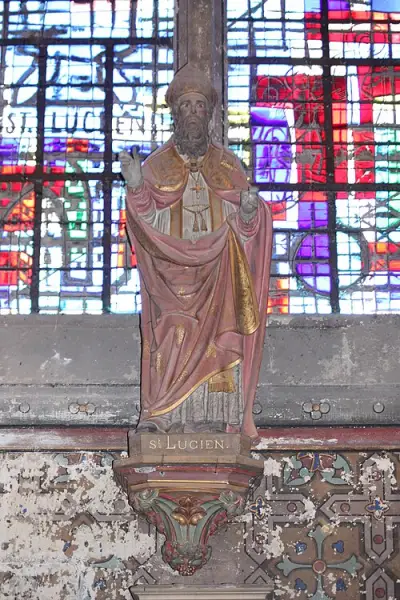
Overview
Lucian of Beauvais, called in French Lucien and in Latin Lucianus, is honored as a Christian martyr put to death around 290 during the Diocletian persecution, though later traditions moved his martyrdom back to the first century so that the church of Beauvais could claim apostolic origins. He is remembered as the Apostle of Beauvais, and the foundation of that diocese is traditionally attributed to him. The details of his life are largely unknown, and the French historian Louis Duchesne, among others, regards the whole story as unhistorical. His Passio gives him two disciples, Maximian and Julian, who were beheaded with him on the hill of Montmille. The legend makes him a Roman noble converted by Saint Peter himself, sent to Gaul by Pope Clement I alongside Saint Denis and Rieul of Reims, a preacher at Beauvais famed for mortifications and penances, and finally a victim of imperial assassins. After his decapitation he was said to have carried his head toward Beauvais, dying near the town and marking the spot where he wished to be buried. His relics, lost to a fire in 1793, were formerly the principal treasure of the cathedral of Beauvais.
The Complete Life
A Roman Noble of Legend
Almost nothing historically certain survives about Lucian's origins. Tradition makes his family noble and Roman and was named Lucius after his father, taking the name Lucian only when he was converted to Christianity, a conversion the legend attributes to the preaching of Saint Peter himself. The story bears the unmistakable marks of medieval hagiographic fashion: as Hippolyte Delehaye observed, to have belonged to the Savior's immediate circle was considered deeply honorable, and old patrons of churches were regularly identified with figures from the Gospels or with persons imagined to have shared in Christ's earthly life. The date of Lucian's death was likewise shifted backwards in time, so that the see of Beauvais could boast apostolic antiquity; Odo, bishop of Beauvais in the ninth century, was the first writer to call him the city's first bishop. Louis Duchesne and other historians accordingly judge the whole narrative unhistorical. Yet the legend itself is a monument: it records how deeply the church of Beauvais cherished the memory of the martyr whom it honored as father, apostle, and principal patron, and how it dressed that memory in the grandest garments antiquity could supply.
§ Legend
Sent to Gaul with Denis and Rieul
The legend carries Lucian from conversion to mission with the sweep of an epic. In his youth, the story runs, he preached through Italy, was ordained bishop by Pope Clement I, and was dispatched to Gaul in the company of Saint Denis and Rieul of Reims, among other missionaries; he is also called an associate of Saint Quentin. The road was not smooth. He was imprisoned at Parma and freed by the Christians of that city, preached with success at Pavia, and then reached Arles, where he met Rieul once more. The company divided: Denis and Lucian traveled on toward Lutetia, while Marcellinus and his companions continued into Spain. At Lutetia Denis stayed behind, and Lucian pressed onward alone to Beauvais, the town then known by its Roman name of Caesaromagus. Whatever one makes of the itinerary's historicity, it situates Lucian within the oldest and most cherished missionary tradition of France, the band of shadowy preachers credited with planting the Gospel north of the Alps. For the faithful of Beauvais, this apostolic pedigree explained and dignified the faith their city had held for so many centuries.
§ Legend
Preacher and Penitent at Beauvais
At Beauvais the legendary Lucian established the pattern of life for which he was honored. He won fame for his mortifications and penances, and he preached openly against the Roman gods in a city still living under imperial rule. He dwelt in a house identified in later memory with where the collegiate church of Saint-Nicolas now stands, and there Denis and Rieul are said to have visited him. According to Rolandus, author of the Acta Sancti Luciani, he withdrew in time to a mountain near the city and lived as a hermit on grass and water, embracing a severity of life that matched the hardness of his mission. One account credits him with the staggering number of thirty thousand converts, aided in the work by his two disciples, Maximian and Julian. The numbers are the poetry of legend, but the portrait is coherent: a missionary bishop who combined public preaching with private asceticism, gathering a church in pagan territory through holiness of life as much as through words. It is this figure, austere and fruitful, that Beauvais venerated for a millennium and more.
§ Legend
Martyrdom on the Hill of Montmille
The legend closes with a martyrdom of conventional but enduring horror. Three assassins, Latinus, Jarius, and Antor, came despatched by the Roman emperor to kill him; the account inconsistently names Diocletian, who reigned in the third century, betraying the story's uncertain chronology. The executioners dispatched the two disciples before beating Lucian with rods and finally cutting off his head. Here the tale takes the turn characteristic of the cephalophore saints: after his decapitation, Lucian is said to have picked up his head and walked toward Beauvais, crossing the river Thérain at Miauroy before collapsing within a quarter mile of the town, thereby showing his followers where he wished to be buried. In this he shares a legend with his alleged companion Denis of Paris, the most famous head-carrying saint of France. The heavenly signs multiplied at his burial: angels themselves were said to have attended the funeral, and local tradition held that vermilion-colored rosebushes blossomed where his blood had run. His body was laid to rest in the cemetery of Thil, and the spot of his death at Montmille became in time a place of pilgrimage.
§ Legend
Tomb, Basilica, and Relics
Lucian's cult left deep architectural and liturgical traces at Beauvais. After the persecutions ended, a church was raised over his tomb, dedicated to Saints Peter and Lucian; destroyed in the fifth century, it was replaced around 583 when Chilperic I, at the request of Bishop Dodo and Saint Evrou, ordered a new basilica and monastery raised over that ground, with Evrou as abbot. The abbey fell to the Norman invasions in 845 and was rebuilt in the twelfth century, which thereafter received the burials of the cathedral canons. In 1261 Bishop William of Grès translated the relics of Lucian, Maximian, and Julian into a new reliquary before King Louis IX of France, King Theobald II of Navarre, and much of the French nobility, an event long commemorated in the abbey as the fête des Corps Saints. The medieval priory at Montmille, built on the site of the martyrdom, drew pilgrims for centuries. The French Revolution ended it all: the abbey was sold in January 1791 and demolished between 1795 and 1819, and on November 20, 1793 the relics were burned. His name, however, remained in the calendar of the Book of Common Prayer, and Beauvais still keeps its apostle.
§ Veneration
Timeline
- 290
Suffered martyrdom at Beauvais, beheaded on the hill of Montmille together with his disciples Maximian and Julian.
§ Legend
- 583
At the request of Bishop Dodo and Saint Evrou, Chilperic I ordered a new basilica and monastery built over the saint's tomb.
§ Veneration
- 845
The abbey of Saints Peter and Lucian at Beauvais was destroyed during the Norman invasions.
§ Veneration
- 1261
Bishop William of Grès placed the relics of Lucian, Maximian, and Julian in a new reliquary before King Louis IX and King Theobald II.
§ Veneration
- 5 Jan 1791
The abbey was put up for sale and bought by the Parisian Vicente Alterio.
§ Veneration
- 20 Nov 1793
Lucian's relics were thrown into a fire and destroyed by extremists.
§ Veneration
In Their Own Words
To have lived amongst the Saviour's immediate following was...honorable...and accordingly old patrons of churches were identified with certain persons in the gospels or who were supposed to have had some part of Christ's life on earth.
The Record
- Major works
- Traditional foundation of the diocese of Beauvais
- Patron of
- Patron of Beauvais
- Canonization
- Pre-congregation martyr; venerated since antiquity
Prayer
Bibliography
Show 5 sources
- Farmer, David. The Oxford Dictionary of Saints, 5th ed., OUP, 2011. ISBN 9780199596607
- Hippolyte Delehaye, The Legends of the Saints (Dublin, Four Courts Press, 1955), 37.
- "Hieromartyr Lucian the Bishop at Beauvais in France", Orthodox Church in America.
- "Saint Lucien de Beauvais", Radio Don Bosco, January 8, 2023.
- Attwater, Donald and Catherine Rachel John. The Penguin Dictionary of Saints. 3rd edition. New York: Penguin Books, 1993. ISBN 0-14-051312-4.
Profile text adapted from the Wikipedia article, licensed CC BY-SA 4.0.
Pray with this saint every day
Save St. Lucien of Beauvais to your favorites, read the full profile, and get feast-day reminders in the Saints app.
Get the Saints AppFree on the App Store for iPhone and iPad